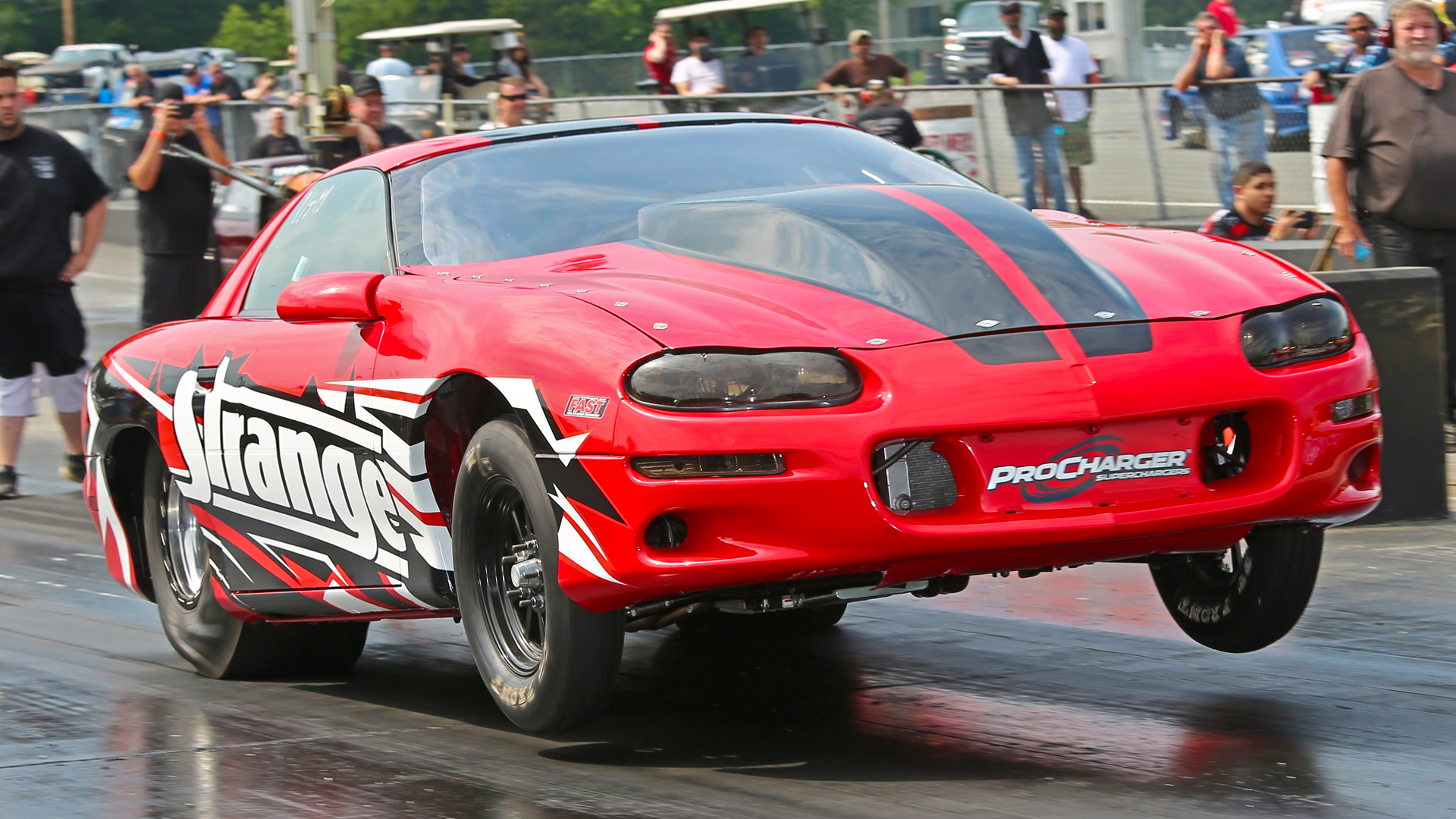
Imagine building a nasty engine for your project car, bolting on some sticky tires, only to watch the increased power and traction demolish the rearend. That scenario happens all too often when enthusiasts fail to think through the entire drivetrain system. Plus, it poses a real safety risk on the street and at the dragstrip.
To learn more about creating a proper drivetrain system with a rearend assembly that can handle increased power and traction, we turned to JC Cascio, Director of Business Development at Strange Engineering in Morton Grove, Illinois. According to the company’s website, Strange Engineering is trusted to deliver differentials for all NHRA classes, making it one of the industry’s leading sources for rearend components. In this article, Cascio helps us break down rearend basics, what to consider when upgrading, and the convenience and overall benefits of installing a bolt-in assembly.
When Should You Upgrade Your Rear-End Assembly
Think of your engine, transmission, driveline, and rearend as one complete system. Increasing torque and horsepower at the engine puts additional force on downstream components, and factory parts are only designed to handle so much.
Cascio explains, “With horsepower and traction so easy to come by, the need for an aftermarket rear has gone up dramatically. The factory rears are designed to handle the output of a factory motor with factory tires. A bolt-on power adder and some sticky tires can easily overpower the factory driveline and cause a failure.”
“Every component of the rearend assembly should be considered during the build,” Cascio warns. “Upgrading one part will only find the next weakest link.”
The entire driveline needs to be strengthened with better parts and materials to improve the overall durability of the assembly. This includes the housing, differential, gears, and larger axles.
That’s why a complete bolt-in rearend assembly is a popular option when upgrading a stock vehicle for street/strip, drag-and-drive, or full-race applications. According to Strange Engineering, its line of bolt-in housings is designed to mount to the factory pickup points in the chassis.
“Strange has fixturing to ensure the rearend will be a true bolt-in unit,” Cascio confirms. “Our engineering staff has spent countless hours documenting factory dimensions and specs. Our fabrication department then designs and builds fixturing for each of the applications so the bracketing is right where it needs to be.”
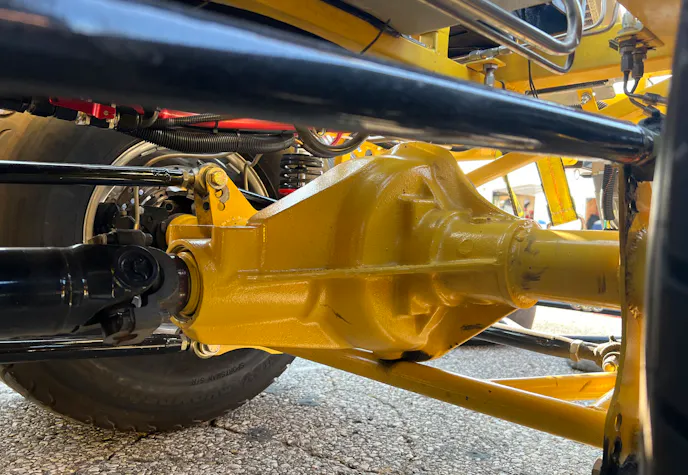
C-Clip vs Non C-Clip Designs Explained
Most factory GM 10-bolt and 12-bolt rearends, along with all Ford 8.8-inch rearends, use a C-clip design to retain the axles. The axle shafts slide into the housing and are retained inside the differential carrier with a C-clip.
The flaw in this design is that if an axle shaft shears at the splines under high torque, nothing prevents the entire axle shaft, brake assembly, and wheel from sliding out of the housing at speed. This can create a catastrophic safety hazard. All Strange Engineering rearends eliminate the C-clip design and retain the axles at the housing ends using a retainer plate or C-clip eliminator.
Dana 60 rearends and drop-out rearend designs, such as the Ford 9-inch, retain the axles at the ends of the housing. A retainer plate slides over the axle bearing and bolts directly to the outer housing flange.
This design allows for a larger-diameter bearing journal and a higher spline count to handle increased torque loads. Together, these features help reduce the risk of failure by increasing the cross-sectional contact area and improving resistance to torsional twist and shearing forces during hard launches. This is what makes these rearends great upgrades over the stock units.
Choosing the Best Bolt-In Housing and Matching Axles
Strange Engineering takes the guesswork out of building and assembling a rearend with complete bolt-in units and matching axles. Its offerings include the Ford 9-inch drop-out design, along with the 12 Bolt and S60 integrated designs.
Cascio provides the following summaries, while full details and specifications can be found on the Strange Engineering website.
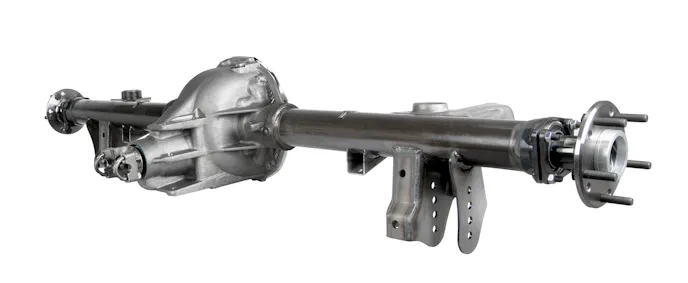
12 Bolt
The 12 Bolt is an integrated design developed for third- and fourth-generation GM F-Body applications. It can also be used in GM leaf-spring vehicles.
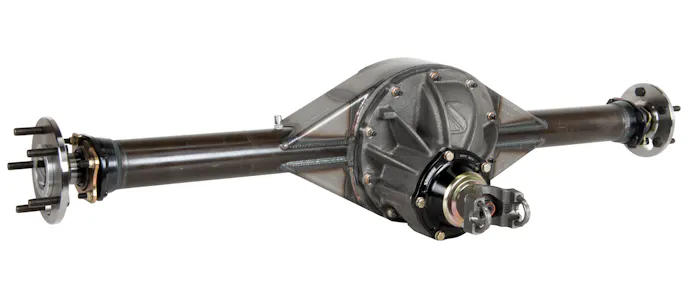
Ford 9-Inch
The Ford 9-inch uses a drop-out design and, according to Cascio, “is the most popular option for the aftermarket rear-ends due to its limitless combinations for race, street, off-road, and any other application. The fabricated housing can be made to any width. The axles are available in 28, 31, 33, 35, and 40 spline configurations. The numerous differential and spool options can be specified to accommodate the most powerful combinations.”
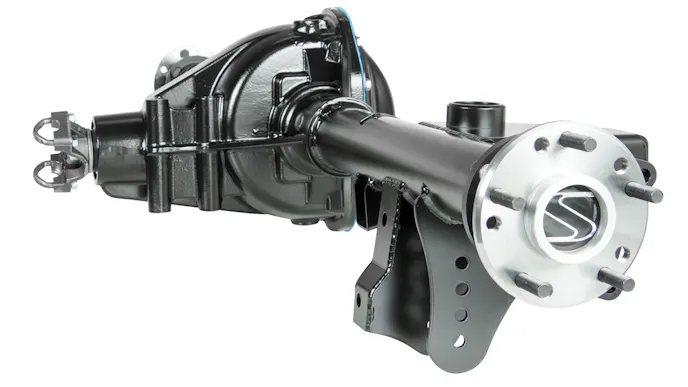
S60
Inspired by the Dana 60, the S60 comes standard with 35-spline axles and a larger 9¾-inch-diameter ring gear. It’s available for GM A-Body, G-Body, and F-Body applications, along with most leaf-spring applications across all brands.
Axles
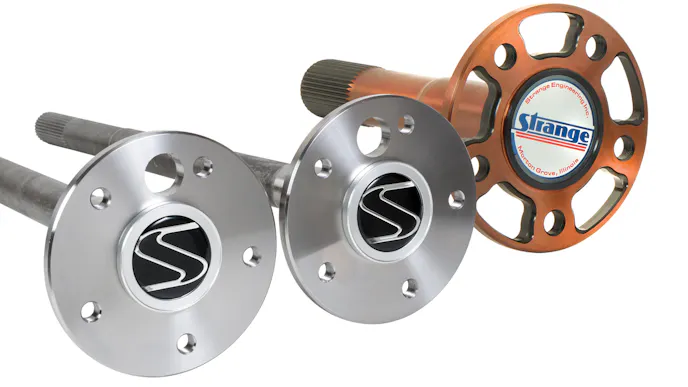
Strange Engineering also offers matching axles for specific rearend applications.
Cascio notes, “the axles are cut, turned, milled and hobbed prior to heat treating. This ensures the strength and durability of the axles.”
Options include Alloy Axles for street/strip applications, Hy-Tuf axles for drag racing, and 300M floater axles designed to put down full power in the most abusive applications.
“The correct choice is dependent on the power and application of the vehicle,” Cascio remarks.
Future Proofing Your Driveline
Underplanning is the most common mistake customers make when selecting a bolt-in rearend assembly.
“It’s a mistake to build a rearend for the current combination and not for where the build may end up. It’s important to consider what the potential of the vehicle is,” Cascio says.
All recommendations depend on the customer’s intended application. Is the vehicle being built for street/strip, drag-and-drive, or full-race use?
Cascio explains, “The drag-and-drive events have certainly blurred the lines between street and strip. All of our bolt-in rear-ends can be configured with spools or differentials, street gears or pro gears, Alloy or Pro Race axles.”
That’s plenty to take in. To help frame the conversation and determine which questions to ask, it’s important to understand how these components differ.
In general, differentials are used in street applications to allow for variations in axle speed during cornering, while spools are designed for straight-line acceleration.
When it comes to axles, Strange Engineering Alloy Axles are popular for drag-and-drive applications because they’re induction-hardened. This means the axle shaft’s outer diameter and splines are hardened to provide the torsional strength needed for drag racing, while the core of the axle, bearing area, and flange retain the flexibility needed to absorb road conditions such as speed bumps, railroad tracks, and potholes.
Meanwhile, Strange Engineering Hy-Tuf Pro Race Axles are through-hardened, meaning the entire axle is hardened to the same level.
“This design offers superior torsional strength ideal for drag racing applications, however, the axle loses flexibility which could be a potential issue on the street,” Cascio says.
Rearend Break-In Procedures: Street Gears vs Pro Gear Sets
Once the bolt-in rearend assembly has been configured to your needs and installed, the next step is to plan for proper break-in. The procedures vary depending on whether the rearend is intended for street or race use.
“The break procedure for a street rear-end should be done over 500 miles,” Cascio explains.
Street gears are constructed from heat-treated 8620 steel designed for long-term street durability.
“Running the rear through ‘heat cycles’ is important to wear in the pattern on the gear and break in the bearings,” Cascio continues. “Getting the rearend up to operating temperature and then allowing it to cool down for a period of time is best. Once you’ve gone through the break in process, the gear oil should be drained, flushed, and replaced with new oil.”
Drag racing rearends equipped with Pro Gear Sets and Pro Race Axles don’t require the same break-in process as street applications. That’s because Strange Engineering Pro Gear Sets are manufactured from slightly softer 9310 nickel steel, which is designed to resist the high-impact shock loads associated with drag-racing-only applications. The trade-off is reduced street durability.
Cascio says, “The race rear ends are set-up and ready to go.”
Of course, periodically inspecting and maintaining your vehicle’s components is always a good practice to help prevent failures.
Conclusion
Too much power will always find the weakest links. That’s especially true as power travels through the drivetrain and is combined with the increased traction of sticky tires.
Working with a trusted partner like Strange Engineering to develop a complete bolt-in rearend assembly can provide added confidence and performance. More importantly, it allows you to build for your vehicle’s ultimate potential rather than simply meeting the demands of its current combination.
In closing, Cascio offers, “the staff at Strange Engineering takes the time to understand a person’s project and what the ultimate goal is to determine the best combination.”
You might also like
Elite Motorsports Looks To Keep Its NHRA Pro Stock Winning Streak Alive In Texas
Elite Motorsports is chasing another Countdown win in Dallas. Here's how the team is approaching the NHRA FallNationals.