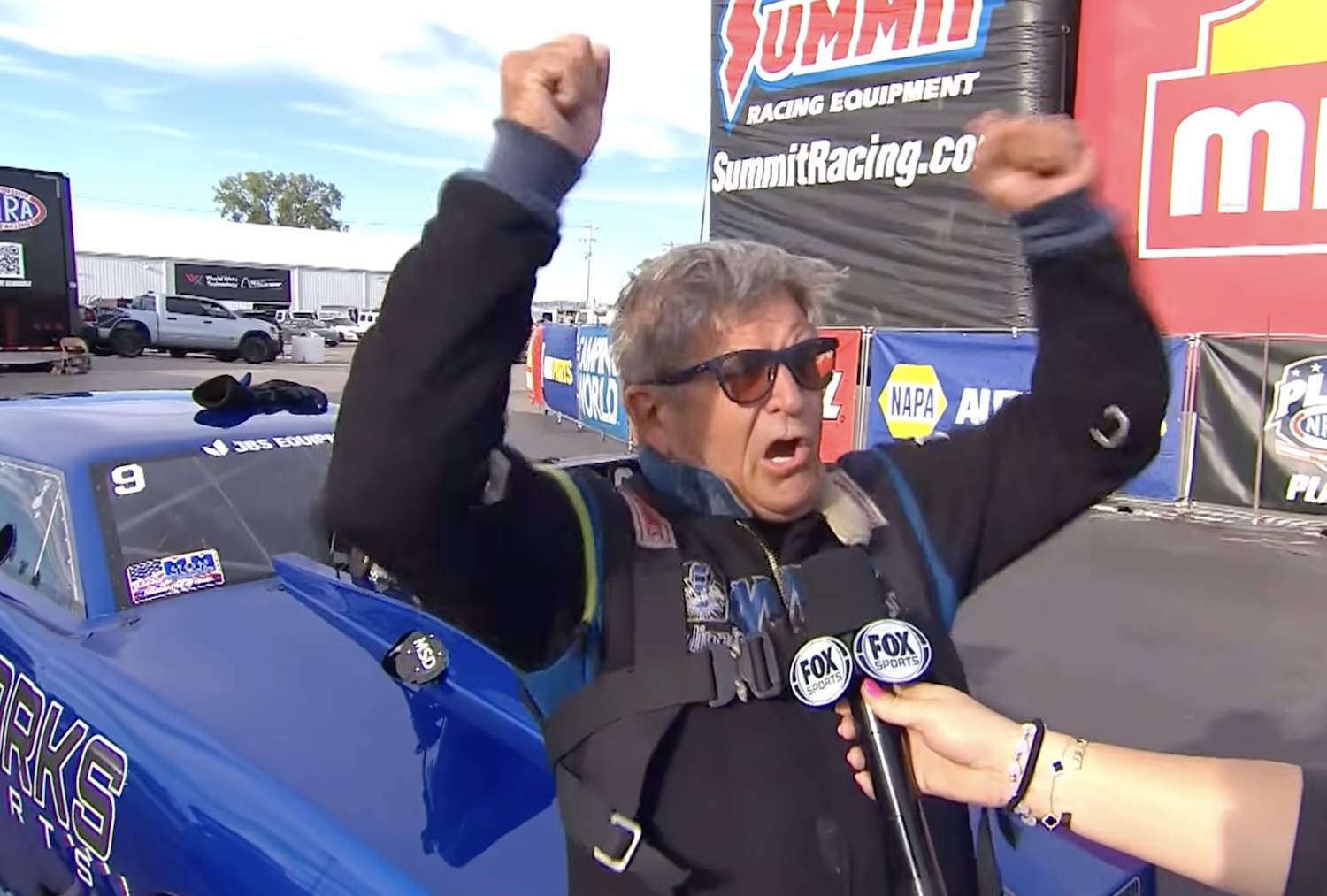
Pro Modified veteran Chip King enjoyed one of his finest hours in the class at the NAPA Auto Parts NHRA Midwest Nationals at World Wide Technology Raceway near St. Louis on Saturday afternoon, turning in the quickest pass in history during what was a weekend-long barrage on the record books.
King, who was in attendance at the first NHRA Pro Modified race a quarter century ago, clocked the first — and still only — sub-5.60 pass ever in the final session of qualifying, going 5.596 seconds. King’s lap came more than nine years after Mike Castellana recorded the first 5.6-second run in NHRA competition at Houston in the spring of 2017. His effort, and those of his peers at St. Louis, also came more than half a decade after Jose Gonzalez established the incoming national record of 5.621 at Gainesville in March of 2021.
Points leader Justin Bond landed the first blow to the national record in Friday’s second session, running 5.619 in the class’ next-to-last pair in near-mineshaft, 68-degree fall conditions. One pair later, Billy Banaka tied the 5.619 in his centrifugal entry but yielded the top spot on speed.
Equally cool conditions and an adjusted altitude below 900 feet put the ball squarely on the tee for the class to swing at in the third session on Saturday afternoon, as Steve Jackson, Nick Januik, Bond, and Derek Menholt all usurped the incoming national e.t. mark — with Menholt’s 5.605 landing atop the provisional order.
A full half a tenth back of the frontrunners entering the final session, King and his familiar Joe Oplawski-tuned, supercharged 1970 Dreamworks Motorsports Dodge Charger were hardly favorites to take over the top spot. Nevertheless, sitting opposite Kevin Rivenbark in the fourth pair out, King reeled off a .920-second short time, a 2.468 to the 330-foot clocks, a quick 3.685 at 203.68 mph to half track, and a 4.721 at 1,000 feet on his way to the historic 5.596 at a booming 257.24 mph.
“We were just hoping to get into the low sixties, but a .59 is unbelievable. It hiked the nose up, set the front end down and smoked the tire, and I thought, ‘This thing’s going to run pretty good.’ The best we had been before that was a .65.
“They didn’t tell me anything on the radio. I was turning the corner thinking, ‘Okay, that was a pretty good run.’ Then Debbie [O’Rourke, series manager] came running at me, and I thought, ‘What did I do?’ I figured I must have done something really bad.”
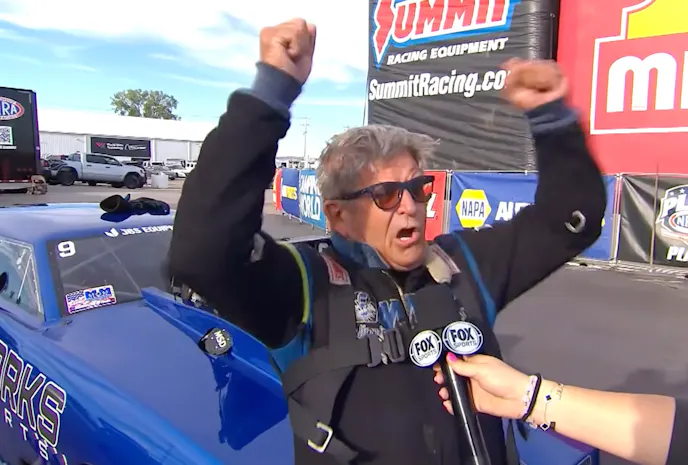
“I’ve got to credit my crew, my team, and the good Lord. It couldn’t mean any more. We’ve worked so hard all these years and come up just a little short so many times. To have it finally happen here in St. Louis, one of my favorite racetracks, is just awesome.” said an elated King after climbing from his race car.
“We hurt a transmission last week, so before Q4 we changed it,” adds Oplawski. “The car just hadn’t wanted to run early. We had another transmission sitting there, and I said, ‘Well, it’s Q4. Let’s see what happens.’ We put it in, and it ran early. I thought it might go a .925 or something, and it went .920 flat. It ran pretty good.”
Three other drivers — Bond, Jackson, and Menholt — all clocked 5.60-second runs in that final session, but none could top the Dreamworks machine’s performance. The field, anchored by Shane Gray’s 5.700, was the quickest in history and only missed being an all-sub-5.70 affair by that meager one thousandth of a second. Screw, roots, and centrifugal-type superchargers, along with a lone nitrous entry, were all represented in the record field.
In all 13 runs were made under the incoming national record — ten of those in qualifying and an additional three in eliminations.
While the timeline from the first run in the 5.60s to the 5.50s spanned an incredible nine years, the class has traversed almost three quarters of a second since its inception. At that inaugural race at Gainesville in March of 2001, King qualified second in a Dodge Viper entry at 6.242 seconds. Six years later, in 2007, Troy Critchley clocked the first 5-second run, a 5.946, and it’s been a steady march forward ever since. Ray Commisso broke into the 5.80s in 2009, Melanie Troxel the 5.70s in 2011, and then Castellana the 5.60s in 2017.
While the 5.50 barrier is not likely to be the last that NHRA Pro Mod will crest unless performance controls are established, the pace of progression would suggest King’s mark will serve as the most recent piece of history for a good, long while.
You might also like
Zimmerer And Wheeler Score 2026 CHAOS Titles
It was a wild year for the Funny Car and Nitro CHAOS series. Here's a recap of how the title chases played out and who scored the wins.