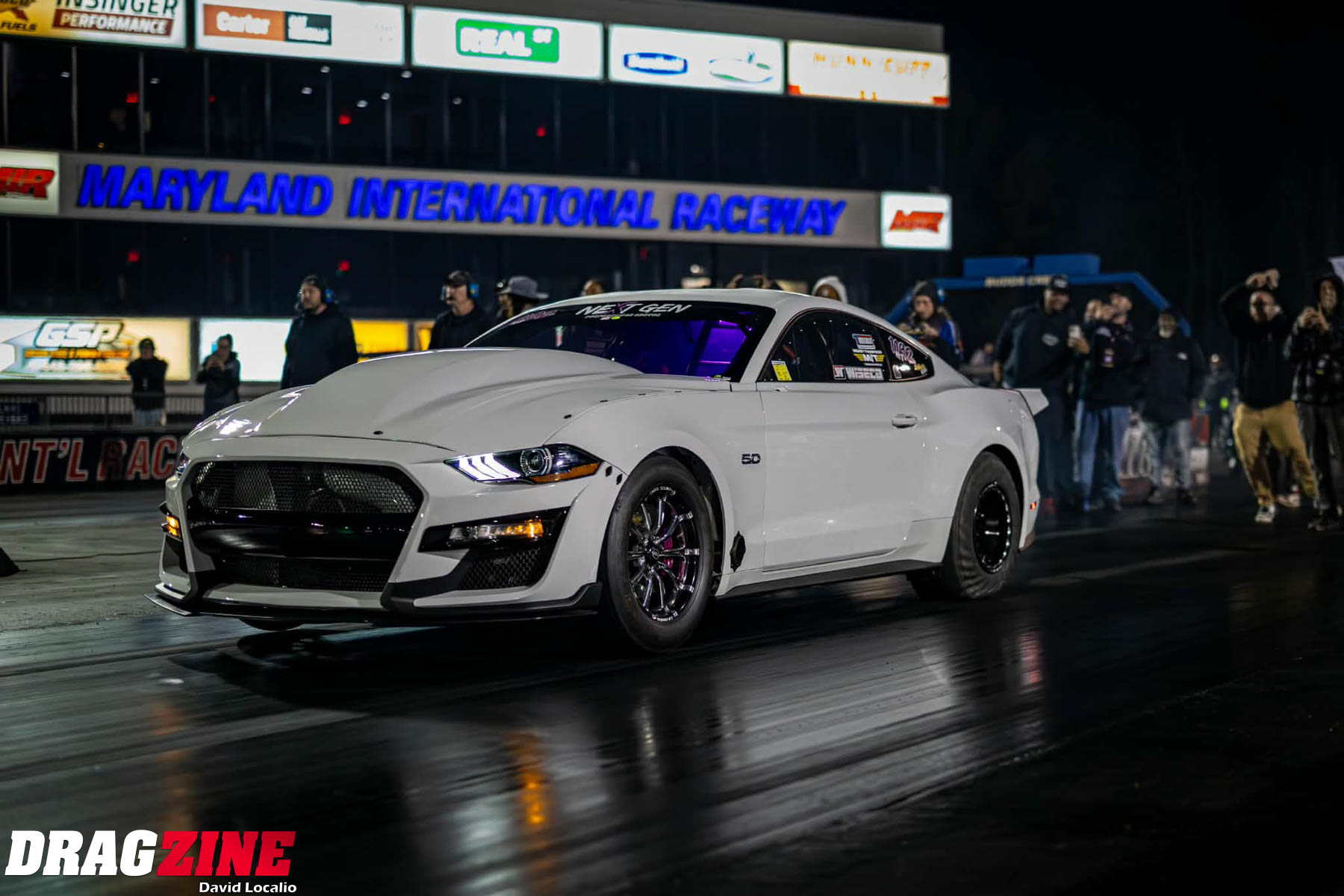
When Ford rolled out zero-percent financing offers during the COVID-19 pandemic in 2020, Brandy Lorence saw a chance to retire her aging 2004 Mustang GT in favor of something a little newer, a little more technologically advanced, and with the performance potential that Ford’s third-generation Coyote engine had become known for. It seemed like a sensible purchase to an outsider, but the brand-new Mustang barely made it through its first 200 miles before Brandy decided it needed a supercharger.
Brandy had been looking for a white 2020 Mustang GT equipped with Ford’s Performance Package 1, a factory combination that was surprisingly difficult to find at dealerships near her home in Maryland. After searching online, she eventually located one in South Carolina, put down a deposit without so much as a test drive, and excitedly waited for her new purchase to arrive.


The white-and-black model was exactly what she had been looking for, and while the Performance Package provided some additional appeal, the 5.0-liter Coyote under the hood was ultimately what made the car so attractive to her.
Of course, the factory’s interpretation of performance and Brandy’s were two altogether different things.
With just 200 miles on the odometer, the Mustang was outfitted with a ProCharger D-1X centrifugal supercharger, beginning a transformation that would eventually see the car running deep into the seven-second zone at speeds approaching 180 mph.
“I absolutely love the sound of a ProCharger,” Brandy says, noting that the distinctive whine of the blower has occasionally drawn some amusing reactions from people unfamiliar with the sound of a supercharger. “People would come up to me who aren’t into racing, saying it sounds like I need to take the car to get checked out because it doesn’t sound like it’s running well.”
Brandy’s attraction to fast cars and motorsports began long before her Coyote-powered Mustang entered the picture.
Growing up on 13 acres in Maryland, she was surrounded by dirt bikes, four-wheelers, and classic cars, and developed an appreciation for speed at an early age. “I have always been a need-for-speed chick. I wasn’t your typical little girl playing with babies.” Maryland International Raceway was less than 20 minutes from her childhood home, making trips to the dragstrip a regular occurrence and giving her an up-close look at a sport she was determined to eventually participate in herself.

“One day that will be me on the track,” Brandy remembers telling herself.
As a teenager, she got her first taste of fast cars with that 2004 GT, although purchasing it required some cooperation from her father and a considerable amount of patience from her mother.
“My mom was so upset with my father that he let me buy a V8-powered car at 16 years old. My dad snuck behind her, and we went to purchase it. My mother didn’t speak to my father for a month over it!” she recalls.
That Mustang would eventually become her introduction to drag racing. After she and her future husband, Tommy Lorence, met in 2010, they discovered they shared a common interest in Ford’s two-valve modular-powered Mustangs.
In 2011, Tommy took the car to Maryland International Raceway for its first trip down the quarter-mile, with Brandy asking him to make the initial pass before taking a turn behind the wheel herself. Despite some understandable nerves, the first outing went remarkably well, particularly the burnout and staging process, although Brandy admits she’d had a little practice doing burnouts long before ever pulling into the water box at a dragstrip.

Her first quarter-mile pass was somewhere in the 15-second range, but the experience was enough to convince her that going racing was something she wanted to do a lot more of.
Eventually, a 150-horsepower nitrous oxide system found its way onto the Mustang, which already had some 120,000 miles on it, and the car progressed from running 15s to 11.0-second elapsed times. For someone just getting her feet wet in the sport, that was a huge improvement, and one that further fueled an interest in going quicker.
Looking back at those early outings now, with a car capable of covering the quarter-mile in the 7.40s at 180 mph, Brandy can appreciate just how far things have progressed.
“It’s an addictive sport, but it will always be a passion of mine. I will still be doing it even when I am elderly,” she says.
The current Mustang is well removed from the relatively simple combination that got her started, with Next Gen Performance Center overseeing much of its development into a competitive, purpose-built drag racing machine.
The engine is based around a sleeved Ford Predator block assembled by TKM, with a billet crankshaft, GRP aluminum connecting rods, and custom pistons. HeadGames Motorworks performed the cylinder head work on the Gen 3 heads, which are complemented by custom blower camshafts.

Depending on the event, Brandy has utilized both ProCharger’s F-1A-94 and larger F-3 centrifugal superchargers, with the smaller unit serving as the combination of choice for competition at the Import vs Domestic World Cup Finals. A custom air-to-water intercooler fabricated by 1320 Fabrication helps manage intake temperatures, while the engine operates on M1 methanol delivered through a mechanical fuel pump and 720-pound FuelTech injectors.
A FuelTech engine management system, wired by Next Gen Performance Center, handles the electronics, with Eric Holliday responsible for tuning the combination. Behind the engine is a Proformance Transmission-built TH400 three-speed automatic, prepared through Next Gen, utilizing a Neal Chance torque converter and M&M air shifter.
The chassis is equally serious, with 1320 Fabrication responsible for its 25.3-spec roll cage and chassis work. Santhuff double-adjustable struts support the front end, while a TRZ S550 solid 9-inch rear conversion and Penske shocks handle the rear suspension. RC Components wheels are used at all four corners, with 15×12-inch rears wearing Mickey Thompson ET Pro tires. Strange Engineering rear brakes and custom pink Baer front brakes round out the rolling package.
Brandy has also retained some of the visual character that attracted her to the car in the first place, although the addition of a GT500-style front bumper and rear wing gives the Mustang a more aggressive appearance than it had when it arrived from South Carolina. It’s a combination she takes pride in keeping clean and presentable, even as the demands of competitive drag racing have pushed the car farther and farther away from its street-car origins.
Through it all, Brandy has leaned on a group of people who have helped make the project what it is today, beginning with Tommy, whom she credits for being her biggest supporter and continually encouraging her to push beyond previous accomplishments.

Next Gen Performance Center has played an instrumental role in the build, while tuner Eric Holliday has earned Brandy’s confidence not only for his tuning abilities, but apparently for knowing when certain information is best kept to himself.
“Eric [is] on the keyboard even when it means keeping secrets from me so I don’t panic, but he is the true science behind it all,” Brandy jokes.
She also credits Matthew Herbert for bringing an infectious level of enthusiasm to the team, along with crew members Michael Troiano, Marcos Rojas, Thomas Fox, Charlie Barnes and the rest of the Next Gen group, as well as the family and fans who have supported the effort.
Considering that it all began with a teenager who wanted a V8 Mustang and a father willing to risk a month in the doghouse at home to make it happen, Brandy’s performance progression is quite a story in itself. And while the 2020 Mustang has come an awfully long way since that first ProCharger installation at 200 miles, there’s little reason to believe Brandy has reached the point where she’s satisfied with how fast it goes.
You might also like
How The 2026 NHRA Championship Standings Compare under Two Formats
A hypothetical season-long points analysis offers a different perspective on the 2026 NHRA championship battles.