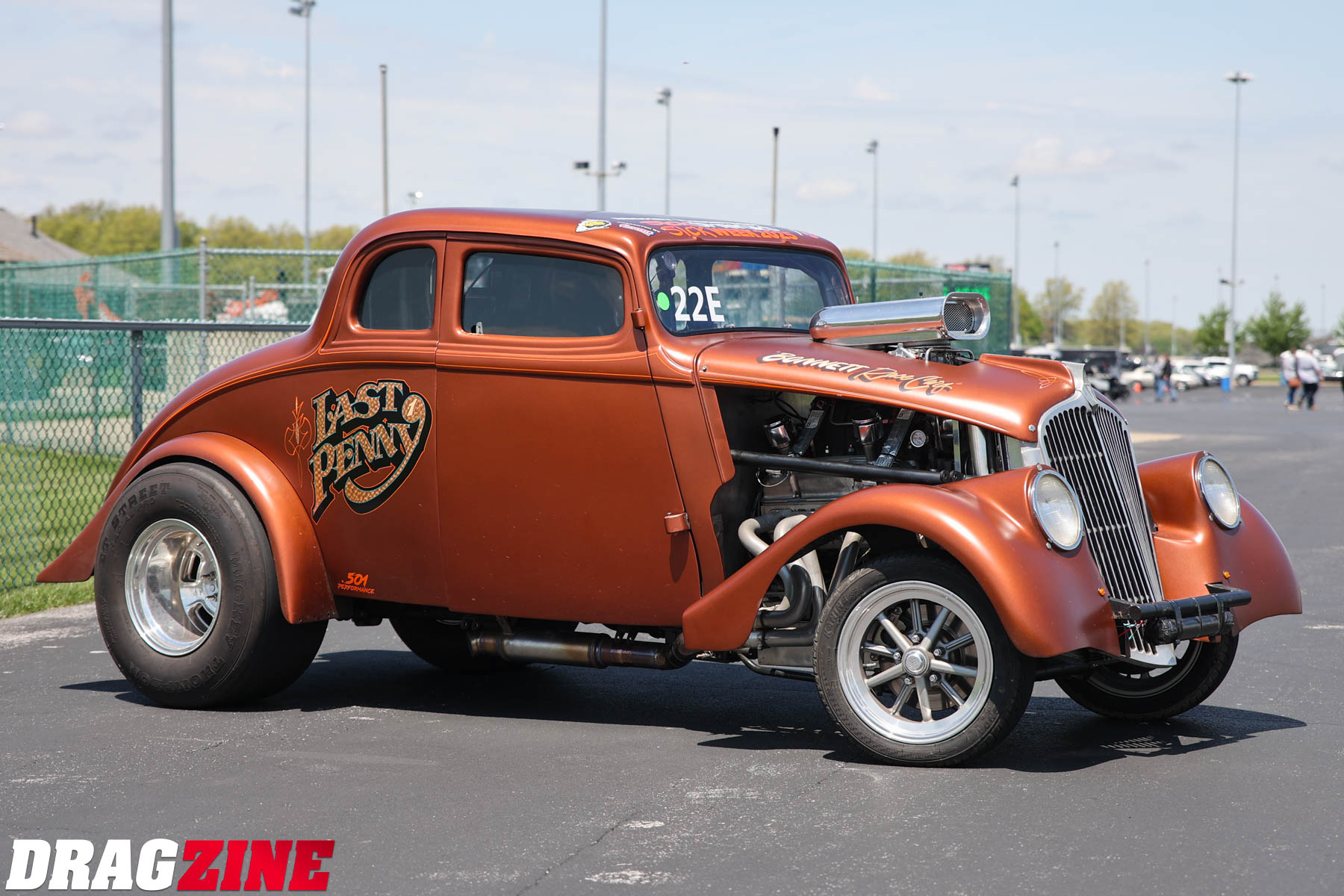
There’s definitely an easier way to go racing than to build a short-wheelbase, supercharged 1933 Willys street car with limited visibility, a straight axle, manual steering, and nearly 900 horses ready to party. And Jeremy Bonnett knows that, but he simply doesn’t care.
The racer has dedicated his life to building and driving nostalgia racecars that honor the sport’s earliest days, when hot rodders fabricated their own parts, creativity could overcome financial constraints, and every run required both courage and commitment. Now, the 55-year-old owner of Bonnett Race Cars has built a livelihood on these machines, and his copper-colored Willys, which he’s named “The Last Penny,” is a shining example of his work.


Growing up, Bonnett’s father had racecars, and he got involved in the sport, although he chose to race motorcycles at first. He spent 25 years working in a machine shop and learned to build cars, so when he started on his own in 1989, he was already an expert.
Bonnett ended up driving a ’33 Willys for gasser legend Don Moyer and fell in love with the platform. “I was working on another racer’s car in his barn in 2003 and saw the Willys. He offered to let me buy it, but I didn’t,” said Bonnett, who returned a week later and made a deal with the other man to purchase the 1933 coupe that was just “a shell and a couple frame rails” at the time.
That shell, however, carried an unusual history; rather than using a modern reproduction body, Bonnett had stumbled across an original Chuck Finders fiberglass racing body that dated back to the 1960s. That body was in pretty rough shape, but Bonnett was able to restore it to its former glory by “glassing in a roof and throwing some paint on it.”
That paint, ironically, became the literal highlight of the entire build. After deciding to christen the car “The Last Penny”, Bonnett went to Eastwood and found an eye-catching copper color on the clearance rack. “So, it was $102 for a paint job for this thing,” he laughed.

Back at the family business, Bonnett and his four sons, along with his girlfriend, Sarah, immediately got to work tearing down the Willys, one year later, in 2004, Bonnett Race Cars moved into its current location in Litchfield, Ohio.
“I wanted to build this, a childhood dream car of mine, specifically for drag-and-drive use,” explained Bonnett. “We have a whole stable full of nostalgia race cars, and this was the last one I wanted to do, but hadn’t yet.”
His 25-year-old son, Jared, wanted to tackle the chassis. So, the young man fabricated the framework, his first 7.50 cert project, which gives the Willys more potential E.T. than the average 8.50-cert gasser—and did an excellent job with Bonnett lending guidance as needed. “From start to finish, the car never left our shop, my whole family helped build it,” said the proud father. “That was my favorite part of the entire thing, working on it with my kids.”
While the roll cage and other work was being sorted out, the next step was to cut the front end off the Willys so the family could rework the car in true gasser style with a straight axle and a manual steering box. Viking double-adjustable shocks and modern Wilwood brakes were installed at all four corners, and a ladder bar-style suspension was configured in the rear.

Next, Quick Performance 35-spline axles were connected to a 9-inch rear end with 3.73:1 gears. A chromoly driveshaft from CCI Driveline linked the third member to the Powerglide transmission with its Reid Racing case and 4,000 rpm stall-speed 501 Performance torque converter.
Moving forward through the Willys’s powertrain, Bonnett’s old-school approach is evident everywhere. “The street motor that we had in it up until recently really wasn’t anything special. It’s just a 400 cubic inch small-block Chevrolet bumped up to 414 ci with a 3.875” stroke and was built by Mountain Motors,” said Bonnett.
Producing an estimated 850-900 horsepower and 750-ish foot-pounds of torque thanks to the Dyer’s Blowers 6-71 supercharger pushing 12 pounds of boost, the 9.2:1 compression engine utilizes Diamond pistons, Callies’ Ultra connecting rods, a Callies crankshaft, and a custom-ground camshaft by Chris Straub Technologies.


Up top, Air Flow Research 1110 220 cc cylinder heads were fitted with T&D Machine Products rockers and paired with a set of Quick Fuel 750 cfm carburetors. “Yeah, we still run carbs,” affirmed Bonnett, who also installed a set of trick Schoenfeld sprint car-style headers. “We drive the ‘33 on pump gas on the street, then put 120-octane race fuel in at the track. Other than the MSD Ultra 6AL ignition control box and distributor, there’s no fancy electronics. It’s pretty basic: just a throttle and a brake pedal and a shifter.”
Inside, the Willys is pretty Spartan, too. There’s an aluminum dash, a pair of Kirkey race seats, and not a whole lot else. “The car is so small that the Funny Car cage split in the middle to give me room to drive, and I basically sit shoulder-to-shoulder with the passenger,” joked Bonnett.
The tiny interior also posed the problem of extremely limited visibility, especially considering how far back the driver sits, so it’s hard for Bonnett to see out. “I actually installed a backup camera and a screen to show around the car, which helps a ton when driving,” he said. “And then there’s the blower blocking so much of the windshield. At the Sick Smokies drag-and-drive going through the Tail of the Dragon, I had to physically hold myself up over the top of the steering wheel to see where I was going to the right!”
Although he competed in his first-ever Hot Rod Drag Week in 2016 with a supercharged 1929 Ford Model A sedan and went on to finish second at Roadkill Nights Woodward with it, Bonnett has been busy racing ever since. He can usually be found in Gasser and Hot Rod classes at nostalgia events, as well as plenty of drag-and-drives.
He’s picked up plenty of wins over the years, too, at major events like the Rock’N’Race and annual Blue Suede Cruise. “In addition to the Model A, we also have a ’52 Henry J that’s won a ton of bracket- and index-style nostalgia races, and a ’41 Willys that my 78-year-old father, John, ran for years,” noted Bonnett, blessed to have three generations of his family together at the track.
At the Mickey Thompson Turn & Burn Drag-and-Drive held in May of 2026 at Ohio’s famed Summit Motorsports Park, though, Bonnett ran into a bit of trouble with his 1933 Willys. “We knocked the top off of two pistons, but even so, it ran pretty well on our last two passes,” he stated. “So, we yanked that motor out, and it didn’t hurt the cylinder, but it did beat up the head pretty bad.”
Bonnett is rebuilding the small block, but also has an aluminum, 18-degree Brodix engine in the works which will use a larger 8-71 supercharger and run on a fuel injection system.

To date, Bonnett has run a personal best of 8.60 seconds in the quarter mile at 153 mph (and clocked a respectable 1.21 60-foot time) with the lightweight Gasser. “With a 100-inch wheelbase, 160 or 170 mph is probably about as fast as you’ll want to go. They aren’t very aerodynamic, either, and lose downforce down the track, so it moves around a lot, it’s fun to drive,” he added.
A little cool, a little wild, and a whole lot of heritage blended together to form Bonnett’s philosophy throughout the entire process, and it’s reflected in the parts he chose. Case in point, he selected a set of vintage-inspired, 10-spoke Halibrand Wheels and wrapped them in Mickey Thompson 315 drag radial rubber, which he leaves on the car, even for street use, and only switches to something else if it’s raining.
From its start as a decaying relic tucked away in a barn to its current status as a boosted beauty of a hot rod, Bonnett transformed his “Last Penny” 1933 Willys into a true drag-and-drive machine with pure Gasser style, all built entirely in-house and all built entirely by family.


CAR: 1933 Willys
ENGINE: 414 ci small-block Chevrolet by Mountain Motors
HEADS: Air Flow Research 1110 220 cc
CRANK: Callies 3.875” stroke
RODS: Callies Ultra
PISTONS: Diamond
CAM: Chris Straub Technologies
VALVETRAIN: T&D Machine Products rockers
POWER ADDER: Dyer’s Blowers 6-71 supercharger
CARBURETORS: Dual Quick Fuel 750 cfm
TRANSMISSION: Powerglide, Reid Racing case
CONVERTER: 501 Performance
DRIVESHAFT: CCI Driveline
REAR END: 9-inch, 3.73:1 gears, Quick Performance 35-spline axles
SUSPENSION: Viking double-adjustable shocks
BRAKES: Wilwood
WHEELS: Halibrand
TIRES: Mickey Thompson 315 drag radials
HORSEPOWER: 850-900 (estimated)
TORQUE: unknown
BEST 60’: 1.21 seconds
QUICKEST ET: 8.60 seconds (1/4 mile)
FASTEST MPH: 153 mph (1/4 mile)
You might also like
Wild Ride: Diesel Record Attempt Nearly Ends In The Wall
When you're chasing records things can get a little crazy in a hurry. Austin Doidge's attempted record run nearly ended in disaster.