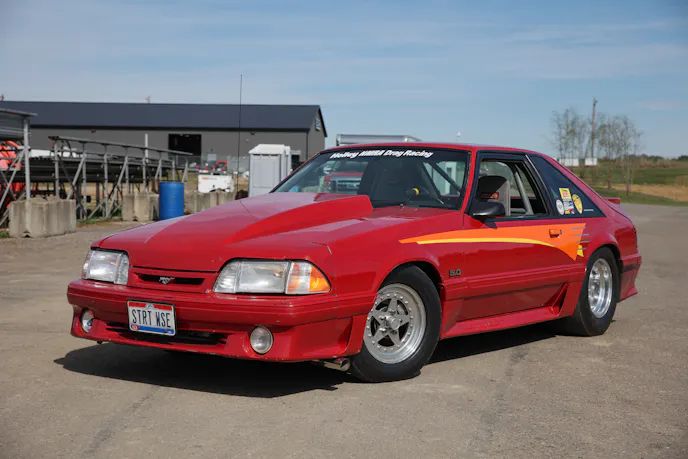
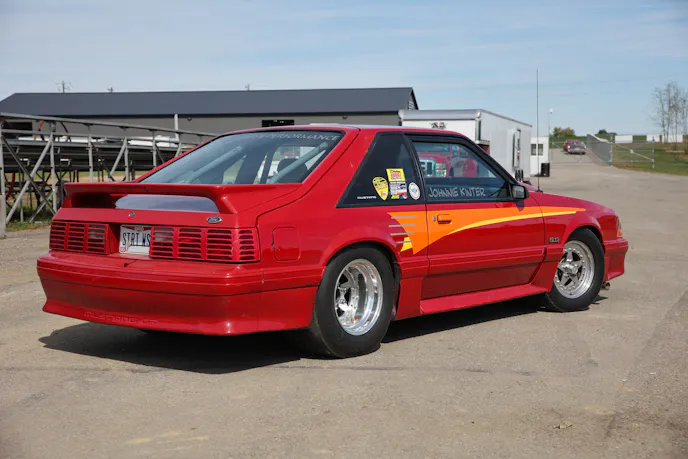
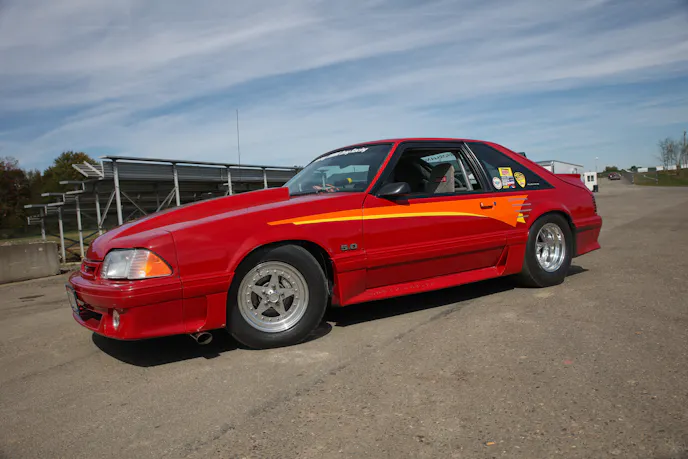
There is a certain kind of confidence that comes from sticking with one car long enough to know its entire racing history and every detail inside and out. To John Kinter, his 1988 Ford Mustang GT is exactly that. It carries the marks of time, from its early days as a street/strip Fox-body to its current form as a twin-turbo, H-pattern Coyote-powered car that still answers to the same basic rule Kinter has followed since the beginning: if it breaks, he fixes it, and if it runs, he drives it.
That philosophy was already forming when Kinter was a teenager in Ohio, long before he owned a shop full of tools or a Mustang known throughout Ford racing circles. At 13 years old, standing at the IHRA World Nationals, drag racing became a permanent part of his life. The sounds, the speed, and the mechanical demands of it all stuck with him.
“I was hooked immediately, once you see it up close like that, it gets in your head, and it never really leaves,” Kinter says.
Now 53 and calling Wellington, Ohio home, Kinter owns a Snap-On Tools franchise and somehow balances running a business, coaching high school baseball, raising two teenagers, and maintaining a car that has quietly built a legacy over nearly three decades. He bought the Mustang in 1994 after finding it in North Canton, Ohio, set up as an autocross and road-race car. It came with a trailer and extra parts, most of which he sold off to offset the cost. At the time, it was simply a good deal. Over the years, it became something much more.
Kinter’s passion for racing was shaped early and reinforced often. His father owned a pair of Fairlanes, a 1966 and a 1967. When John was 12, those cars sparked an interest that quickly turned serious. His father had raced a 1965 Cyclone before meeting Kinter’s mother, and his grandfather built local championship-winning circle track cars before John was born.
“I guess it’s just in my blood. My dad always said he hoped that someday in heaven, he could listen to me and my grandfather sit around and talk cars and racing together. I always liked that idea,” Kinter says.
Money was scarce when Kinter was young, so his automotive education came the hard way, teaching himself how to build engines, manual transmissions, and rearends, because he had no other option. He read constantly, asked questions, and learned by doing, often on his own cars and sometimes on other people’s projects to help fund his racing.

“To afford racing, I did a ton of side work, I built engines, did rear gears, transmissions, and ported heads. I’ve probably done six to eight sets of heads over the years, even cast iron heads that took forever, but that was all we had when I started racing. People were always willing to help a young guy who asked questions, and I never forgot that,” Kinter states.
The Mustang was his outlet, and through the mid and late 1990s, it developed a reputation on the street and the strip. Kinter regularly drove it to events, raced it, and drove it home, sometimes after trips that stretched more than 11 hours each way.
“We didn’t call it drag and drive back then, it was just what you did. You drove it, raced it, and figured out how to get home,” Kinter explains. “I often joke that I invented drag and drive.”
For years, the car remained a naturally aspirated, stick-shift combination, and it built a respected place in NMCA, FFW, NSCA, and NMRA competition. Along the way, Kinter held seven national records, won numerous events, and qualified number one at the first two World Ford Challenge races in the Pure Stock class. The Mustang became known as a benchmark Fox-body, one that was consistently competitive.
“It was always a naturally aspirated stick car, and that’s what people expected, that was kind of the identity,” he shares.
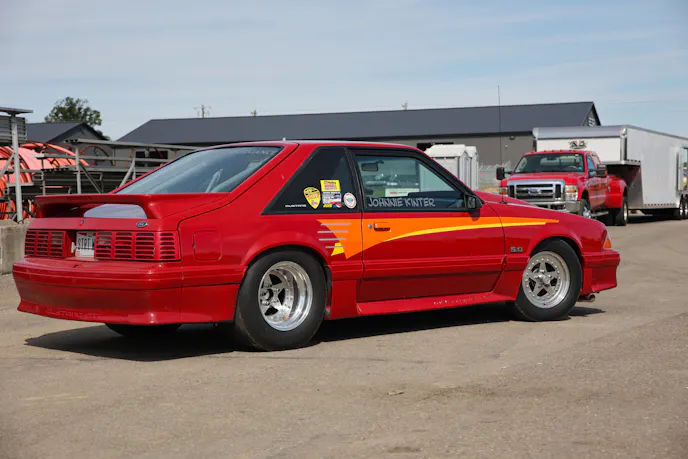
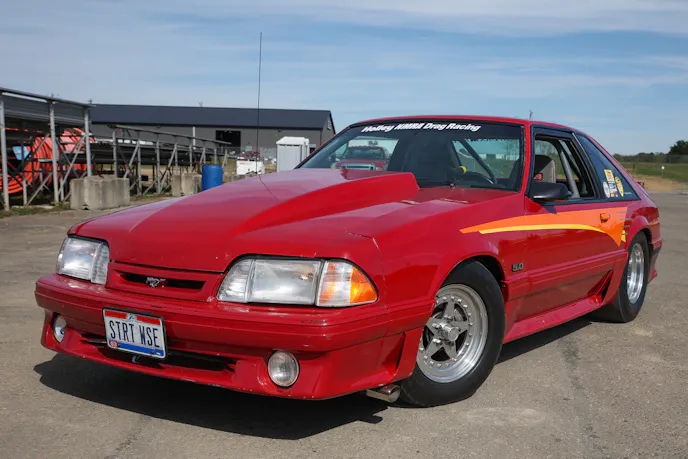
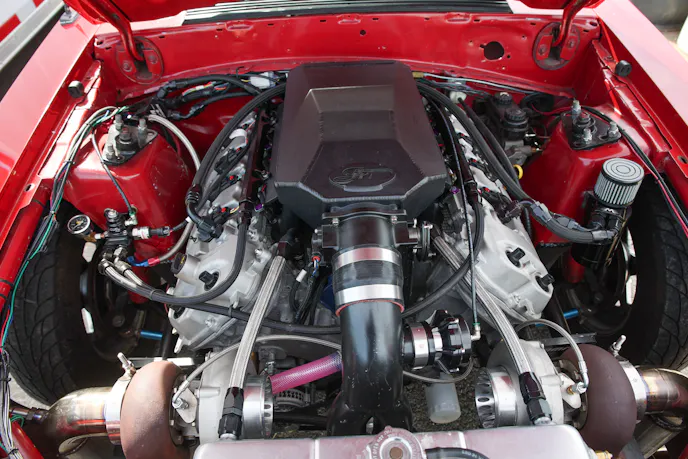
That history made the car’s latest transformation all the more shocking to those who thought they knew it. Quietly, and without any public attention, Kinter retired the small-block Ford and installed a first-generation Coyote paired with twin turbochargers, all while keeping the H-pattern manual transmission that had defined the car from the beginning.
“I kept the Coyote twin-turbo setup pretty secret,” Kinter says. “When I finally brought it out, people were genuinely shocked. I liked that. The car had a reputation, and this challenged it.”
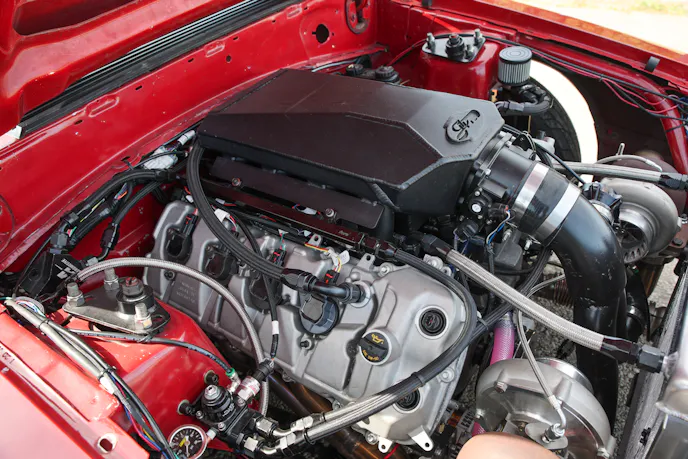
The engine is a 2011 Gen 1 Coyote that remains stock in displacement at 302 cubic inches. It sports a factory crankshaft paired with MAHLE pistons, Manley connecting rods, and has an 11.0:1 compression ratio. Kinter performed the machine work himself at home, including ball honing and re-ringing the short block. The cylinder heads remain stock Coyote castings fitted with PAC springs, and the valves were hand-lapped by Kinter. Variable valve timing has been locked out using an MMR kit, while the factory camshafts remain in place.
“I’m not interested in throwing exotic parts at something just to say I did. I want parts I understand that I can service and that have proven themselves,” he says.
Fuel and spark are managed by a Holley Dominator ECU tuned by Big 3 Racing, with Bosch 210 injectors fed by dual Aeromotive A1000 pumps. A Goetz air-to-water intake manifold and Holley Sniper 90mm throttle body sit atop the engine, feeding a custom cold side with a VS Racing blow-off valve. Exhaust exits through CG Fabrication headers with 1.75-inch primaries.
Boost comes from a pair of 67mm VS Racing turbochargers feeding through an air-to-water intercooler. With only four passes on the current setup and no fully clean runs, the Mustang has already gone 9.99 seconds at 145 mph on just 10 pounds of boost. On the dyno, it has produced 917 horsepower at the rear wheels at 15 pounds.
“There’s a lot more left in it,” Kinter shares. “We’re still learning the combination, and honestly, that’s the part I enjoy.”
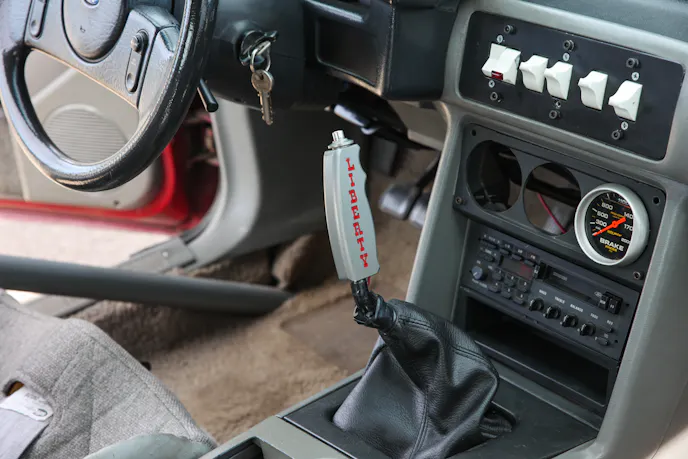
Power is transferred through a face-plated T56 Magnum six-speed modified by Liberty Gears, coupled to a Centerforce dual-disc DYAD XDS clutch and steel flywheel. Out back, an 8.8-inch rearend narrowed by Kinter himself houses 4.10 gears, 35-spline Strange axles, and a Strange spool. The chassis features custom control arms, Lakewood 90/10 front struts, Viking double-adjustable rear coilovers, and a mini-tubbed rear section to accommodate serious tire.
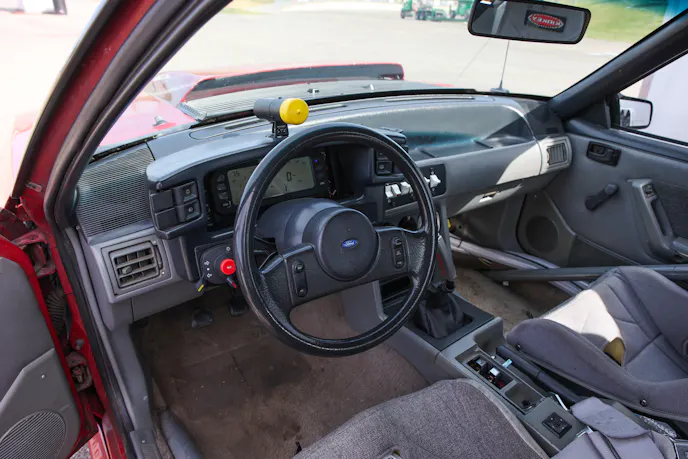
The Mustang rides on Holeshot Holestar wheels with Mickey Thompson rubber, slicks for competition, and DOT tires when needed on the road. Aerospace front brakes and Wilwood rears handle stopping duties. Inside, a custom chromoly cage, Kirkey seats, RJS belts, a Racepak dash, and a custom switch panel emphasize function over flash.
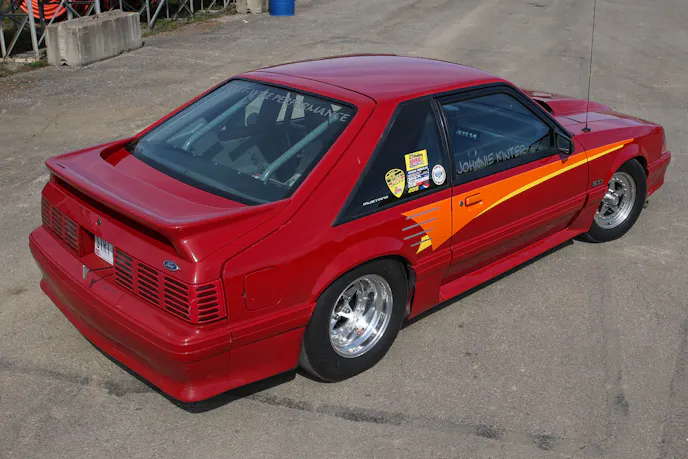
The exterior remains red, finished in Dupont paint applied in five coats by Jim Roepke of Ashland, Ohio, with Kinter assisting during the original paintwork in 1999. A Cobra grille insert and H.O. Fibertrend hood provide subtle visual cues without overshadowing the car’s purpose.
For Kinter, the Mustang has always served a role beyond competition. “When things are rough for some people, they drink or go to therapy, but I bury myself in the garage. This car is where I worked through things or took out my aggression. My kids don’t know life without me racing this Mustang. I met my wife through people I raced with. It’s a huge part of who I am,” he explains.
That extends to the rest of his garage. Kinter still owns the 1967 Fairlane passed down from his father, now fuel-injected with individual throttle bodies and a Tremec five-speed, a mostly street-driven car that has run 10.94 seconds at 124 mph on DOT tires. He is currently building a 1987 Thunderbird Turbo Coupe as a stick-shift race car, while two Fox-body Mustangs inherited from a late friend now belong to his son and daughter.
Despite decades of racing success with this car, Kinter is still grounded in the realities of time and his responsibilities. Most work on the Mustang happens late at night, after his family has gone to bed. “Sometimes the only time I have is when everyone else is sleeping. That’s just how it works,” he says.
“In addition to owning my business, I have two kids in sports almost year-round, I race, and I also coach high school baseball. I always make sure to make family events, even if it means not sleeping much, so I can get work done on the car. Oftentimes, I wait until my wife and kids go to bed, and then I will head out to the shop. While most people are getting ready for bed, I’m just starting my work on the car.”
The car has not been left at another shop for major work in nearly 20 years. Friends help when needed, but the vision, fabrication, and execution remain his. In a sport often defined by constant reinvention and swapping to ever-newer or more advanced chassis, John and his Mustang have stood out, in large part for his refusal to abandon what made the car special in the first place.
He adds in closing: “Other than being with my family, when I’m buckled into that car, that’s the place where I know I’m exactly where I belong.”
You might also like
From Underdog to Contender: Shawn Reed Is Earning Respect in Top Fuel
Shawn Reed has worked hard to earn the respect of his fellow Top Fuel racers. Reed is looking to change things up in 2026 and beyond.