Standout small tire racers Brett Lasala and Eric Laferriere put on a performance for the ages at the annual TX2K street car shootout in Ennis, Texas over the weekend, in the process perfectly illustrating the design of the 2JZ versus The World category in which they competed.
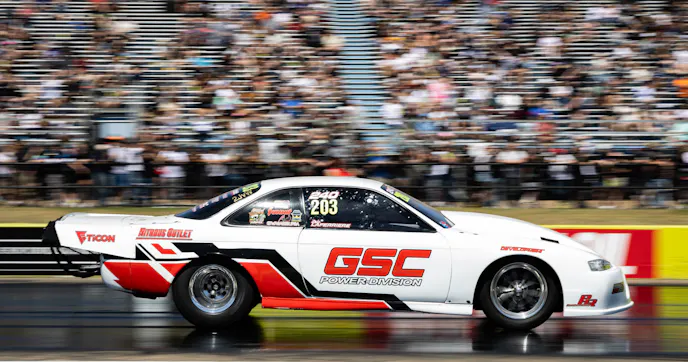
LaFerriere, driving the venerable “White Rice” 1995 Nissan 240SX with turbocharged, inline-six Toyota 2JZ horsepower, and LaSala, with his popular “Snot Rocket 3.0” twin-turbo, Ford Coyote-powered S197 Mustang, traded barbs throughout six rounds of qualifying at the Texas Motorplex. Each of them knocking on the door to the five-second zone on 275 drag radials. So locked together were the two performance-wise that they each record runs of 6.053 and 6.052 just minutes apart in an earlier session to trade number one.
In Saturday’s final qualifying session under the Texas stars, LaFerriere stunned the crowd with the first 5-second pass in competition in the history of TX2K, going 5.905 at 242.73 mph. Not only did the pass supplant LaSala’s prior class-leading 6.004 to qualify number one, but it broke LaFerriere’s existing 6.03-second import drag radial-tire 1/4-mile world record. LsFerriere and car owner Duy Bui also earned a $10,000 bounty payout from event promoter Peter Blach for their magical performance.
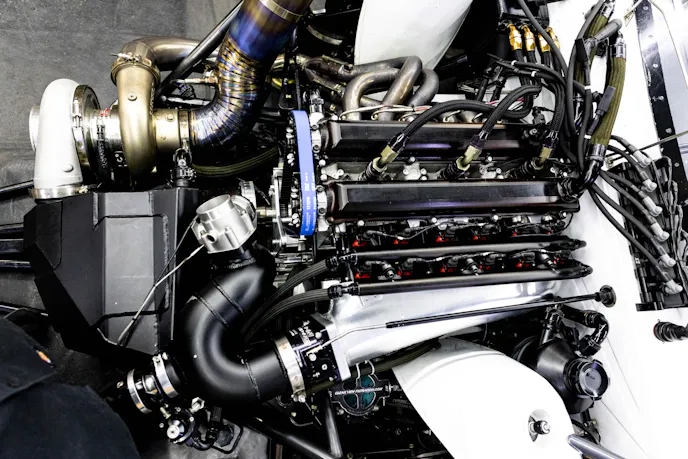
The 2JZ combination that Duy Bui and his team have put together to propel White Rice to these legendary numbers is truly amazing. The engine is based around a Bullet billet black, Marine billet crankshaft, GRP rods, and Ross pistons. The cylinder head is a stock cast Toyota 2JZ head prepared to their specs, and is a joint venture of people that the team uses for different operations. Xtreme Cylinder Heads, Headgames Motorworks, and Slick Rick Racing Heads all have a hand in the head.
The head is outfitted with everything from the GSC Power-Division catalog for a 2JZ. A set of Power House Racing cam sprockets and a belt tensioner system keep things moving. Nitrous components for the engine come from Nitrous Outlet. A Precision Turbo & Engine NextGen 111 crammed all the boost into the mill. Behind everything is an M&M Transmission TH400 transmission, lock up torque converter, and floater rearend from Merillat Racing.
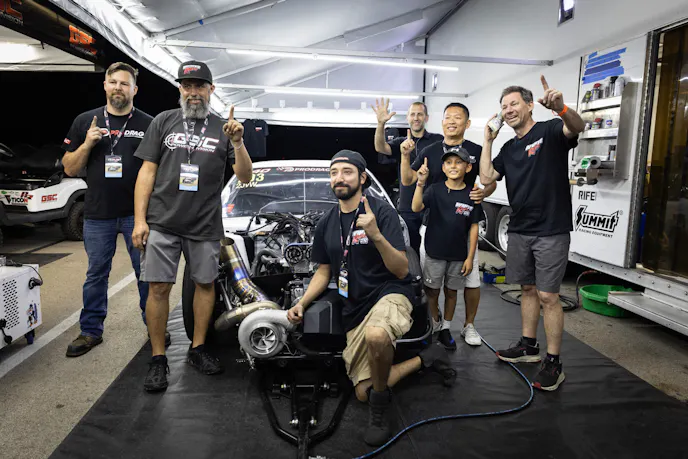
It was Lasala, however, whose story was interwoven with LaFerriere’s all weekend, who had the final laugh. Lasala’s bright “Gotta Have It Green” Mustang, built to run the popular Limited Drag Radial class, had been 5.97 at last fall’s Import vs Domestic World Cup Finals, and 3.80s in 1/8-mile class trim, and so its capabilities were well defined. Lasala was knocking on the door throughout qualifying, and Blach threw out an extra $10,00 bonus if Snot Rocket 3.0 could go sub-6.00 in Saturday evening’s final qualifier, a mark he ultimately came oh-so close to with a 6.004 at 240.91 mph, trailing only “White Rice.”
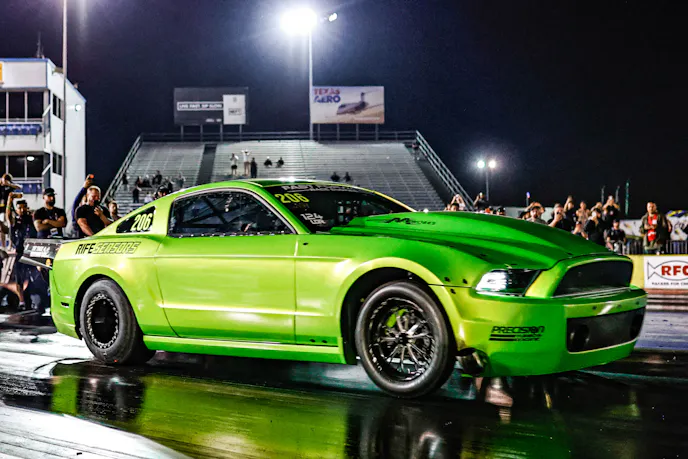
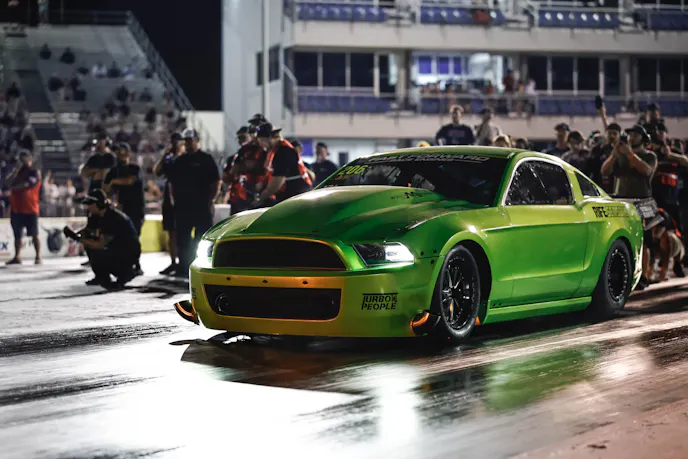
But come eliminations on Sunday, LaFerriere’s machine kicked the tires loose in a huge round one upset by Aldo Mireles. Lasala continued his march, running 6.24 and 6.42 in round one and in the semifinals, respectively, setting up what was to be a final round contest with Mac Brosnan and his Nissan. But with Brosnan broke and unable to make the call, Lasala and tuner Job Spetter went for it, storming to a 5.879 at 242.76 mph, career-best pass, a TX2k record, and the quickest run with a small-block on radials in history. The 5.879 came on the heels of a 1.055 sixty-foot, a 3.881 at 199.08 mph to half track.
Fast Forward Racing Engines (FFRE) built Snot Rocket 3.0’s monster Coyote-based engine. A billet Noonan Race Engineering block serves as the engine’s foundation. A pair of Precision Turbo NextGen turbos feed the small block all the boost it can handle. Moore Race Chassis recently completed an update on the Snot Rocket that has made it even more consistent and able to use every bit of that FFRE horsepower.
In total, Lasala left the Motorplex with $36,000 in class payout and bounty money and a memory that won’t soon be forgotten by the TX2K faithful.
You might also like
How To Add Sesnors To Your Holley Harness With The Power Tap
You don't have to be intimidated by adding a sensor to your Holley EFI harness. The Power Tap allows you to add a sensor with no cutting.