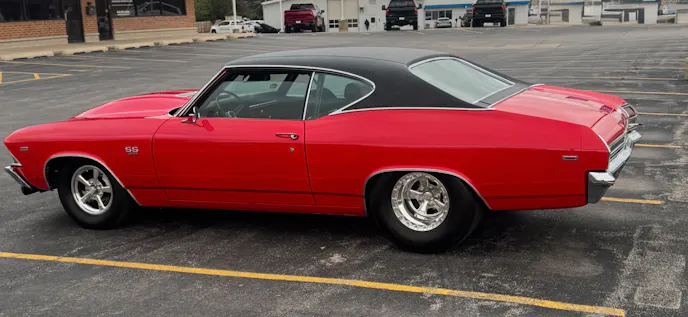
Some folks see celebrities in magazines and daydream about meeting them. Mark Viso, however, developed a crush on his 1969 Chevrolet Chevelle SS when he first saw it gracing the cover of the April 1992 issue of Chevy High Performance magazine and hoped to own it one day. Spoiler alert: his wish came true.
Although the car, which he nicknamed “Rosey,” has been sold and bought back five times since he first acquired it in 1994, its legal title never changed. Through every transaction, every change of hands, and every shift in circumstances, Viso always remained the Chevelle’s rightful owner.
Despite his multiple attempts to relinquish ownership, the Chevelle refused to go away. Viso’s most recent repurchase was in 2021 after the previous buyer had “babysat” the car for five years. As one of the most iconic performance platforms of its era, the Chevelle’s permanence in Viso’s life seems practically predestined.
Now 67 years old and happily retired in his home state of Illinois, Viso grew up during the muscle car era. “Some of the baddest cars were built in 1969, and it was only right to finally own one,” stated the enthusiast, who credits his friends at FastTimes Motorworks with getting him interested in drag racing and inspiring him to run with the now-defunct NMCA. “I’ve owned two ‘67 Camaros, two ‘69 Camaros, two ‘69 Chevelles, and one ‘71 Chevelle, too.”
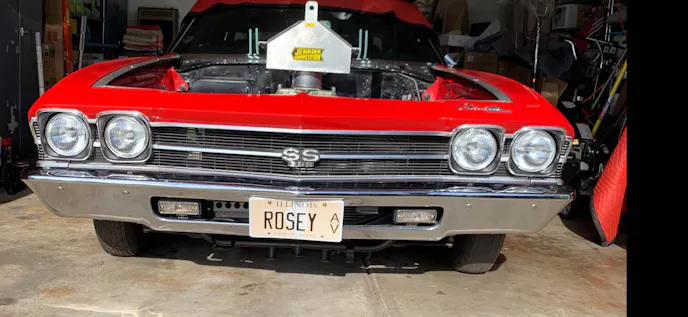
In 1994, Viso found his “cover girl” Chevelle listed for sale in Hemmings Motor News, the world’s largest classic car marketplace since 1954. He spent the next 20-plus years shaping it into the machine he envisioned decades ago: purpose-built and ready for modern drag-and-drive competition.
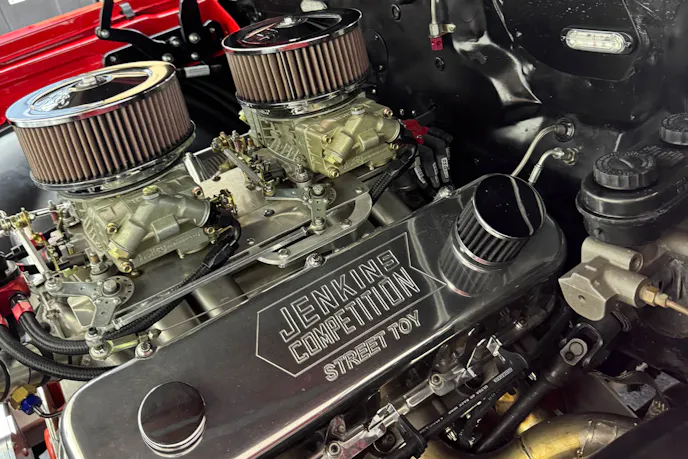
Beneath the VFN Sunoco-style Super Sport fiberglass hood sits a naturally aspirated 572 cubic-inch Chevrolet engine that blends old-school displacement with modern manufacturing. Machined and built by none other than Pro Stock legend Bill “Grumpy” Jenkins at his Jenkins Competition shop in Malvern, Pennsylvania, the 4.625-inch-bore big block was fitted with a 4.250-inch-stroke Liberty Performance crankshaft.
“It runs on pump gas at 10.5:1 compression with Diamond pistons and Manley rods,” noted Viso. “Jenkins also built the aluminum Air Flow Research 357cc big-block Chevy heads and fitted them with 2.25-inch Ferrea stainless intake valves and 1.92-inch exhaust valves.” A custom hydraulic COMP camshaft actuates the valvetrain through Jesel Pro Series 1.75-ratio rockers, and Moroso parts handle oil control via a dedicated pan and pump.

Jenkins also took point on spec’ing the custom low-profile intake manifold, which feeds the 572 through a traditional carbureted induction system with a K&N filter. Holley 950 cfm dual-quads were utilized and modified by Jenkins to flow approximately 1,100 cfm each.
Meanwhile, fuel is delivered through an Aeromotive system regulated to run at 6.5 psi, while the ignition honors are handled by a complete MSD package with Moroso Ultra 40 wires and Autolite AR3932 racing spark plugs. “And if you splash a little race gas in there and take the timing from 36 degrees to 38 degrees, she really wakes up,” shared Viso.
Spent exhaust gases are expelled through custom stainless headers fabricated by Harold Furo of Furo Racecraft, flow through 4.5-inch piping, and exit via custom stainless mufflers.
The all-motor setup means no boost, no nitrous, no nothing except for pure American-made power; on pump gas, it delivers 820 flywheel horsepower and 761 pound-feet of torque. With nothing more than airflow and displacement to get the job done, Rick Geradi of Rolling Meadows, Illinois, is responsible for carefully calibrating it to extract every ounce of performance possible, but the car has yet to hit the track and stretch its legs to see what it could run in the quarter mile with its current combination.
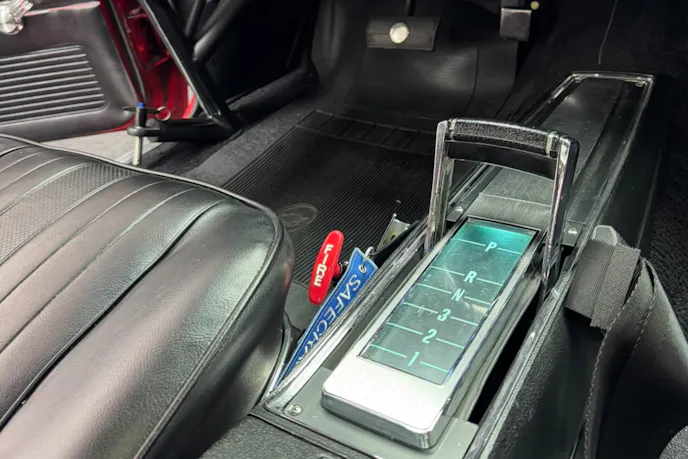
“I’m running a full manual Turbo 400 transmission built by Steven Wardlow of Delavan, Wisconsin, with a 3,800-rpm-stall Coan 8-inch converter and a billet Meziere flexplate,” Viso added. “It’s also got the factory horseshoe-handle shifter and a custom driveshaft with a safety loop from Furo Racecraft.”
The Chevelle’s 9-inch rearend, from the masters at Larry Jeffers Race Cars, uses 4.30 gears with a spool and 40-spline axles; it’s all engineered for driveability and durability, and the chassis components reflect a similar build philosophy.
Up front, TRZ Motorsports control arms work with Strange shocks and custom-spec springs. Out back, adjustable Strange shocks and springs collaborate with a custom anti-roll bar to maintain stability under launch or load.
“Strange brakes are installed front and rear, and I’ve got a set of Mickey Thompson Pro 5.0 wheels with double beadlocks on the rears,” said Viso, who chose an appropriately matching set of Mickey Thompson 315 drag radial tires to wrap the rollers. The stance is aggressive but controlled and bridges vintage attitude with contemporary functionality.
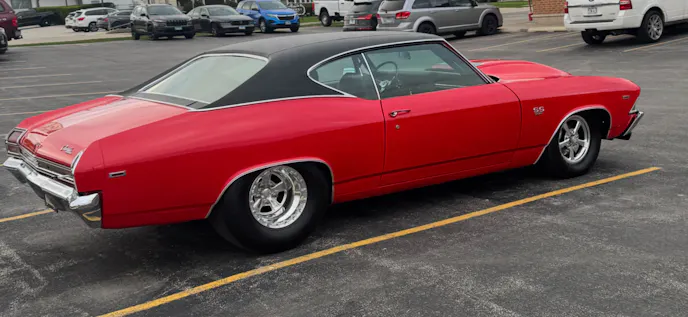
Visually, Viso’s Chevelle flat-out commands attention. Although it was in “perfect” condition when he first found it, the owner repainted the factory red with Porsche Guardsred instead, only making minor touchups over the years. The famous color amplifies the classic ’69 body lines, highlighting the sharp fender creases and muscular quarter panels that defined Chevrolet’s peak performance styling. “I also added a VFN spoiler and front lower ground effects, and BNC Quality Autobody in Schaumburg, Illinois, sprayed the solvent paint over all of it,” Viso noted.
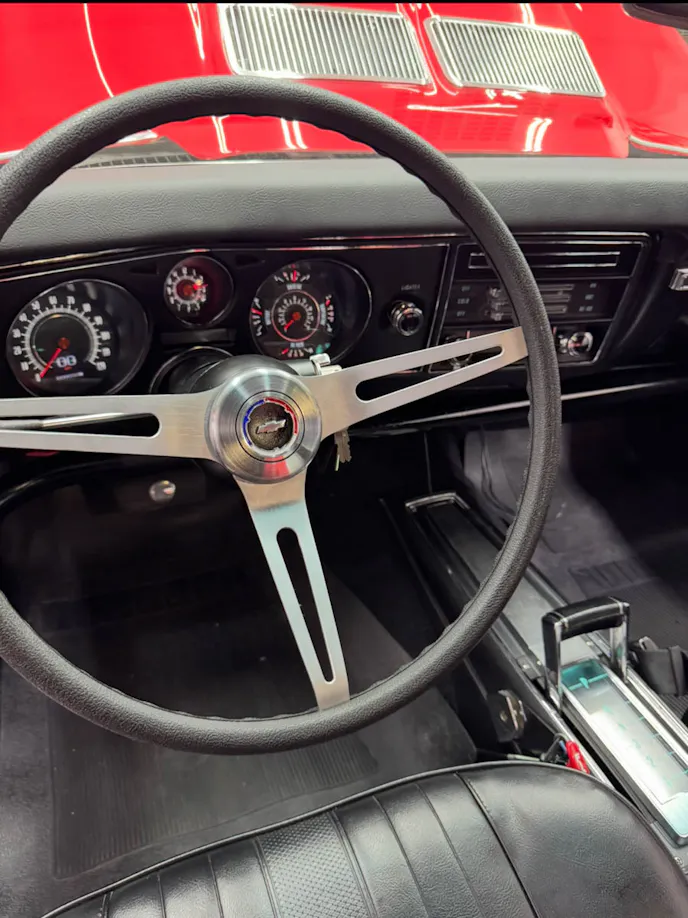
Inside, the factory black interior remains largely intact, including the rear seat. An all-chromoly roll cage integrates safety without stripping the cabin of its original character, and removable and swing-out door bars allow for practical access. A parachute and 10-pound fire suppression system reinforce the car’s track intentions and keep Viso safe, while Dakota Digital instrumentation modernizes data acquisition without disrupting the classic layout.
Despite its picture-perfect setup, “Rosey” has yet to make an official pass with the Jenkins-built bullet. “It’s only got 10 miles on it and hasn’t even run down the track yet,” affirmed Viso, who is absolutely eager to get out there and see what his double-decade build can do. “But, when I ran it the last time in 2009 after I had bought it back again, it went 8.40s with no tune-up in it. That was with a ProCharged aluminum motor at 3,450 pounds, though.”
Now, his goal isn’t simply to trailer in, make a few hits, and head home. Viso intentionally built the beast to dominate both the street and strip, and to prove its capability under real world conditions. Specifically, Viso is aiming for mid- to high-9-second passes, impressive numbers considering the Chevelle is naturally aspirated and currently weighs 3,650 pounds.
What was a streetcar at first eventually became a drag car, and now it’s the best of both; Viso plans to campaign the car in 2026 in drag-and-drive events such as Sick Week and the Hot Rod Power Tour, just as soon as the weather warms up a little and Illinois thaws out from winter.
“My favorite thing about the car is, well, everything,” he laughed. “The color combination is amazing, the paint is phenomenal for being almost 30 years old, and it’s got an awesome stance and wicked sound.” Still building, constantly refining, and always updating, Viso’s project is the “gift that keeps taking”, an ever-evolving testament to his dedication and persistence.
And, it’s a gift that his family can enjoy, too. “This car isn’t a trailer queen! My grandkids can crawl in through the roll cage and get in the back seat,” he affirmed. “I’m especially thankful for my family’s support, and for those who helped me get it back together like Larry Jeffers, Harold Furo, Steven Wardlow, and my wiring wizard, John Stefiuk.”
When Viso does finally get behind the wheel, strap in, stage his 1969 Chevrolet Chevelle SS for the first time, and hold on as the all-motor 572 ci big block powerplant propels him down the track, it won’t just be the first time he captures a timeslip with the car, it’ll be the tangible culmination of a lifelong dream that’s come to fruition. After an incredible journey spanning nearly 30 years, Viso’s “Rosey” is the true meaning of American muscle that always finds its way back home.
CAR: 1969 Chevrolet Chevelle SS
CHASSIS: Chromoly roll cage
ENGINE: Jenkins Competition 572 ci big block Chevy
HEADS: Air Flow Research 357cc
CRANK: Liberty Performance
RODS: Manley
PISTONS: Diamond
CAM: COMP
VALVETRAIN: Ferrea valves, Jesel rockers
POWER ADDER: none
CARBURETOR: Holley 950 cfm dual-quads
FUEL SYSTEM: Aeromotive
TRANSMISSION: Turbo 400 built by Steven Wardlow
CONVERTER: Coan 8-inch
DRIVESHAFT: Custom
REAR END: Larry Jeffers Race Cars 9-inch with 4.30:1 gears
SUSPENSION: TRZ Motorsports control arms and Strange Engineering shocks
BRAKES: Strange Engineering
WHEELS: Mickey Thompson Pro 5.0
TIRES: Mickey Thompson 315 drag radials
HORSEPOWER: 820 hp
TORQUE: 761 lb-ft
You might also like
Ryan Rudrick Continues Family's Racing Tradition Behind The Wheel Of His 1970 Plymouth Duster
Ryan Rudrick has grown up around racing. Rudrick now pilots his family's 1970 Duster in NHRA's Stock class at events across the country.