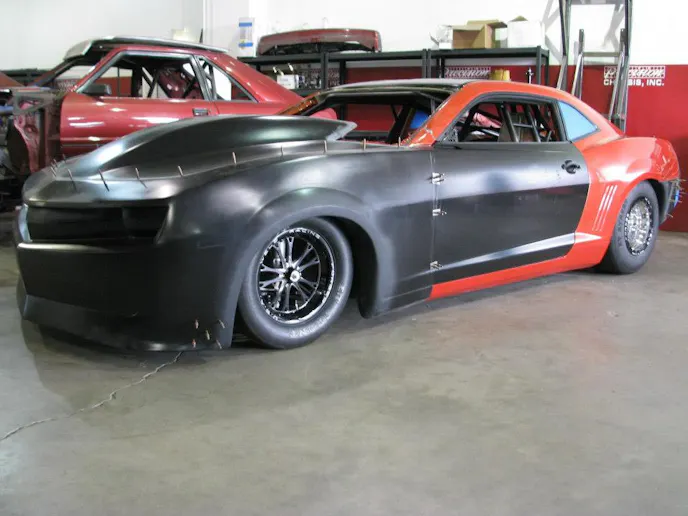
It seems like every week we hear about another two or three or five cars being built for the X275 class. The limited power-adder use and the short eighth-mile track gives every combination a fighting chance to win, and racers are taking advantage of relative rules stability to build new cars. Pennsylvania racer Steve Beaston is one of those – he’s working with Doug Kline and the team at Precision Chassis in Temple, PA, to build this gorgeous 2010 Camaro into an X275 monster for the 2013 season. The car was dropped off to Kline as a flood recovery; it was totaled by the insurance company with some slight roof and rocker-panel damage, but was structurally-sound and the perfect base for a racecar.
I build everything stiff and adjust with the shocks. I have worked with cars that flexed and they were a nightmare. – Doug Kline
The double-framerail Camaro has all of the latest tricks and tips Kline could muster up; one of the critical things he focused on during the chassis construction was stiffness. He explained, “I build everything stiff and adjust with the shocks. I have worked with cars that flexed and they were a nightmare. Although they made great hits sometimes, they would tend to wheel stand out of the blue.”
Every part of Beaston’s Camaro that could be strengthened was, especially the back end, to provide a strong foundation for the the COPO-style suspension that has been approved for use in X275. It features a four-link style setup like a Mustang, but the upper arms are straight instead of angled inwards. This requires the use of a wishbone to locate the rear-end laterally, but will provide excellent hook at the track. According to Kline, “I worked very closely with Mike Pustelny at MPR Race Cars to get all the pick-up points correct. He did all the R&D and designed the prototype COPO.”
You might also like
Inside The Technology Of A Modern NHRA Cobra Jet Mustang
The modern Cobra Jet Mustang is a drag racing beast. On this episode of Tech Inspection we dive into what makes these cars fast.