
You want to use the right tool for any project, and that mindset also needs to be applied to piston selection for a high-performance engine. Just because a piston possesses the correct physical dimensions to fit in an engine doesn’t mean it’s the best choice. In this article, we’re going to cover why boosted engines use a specific piston design.
Project Hustler is getting a very stout Gen III HEMI from Blackbird Performance stuffed in between its front fenders. We’ve already covered the foundation of the engine, which includes a Callies Helliphant block, Magnum crank, and Ultra connecting rods. To finish off the boosted short block, we’re adding a set of boost-ready Wiseco pistons.
Boosted Versus Naturally Aspirated Pistons
Boosted pistons and naturally aspirated (N/A) pistons both share a circular shape, and that’s where the similarities end. These pistons live in very different environments, so each requires its own unique features.
The biggest difference between the two pistons is the forces they’re exposed to inside the engine. A boosted piston is hit with more cylinder pressure than the N/A piston, which requires a more robust design. The N/A piston is going to be running at high RPM levels but will see less cylinder pressure; therefore, it needs to be lighter.
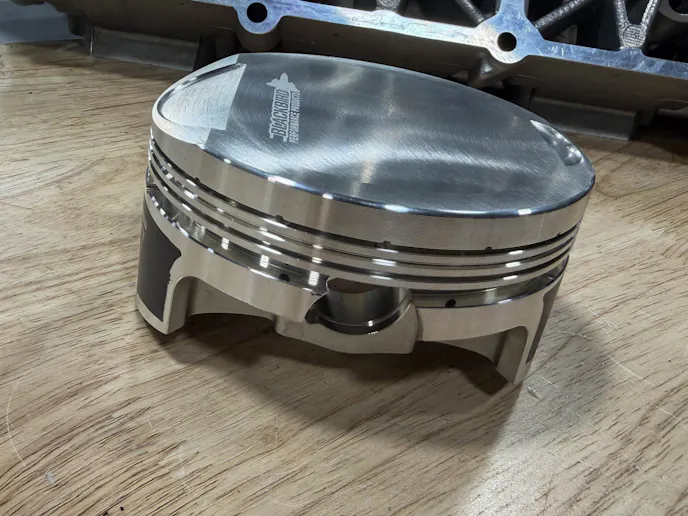
Think of it this way: a boosted piston needs to be built like a tank, because it’s going to be taking on a lot more direct pressure. The N/A piston needs to be built for speed and agility like a fighter jet, since it will be zooming up and down the cylinder more often, but with less resistance.
Most boosted and N/A pistons will have different crown designs. N/A pistons implement a flat-top or dome crown, depending on the engine package, to provide the best burn possible. A boosted engine will use a dished crown to maximize burn efficiency in the chamber and lower the compression to a boost-friendly level. We’ll take a deeper dive into boosted crown design later in the article.
Compression ratio is another defining factor between boosted and NA pistons. If you’re building an NA engine, compression ratio is your friend, since you’re trying to generate as much horsepower as possible and don’t have boosted air to aid in that quest. This is why you’ll see NA engines with compression ratios in the 12:1 to 13:1 range, depending on the application.
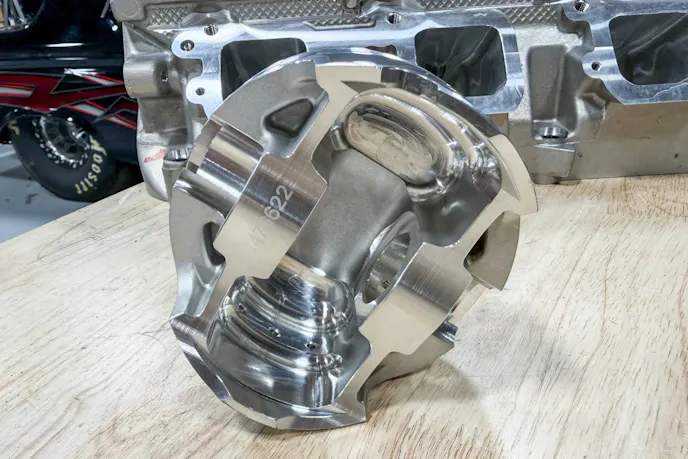
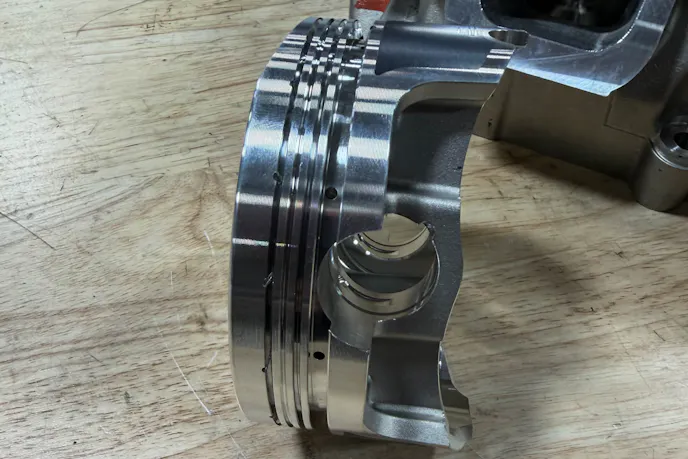
On the other side of the coin, a boosted engine typically wants a lower static compression ratio. This lower compression ratio is needed due to the additional cylinder pressure the engine sees when boost is introduced.
Wiseco’s Vic Ellinger adds more detail on why lower compression ratios are used in boosted applications:
“You’re going to get a wider tuning window with a lower compression ratio. We’re adding major amounts of cylinder pressure to the engine, and compression can cause detonation, especially when octane is a limiting factor. You want to control that as much as possible.”
Crown Design And Material Selection Is Critical
You can easily get lost in the weeds when it comes to piston design characteristics. For this particular article, we’re going to focus on why crown design and the material the piston is made of are important.
There are countless variables that will play into the crown design of a piston. The design of the cylinder head is going to have a big impact on the type of crown a piston will need in a boosted application.
“A cylinder head with good flow that’s being used on a boosted engine could have small chambers, sort of what you might see on a high-end N/A cylinder head. It will need a piston with a crown that ‘softens’ things up with a ‘lazy’ dish design. Big stroke applications require a donut dish that has a hump in the center to allow for proper crown thickness and rod clearance,” Ellinger says.
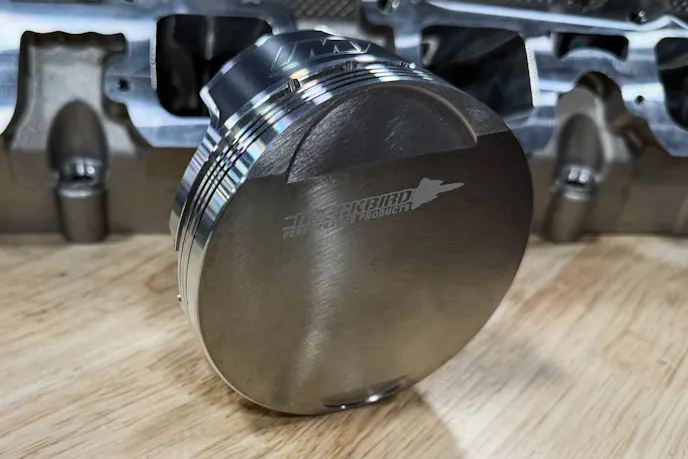
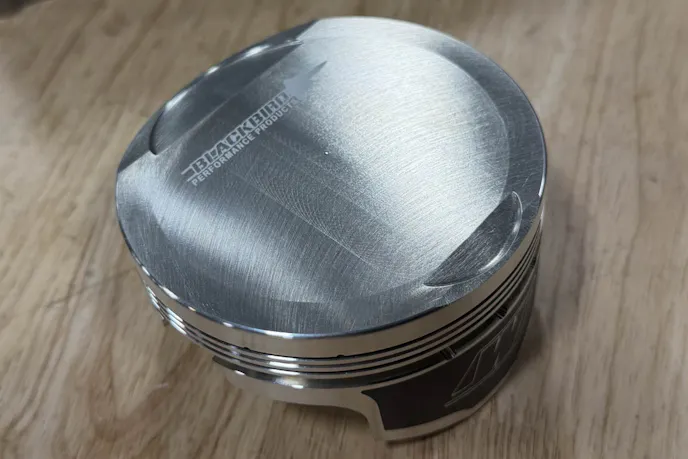
According to Ellinger, there are two types of crown designs that work well for turbocharged applications in particular. For an engine that’s going to see moderate boost, a reverse dome is going to provide the best burn and efficiency. When an engine is going to see a lot of boost, a spherical dish is implemented to help deal with the additional cylinder pressure.
“Typically, with a boosted piston, we are wanting a chamber and piston combo that encourages a less turbulent air fuel mix. A ‘lazy’ burn if you will. We typically use a spherical dish versus the reverse dome design that promotes quench,” Ellinger states.
More horsepower means cylinder pressures inside the engine are going to increase, and that’s why the material a piston is made from is so important. The two most popular materials used in high-performance pistons are 4032 forged aluminum and 2618 alloy.
Typically, a 4032 forged aluminum piston is going to be used as an upgrade in a stock engine or for a stout street car engine. The 12-percent silicon content provides valuable durability for these applications. The problem is, the material is less ductile than 2618 alloy, which means it doesn’t have the same crack-resistance characteristics.
The lower silicon content and greater malleability of 2618 alloy are why it has become the material of choice for high-performance pistons, especially in boosted applications. The malleability of 2618 alloy allows it to deal with the increased loads and stress of a boosted engine. A 2618 alloy piston is going to experience significantly more thermal expansion than a 4032 piston, so piston-to-wall clearances will need to be addressed accordingly to account for this growth.
“You’ll find that 2618 alloys are used in the majority of the high-performance builds to prevent failure. Basically, 4032 has higher silica content and will tend to shatter before it cracks unlike 2618. If the engine is going to be making over 750 horsepower, we are going to recommend the use of 2618 alloy pistons,” Ellinger says.
Beneficial Turbo Piston Features To Keep In Mind
According to Ellinger, if you’re trying to optimize your turbo combination for as much horsepower as possible, there are a few piston features you should keep in mind. These aren’t going to work for every application, but if you’re picking out your own pistons, you might want to consider them.
Gas ports will assist with keeping the top ring sealed to the cylinder walls and prevent combustion gases from ending up in the crankcase. A set of tool-steel wrist pins is a good investment, since they provide additional strength and handle the elevated cylinder pressures created by a boosted engine. Ceramic crown and skirt coatings are a great addition, since they fight heat and friction.

“Don’t be afraid to run the piston down [in the hole] and add some dome or use a flat top, if the pin height allows it. This can be very beneficial to a stronger piston that is more forgiving if the tune is missed. A trick we use is to do a convex dome or flat top to increase the thickness over the rod to help from caving the piston in if the engine goes lean. It takes longer to heat soak and collapse the center of the part,” Ellinger says.
Pairing the right piston with your boosted engine is critical to extracting as much horsepower as possible. Boosted pistons have their own unique features that make them perfect for taking on the additional cylinder pressure and abuse a forced-induction engine creates. Make sure you follow Project Hustler right here and see what our boosted Gen-III HEMI makes when we put it on the dyno.
You might also like
Angelle Sampey Earns NHRA Top Fuel License With 3.688 Pass for AB Motorsports
Angelle Sampey is ready for her NHRA Top Fuel debut. The three-time NHRA world champion finished her licensing in Las Vegas.