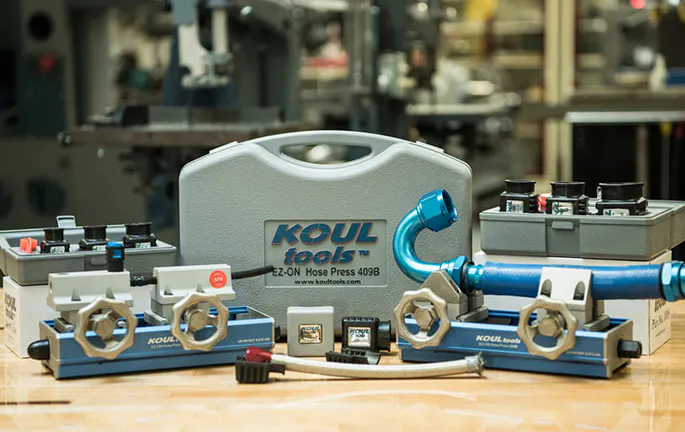
Throughout the course of building a race car, there will come a time when you’ll need to build a hose. There’s the easy way and the hard way. The hard way is a struggle that ends in foul language, cut-up hands, and leaky fittings. In this article, we’ll let the man who invented an easier way show us how it’s done. Along the way, soak in the wisdom he shares from decades of success in automotive and motorcycle aftermarket entrepreneurship.
First, let’s get familiar with some basic hose designs and fittings you’ll encounter. In just about all situations, the objective is to create long-lasting plumbing with properly sealed connections.
There are many types of hoses. The most important safety measure you can take is to ensure that what you’re using is designed for what you’re passing through it. In short, brake hose is designed to perform with brake fluid under high pressure. Hoses that transfer oil are designed for thermal tolerance. Fuel hose requires chemical compatibility.
Common Fittings And Why Motorsports Adopted Them
Modern purpose-built cars in motorsports, especially drag racing, use application-specific hoses with AN fittings. The braided stainless wrap adds a layer of strength, protection, expansion control, and safety to withstand higher temperatures and vibration. Plus, they look professional and trace their origins to World War II military aircraft. You’ll also find hoses that are made from woven material to save weight.
AN stands for Army-Navy specification. The standard dictates a conical 37-degree flare fitting that seals metal-to-metal with a matching cone and includes straight UNJF threads.
AN fittings come in various sizes identified by a “-XX” number that corresponds to the nominal hose outside diameter (OD) in 1/16-inch increments. For example:
- AN-4 fits 1/4-inch OD hose (4/16 = 1/4)
- AN-8 fits 1/2-inch OD hose (8/16 = 1/2)
- AN-12 fits 3/4-inch hose (12/16 = 3/4)
AN fittings maintain tighter UNJF thread tolerances and are often made from high-grade aluminum or stainless steel for durability in motorsports applications.
That’s important to note because you may also encounter Joint Industry Council (JIC) specification fittings. The JIC standard also uses a 37-degree fitting and may seem interchangeable with AN. However, JIC uses looser-tolerance UNF threads acceptable in industrial settings, but not the precision environments of aerospace or military applications. That’s why motorsports adopted the AN standard.
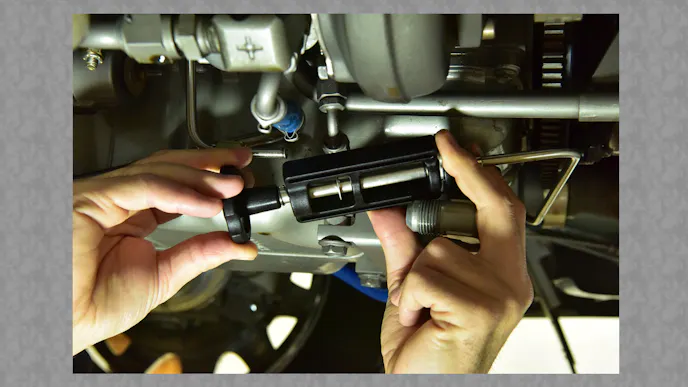
In contrast to AN fittings found in motorsports, many OEM automotive applications use Society of Automotive Engineers (SAE) J512/J513 standard 45-degree flared tube fittings in hard-line applications, such as brake systems. They may also be found on mass-produced fuel and transmission lines. These also create metal-to-metal sealed connections. You may encounter these in grassroots race car builds, street performance projects, restorations, or routine maintenance applications.
Lastly, barb fittings are often found in low-pressure applications like vacuum lines. These fittings are often made from brass, stainless steel, nylon, or polypropylene plastic. They contain one or a series of angled ridges (barbs) that the hose slides over. The hose expands and contracts over the barb when installed, preventing it from easily sliding back off.
How (Richard) Dick Raczuk Invented A Game Changer
Now that we’ve covered appropriate hoses and fittings, let’s look at best practices and tools that make building a hose quick, painless, and high-quality.
Enter Dick Raczuk in his shop in the late 1990s. Having worked as a tool product engineer for Honda and later successfully retired from Kerker, the motorcycle performance exhaust company he founded and operated until 1985. Raczuk spent his time restoring a rare 1941 Graham Hollywood during his retirement. This is where he discovered the need for a way to assemble hoses and fittings.
“I was plumbing with an AN hose, and I’m cutting my fingers all up trying to put that into this,” he said, holding up a frayed stainless braided hose during our interview. “You have a hell of a time. Everybody puts this in race cars because it’s brutal hose. It’s hard. It doesn’t wear through. They’ve been fighting installing the fittings into the hose, and I was running into the same thing. So I just made a funnel, and it went right in.”
With a gleam in his eye, Raczuk added that the car later appeared on the cover of Hot Rod magazine.
“I had a lot of visitors while I was building this car, and they always said what a cool tool. I said, you know, there’s a name.”
Solutions To Make Your Next Hose Build Easier
Since then, Raczuk has introduced several additional Koul Tools kits and refined best practices to make shop life and hose building much easier. Here are his top answers to common questions to help you avoid building hoses the hard way.
How Do I Prevent Stainless Steel Braid Flare?
When cutting stainless steel braided hose, wrap tape around the area you plan to cut and secure it in a vise. Make sure your cut mark lies on the tape. The tape prevents the braid from flaring. Then use a fine-tooth metal blade or cut-off wheel to slowly saw through the hose.
After Cutting The Hose, How Do I Properly Clean It?
After the cut, spray compressed air from the opposite end of the hose to blow away any fine dust particles. Do not blow debris into the hose. Proper cleaning solvents compatible with the type of hose you’re using may also be used.
How Do I Get A Stainless Steel Braided Hose To Fit Properly In An AN Fitting?
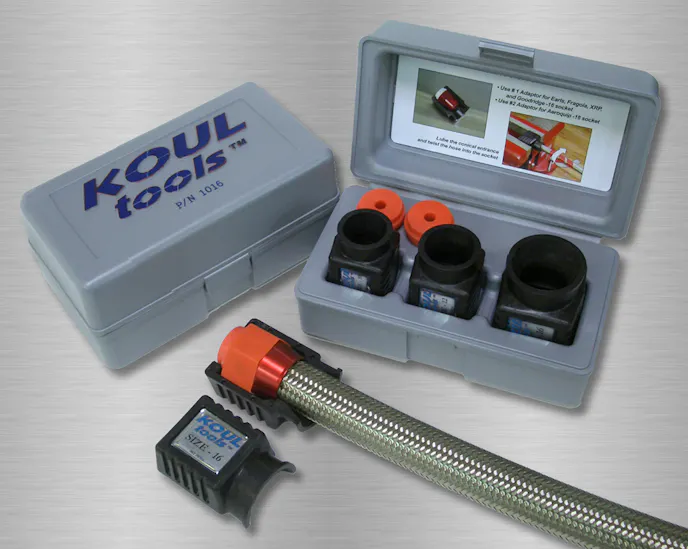
The patented Koul Tools AN Hose Assembly Tool funnels the hose properly into the fitting, quickly and without cutting up your hands.
Place the AN fitting in the fixture and clamp it in a vise. Guide the hose into the fixture and push until it stops. The design funnels the hose squarely into the fitting for a perfect fit every time.
“The whole function is a funnel,” Raczuk explains. “You just cannot beat a funnel.”
When introduced, the invention earned Raczuk a runner-up New Product Award at the SEMA Show in 2005.
The AN Hose Assembly Tool is available in various kit options by size and application, including Pro Combo and Hot Rod kits, and can also be purchased individually. One note: the AN Hose Assembly Tool does not work with PTFE hose.
When threading connector ends together, Raczuk recommends cleaning the components thoroughly and applying a drop of oil to the threads for smoother installation.
How Do I Fix A Worn Or Pitted Male AN Fitting?
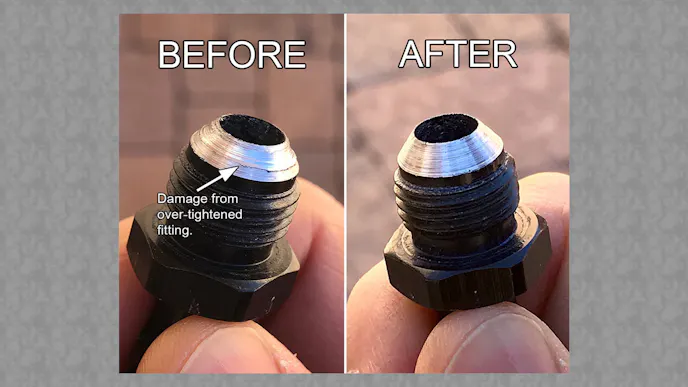
Koul Tools developed the AN Fitting Fixer for this purpose. It uses a diamond-dusted inverted cone lapping head to repair the sealing surface on 37-degree steel and aluminum fittings. It’s available in two kit sizes:
Large: 5/8-inch to 1-inch OD hose
Small: 3/16-inch to 1/2-inch OD hose
How Can I Install A Push-On Barb Fitting Easily?
When pressing a hose onto a barb fitting, you risk damaging the fitting depending on its material. One slip is all it takes.
Koul Tools offers the EZ-ON Hose Press to eliminate that risk. The patented benchtop press holds the barb fitting in a vise while the hose is clamped into a sliding press mechanism. The vise accommodates both straight and angled fittings.
What Can I Do To Make Building Hoses Easier At The Track?
All Koul Tools come with carrying cases for trailer transport.
If you must install a hose by hand, slightly heat the end of the hose by dipping it in hot water or giving it a quick pass with a heat gun. This softens the rubber enough to make it more pliable. Wear mechanic gloves, push firmly, and ensure the hose seats fully against the fitting.
How Can I Repair A Flare Fitting?
Over time, the seat on a metal flare fitting can wear and cause leaks. Rather than replacing the entire line, Koul Tools developed the Surseat Flare Lapping Tool. It removes imperfections in the seat and restores the proper angle. Kits are available with collets and 37-degree and/or 45-degree diamond-dusted lapping heads.
How Do I Care For My Koul Tools?
The build quality of any tool determines how long it will serve you.
“They’re lifetime tools,” Raczuk says. “They’re built well, and the comment we get is ‘thank you.’ That makes the whole deal worthwhile. We never got one back.” Clean and store them as you would any high-value tool. The same principle applies to the hose and metal line connections you’re making. “Make a nice, clean assembly. It’ll last a long time,” Raczuk concludes.
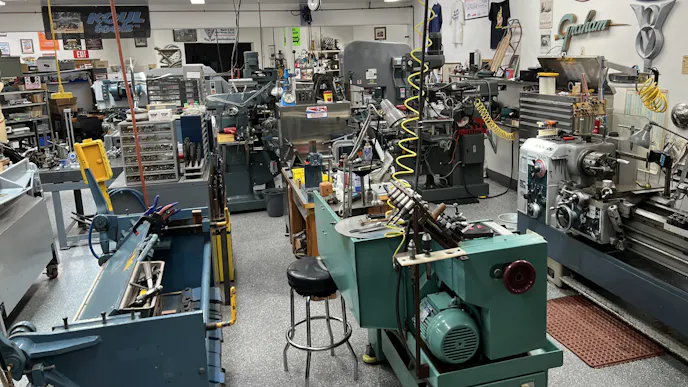
There’s much to admire in simple ingenuity, especially the ability to create a product that makes shop life easier for builders everywhere.
At 87 years young, Raczuk jokes that he’s just now slowing down. The wisdom he shares is straightforward:
“You don’t need a college degree as much as you need common sense. If you can look at something and come up with a solution, that’s what this country needs more of.”
With Koul Tools available directly and through major parts distributors and retailers, Raczuk continues to emphasize a lesson passed down from his father: “The goal has always been quality control and do a good job.” With the proper tools and attention to clean assembly practices, you too can build a hose with precision and confidence.
You might also like
Lasala, LaFerriere Stun With 5-Second Runs At TX2K26
Brett Lasala and Eric Laferriere traded record-setting runs at TX2K26, with Lasala’s 5.87 win highlighting the 2JZ vs The World showdown.