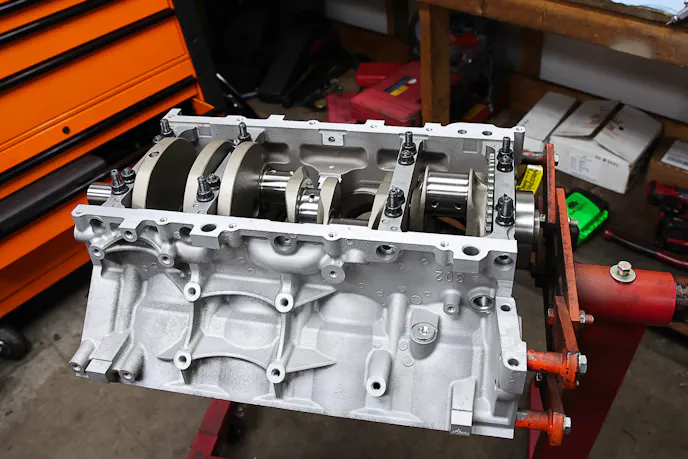
There’s an old saying along the lines of “the devil is in the details.” Something may seem simple, but in fact, the details are complicated and cannot be overlooked. Such is often the case with fasteners, as there are literally a dozen attributes, both physical and metallurgical, that can affect their effectiveness and durability.
For input on the matter, we turned to the folks at Automotive Racing Products (ARP), specifically Rick Feaster, who heads the company’s drag racing program. He works with a wide range of racers, from pro category crew chiefs who prepare and maintain supercharged, nitro-guzzling engines to sportsman racers who deal with a plethora of OEM and aftermarket engine block and cylinder head combinations.
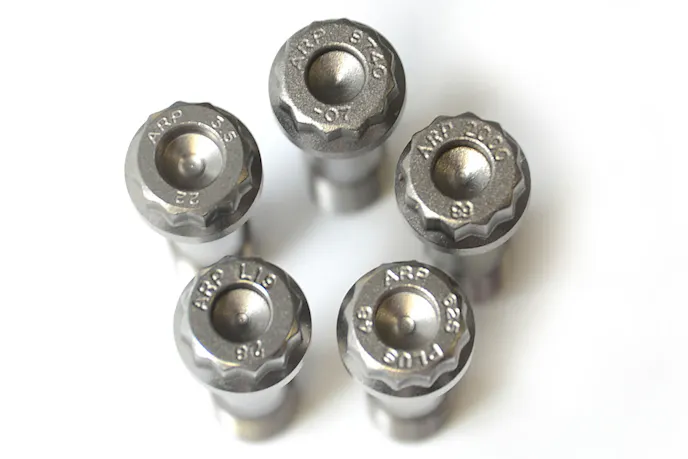
The dynamics of a fastener are fairly straightforward. It must be stretched a specific amount for its inherent elasticity to provide the desired clamping force, like stretching a spring. By way of example, a 3/8-inch-diameter rod bolt made of 8740 chrome moly must be stretched from 0.0055 inch to 0.0060 inch to obtain 10,000 pounds of clamping force. Additional clamping force can be obtained by employing a better alloy or increasing the diameter of the bolt. ARP offers the three most crucial engine fasteners, head studs or bolts, main studs or bolts, and connecting rod bolts, in five alloys that range from 190,000 psi tensile strength to 280,000 psi.
According to Feaster, ARP’s 8740 chrome moly fasteners are more than sufficient for many normally aspirated engines. When cylinder pressures increase, so does the need for a stronger alloy. Feaster says, “For higher-compression unblown engines and many supercharged or turbocharged applications, our proprietary ARP2000® material, which is rated at 220,000 psi tensile strength, works great. Above that, Custom Age 625+ is recommended.”
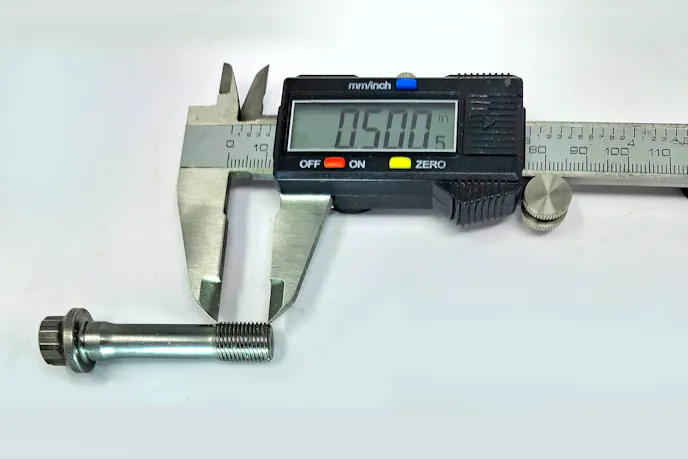
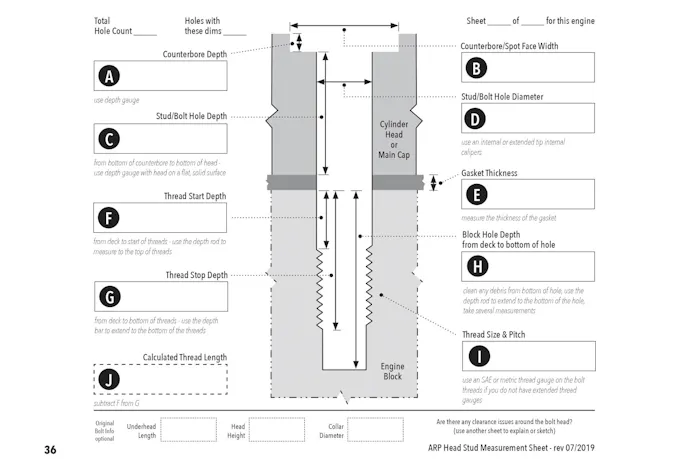
Once the proper alloy has been determined, the critical issue becomes the design of the fastener itself. There are no fewer than ten factors involved:
• Counterbore depth
• Counterbore/spot-face width
• Stud/bolt hole depth
• Stud/bolt hole diameter
• Thread start depth
• Gasket thickness
• Thread stop depth
• Overall thread length
• Thread size and pitch
Optimizing these factors ensures the stud is properly anchored in the block and that clamping force can be precisely applied to seal the combustion chamber or secure the crankshaft. Bear in mind that ARP’s engineering team has, over the years, developed more than 100 head stud kits for small-block, big-block, and LS Chevy applications alone, given the huge number of OEM and aftermarket engine block and cylinder head combinations available today. There is no compromising, and there are no “universal” kits.
Threads, of course, play a major role in a fastener’s effectiveness, but there’s more to it than simply having the correct diameter and pitch. The SAE International has developed standards for threads, with AS8879D being the most stringent in terms of tolerances. You can actually feel the improved snugness (engagement) compared to fasteners made to lesser standards.
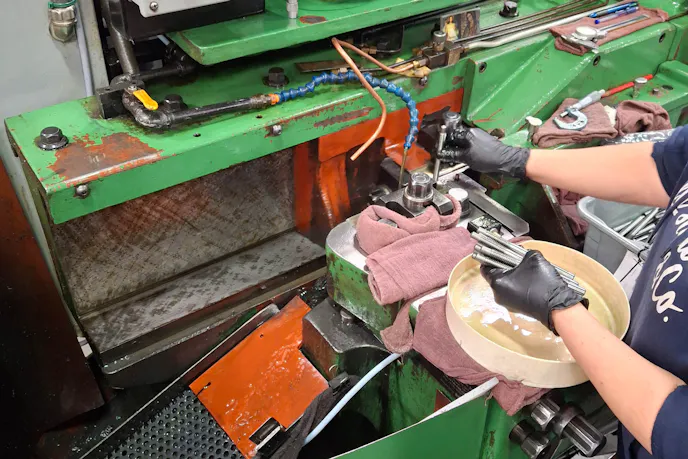
ARP rolls the threads instead of cutting them on screw machines. This process is far superior because the material is formed, providing compressive strength, as opposed to cutting, which affects the grain structure. In a sense, rolled threads are “work hardened.” Additionally, ARP rolls the threads after heat-treating, when the material is harder. This improves fatigue strength significantly, up to 20 times better.
ARP places a major focus on thread quality, having invested in digital scanning equipment that is accurate to 0.0001 mm (that’s 0.000003937 inch). It doesn’t get any better than that.
Feaster does note that with fuel teams typically pulling the heads off an engine and re-torquing them a half-dozen or more times per weekend, multiplied by many races, the major diameter of the threads can “curl” a bit over time and affect engagement, slowing service down. Since time is of the essence and every second counts, teams will cycle out the studs when necessary.
Connecting rod bolts are the most crucial fastener in an engine, as a failure can lead to catastrophic damage. The recommended method of keeping tabs on a rod bolt’s integrity is to measure its “relaxed” length prior to assembly and make note of it. Preload is applied by stretching the bolt, and if it’s stretched too much, the bolt can be yielded. Increasing clamping force can be accomplished by increasing the size of the fastener or using a stronger material. ARP manufactures rod bolts from five different alloys.
When the engine is disassembled for servicing, the rod bolts should be measured again. If any bolt has stretched by 0.001 inch or more, it should be replaced. There’s a handy chart in the ARP catalog that can be employed to keep track of things.
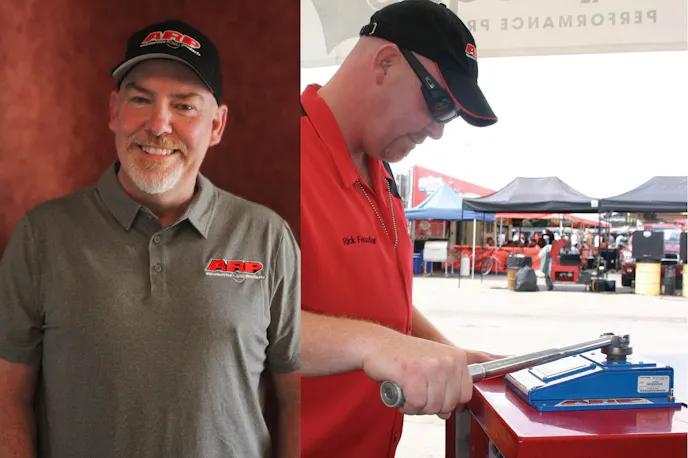
Properly preloading a fastener is essential. To that end, ARP has offered free torque wrench testing at NHRA National events for many years. Feaster commented, “You’d be surprised at the number of racers who are using inaccurate torque wrenches. I’ve seen them off by 30–40 percent, which can have grave consequences. I highly recommend having your torque wrench calibrated.”
This article merely scratches the surface when it comes to fastener technology. There are about three dozen pages of valuable technical information in ARP’s catalog, which can be accessed online at www.ARPcatalog.com.
You might also like
Austin Prock Fails To Qualify In Debut With Tasca Racing
Austin Prock failed to qualify in his debut with Bob Tasca's team at the NHRA Gatornationals after a shocking offseason move.