It doesn’t matter how much horsepower you make, if you can’t apply it to the surface of the track, it’s useless. Power management is the solution to this problem. There are many different ways to approach power management, and in this article, we’re going to look at how high-horsepower vehicles manage it through modern technology.
The power management strategy you implement is tied directly to the tools you have at your disposal. Thanks to advancements in modern ignition systems, even carbureted combinations have access to basic power management. The most advanced forms of power management are available through EFI systems and the ECUs that control them. Tuners have an arsenal of options at their disposal, and those tools have helped contribute to the astounding numbers we see at the track.
The Basics Of Power Management
There really isn’t anything tricky when it comes to the overall concept of power management, the name describes exactly what it is. It’s almost scary how simple it has become to make big horsepower, which is why power management strategies have become so important. You can overpower a vehicle’s chassis and the track easily during any part of a run, so being able to control how and when the horsepower comes in or out is critical.
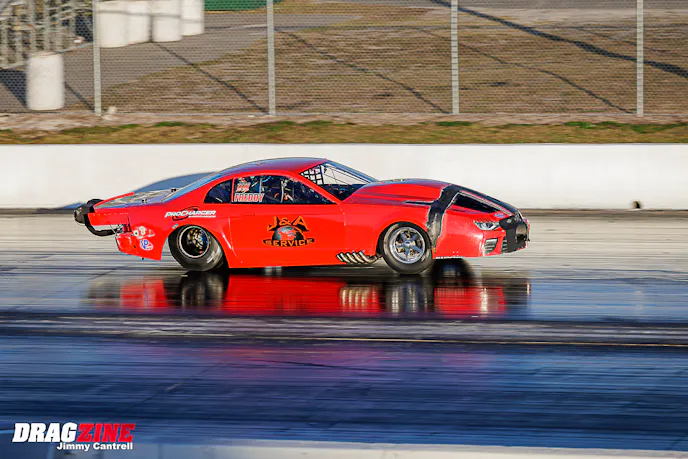
To help us understand power management and how it works, we reached out to Howard Tanner, FuelTech’s Training Educator. Tanner has decades of experience with high-horsepower vehicles and power management concepts.
“Power management isn’t about making less power for the sake of it. It’s about delivering exactly the right amount of power at the right moment to keep all four dynamics (chassis, suspension, tire, and track) working in harmony. Done correctly, it’s what separates a consistent, quick race car from one that pedals, spins, or crashes.”
Now that we’ve addressed what power management is, let’s dive into how you can use it.
How You Manipulate Horsepower For Management Purposes
If you want to properly implement a power management strategy, you need to understand how horsepower is made. We all know that engines are basically big air pumps, so the more air you can move through them, the more horsepower they can make. You mix that air with fuel, add ignition spark, and that kicks off the combustion process that makes horsepower.
What that translates to is that power management strategies need to be based around controlling either fuel, air, spark, or a combination of all three.
“If you’ve watched a tuning session on a dyno, you typically see more power at the end of the session than at the beginning. That’s because during calibration the tuner is creeping up on adding more airflow (boost) and optimizing spark advance (ignition timing),” Tanner explains.
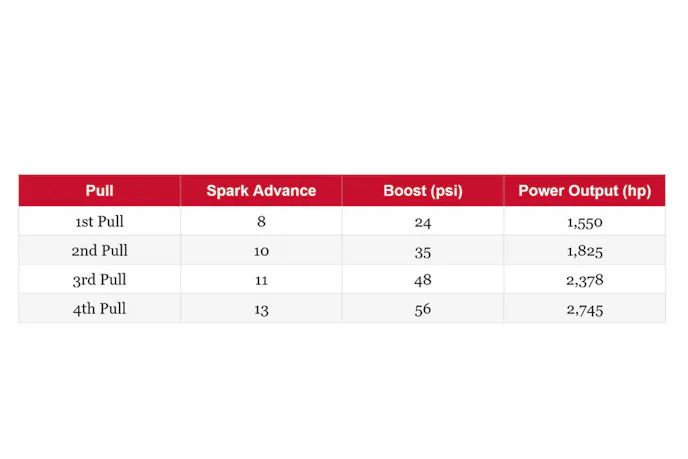
The progression of this dyno session is a great visual representation that not only shows how horsepower is made, but also how you could approach power management.
“From this example you can see that we were able to make the same engine increase power by 1,195 hp. The same way we made this power, we can take it back to the first pull and lower it if we want. Power Management is about finding that thin edge of putting down as much power as you can without exceeding the chassis and tire adhesion,” Tanner states.
Working off this example, let’s dig a little deeper into how you would apply a power management strategy. You can see that horsepower can be added or removed through boost and timing, but which is better to use at the track?
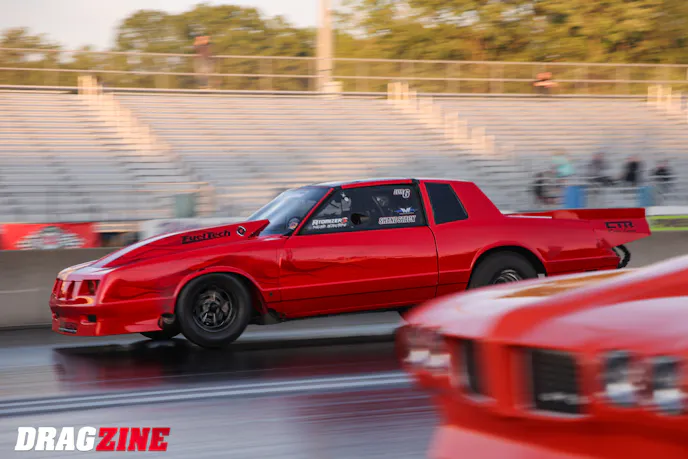
According to Tanner, spark timing is going to be the best way to create an effective power management strategy.
“In a turbo application, if we reduce the speed of the turbo, we remove inertia. Then, when we ask for the power to come back, we have significant delays in re-accelerating the turbo to start moving the airflow again. This is a slow-acting control. A faster method of reducing power is to remove spark timing; this is timing retard.”
Retarding spark timing is an effective way to pull horsepower for your power management strategy. When you retard the spark timing, you’re able to pull power out and bring it back in nearly instantaneously. This gives control over how the chassis and tire behave.
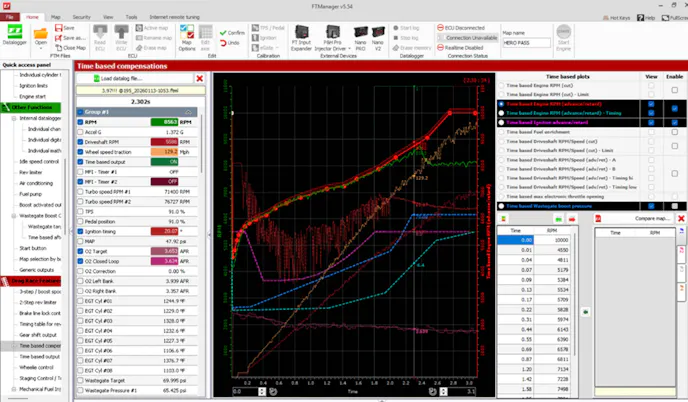
“No big-power car can leave at full power, it’s just physically impossible. What we need to figure out is a curve of power re-introduction that allows the engine to accelerate at its maximum rate while not exceeding the traction capability of the vehicle. By creating an RPM-progressive range and an Engine Plot curve, you allow the controller to provide as much advance as it can take, until it can’t,” Tanner states.
Now, power management isn’t a band-aid for a combination that isn’t ideal or for underlying mechanical issues. The vehicle’s chassis setup has to be correct, and the parts need to work together properly. A great power management strategy won’t be able to overcome a bad mechanical foundation.
Get The Data To Build The Strategy
The only way you’ll be able to create a power management strategy is by making passes at the track. Racers who have successful programs know this, which is why they’re always testing. You need to make clean passes to start with so you have good baseline data. That data can then be analyzed to see where the threshold is and how your power management strategy will work.
“You really don’t want to go out and pour all the beans to the car right away, because you truly don’t know where the threshold is yet. If you can make a clean pass, regardless of your elapsed time, you now have a baseline. It’s now time to analyze the data,” Tanner says.
Power Management vs. Traction Control
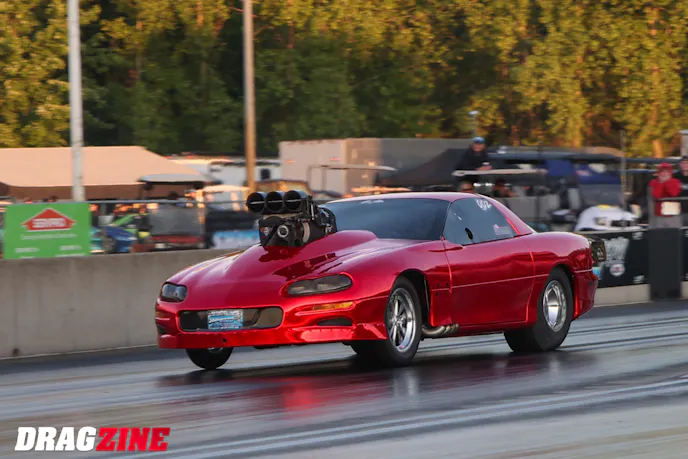
It can be easy to confuse power management and traction control. They might sound like the same thing on the surface, but when you really look at what each does, they are very different. Traction control is reactive to what the vehicle is doing. When it sees a spike in driveshaft speed or the tires spinning, it kicks in. Power management is what the tuner has direct control over, and it is proactive in trying to avoid tire spin.
“Drag racing Power Management is a time-based or speed-based system used to control engine power via ignition timing, fuel cuts, or boost management to maximize traction and acceleration on rear-wheel-drive vehicles. It is a proactive, precise system that controls power throughout the entire run. Traditional traction control detects wheel slip after it has already occurred and then reacts. By the time it reacts, you’ve already lost ground,” Tanner explains.
Using power management as your primary way to keep the car planted to the surface of the track is a better approach. This removes the variables of how traction control might change what the vehicle does during a run. Traction control is a great tool, but power management is going to provide better elapsed times.
Learning About Power Management In Real Time
FuelTech already offers hands-on training for its products at its facility in Ball Ground, Georgia. The classes give students a chance to learn about the FTManager and FuelTech Vision software, and then see how it works while dyno tuning a vehicle.
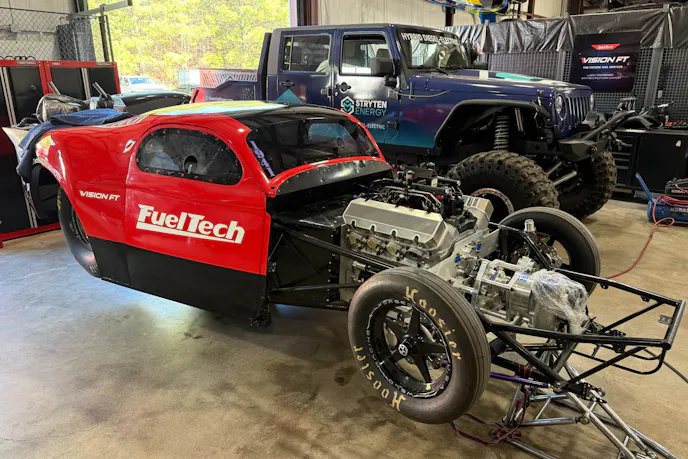
That classroom experience is now going to be offered at the racetrack and will allow students to see how power management concepts work in the real world.
“FuelTech is working on expanding its Education and Training with an on-site Power Management class, utilizing our shop Willys race car at the racetrack to teach how to maximize the traction control function of the FuelTech ECU. We want students to see this working in real time, watching the logs, watching the car, and understanding exactly what the ECU is doing and why,” Tanner explains.
Conclusion
The greatest weapon a racer or tuner has at their disposal is a solid understanding of power management. When you have a firm grasp of power management concepts, it becomes much easier to command a race car to do what you want it to do, no matter what conditions you’re facing.
You might also like
This Unique '95 Lincoln Mark VIII Is A Big-Body, Big-Block Ford Bracket Machine
This unique 1995 Lincoln Mark VIII bracket machine with a big-block Ford for power was a memorable father-son project.