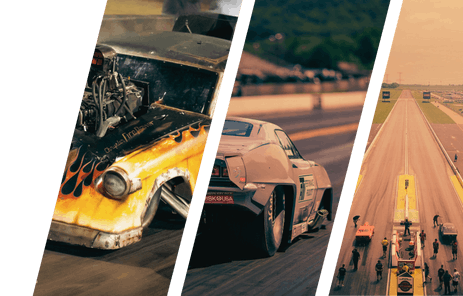
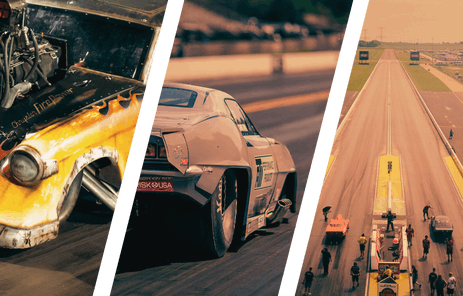
Season 4 of Horsepower Wars, presented by Summit Racing, is nearly at its end. We know you are all chomping at the bit to see how each truck fared in the C10 Shootout competition, especially after seeing some chatter that there was some carnage. However, watching the trucks come together and their initial testing should serve as a nice appetizer. When we left off with the Big 10 build, timing was going to be tight when the engine was stuck in transit from LME and they were forced to make due with a mock-up engine in the meantime. Meanwhile, things were rolling right along for the Coyote 10 despite the heavy fabrication required. But, keep in mind, Bigun intended to dyno and track test the Coyote 10 in North Carolina before hauling it all the way to Ohio for the competition. Big 3 had homefield advantage, with Darana Dragway literally at their doorstep.
Connecting the Dots
To wrap up from Episode 4 of the C10 Shootout, with both engines and transmissions in their respective chassis, both teams put in an order with Wiles Driveshaft to connect the ATI Turbo 400s to the Strange 9-inch rears. For the 1,400 horsepower output, Wiles recommended the 3.75-inch OD Carbon Fiber Driveshaft with (of course) a TH400 Yoke and 1350 U-Joint to match the transmission and rearend. Both builders spec’d around 61 inches from the center of the U-joint to the transmission output shaft.
“The 3.75 with the .125 wall in the ‘Standard Modulis’ – that works in a pretty wide range of applications,” stated owner Ralph Wiles. “We go to a 3.90 OD, still the same ID, once we get to about 3,000 horsepower.” Wiles said that determining the driveshaft specs is a “shaft RPM versus length versus shaft diameter equation” when factoring in the power of the engine – “RPM versus length is pretty critical.” In some applications, like a longer truck, the High Modulis carbon windings may be a better choice. “Carbon is pretty good at killing harmonics. But we got into this with NHRA Pro Stock Truck where they had a long shaft approaching 70 inches with high RPM. That’s where we got into the High Modulis stuff.”
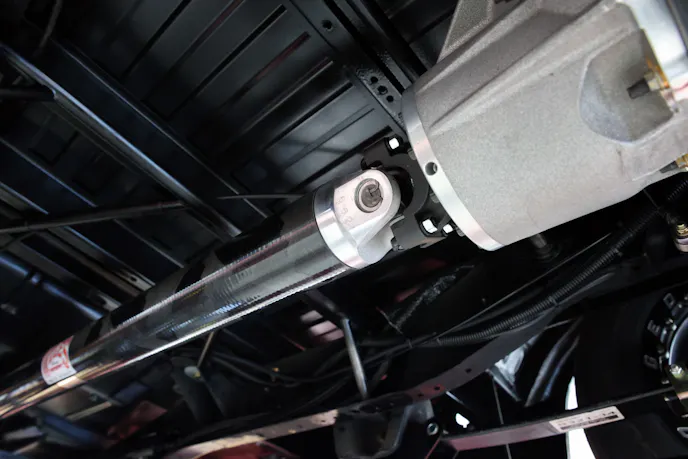
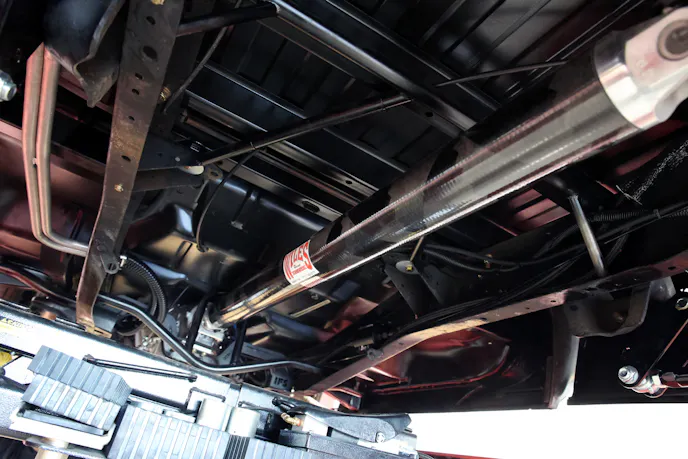
Wiles gets its tubing from the well-known supplier ACPT, who is an expert on the proper winding and bonding methods of the carbon fiber. The tubing is cut and bonded at Wiles facility in Tennessee to Sonnax yokes. The yokes have to be prepped so that the bonds don’t break, so it’s not exactly a foolproof part of the construction process either. Wiles used billet 7075 aluminum yokes on the C10 Shootout driveshafts, but sometimes 6061 or forged yokes are used as well.
Besides the absorption of harmonics, Wiles says carbon fiber is the safest choice for driveshafts period. There are nightmare stories of broken driveshafts dismembering drivers or even bystanders, not to mention the damage to the vehicle. In drag racing and dirt track, he says, carbon is quickly taking over his business as a result. Using a carbon shaft is not without its downsides, though, he is quick to point out: “clearance is a concern at 3.75 or 3.90 inches, tunnels and loops weren’t necessarily made for that. It also doesn’t like to be rubbed. You need to make sure you put the vehicle through full travel to check. The tube is ruined if you put a jack on it and it gets soft, but you can reuse yolks. If ruin one end but the tube is OK, we can put one yoke in it to save money. It’s not a throwaway item as one might have thought initially. We can repair to an extent.”
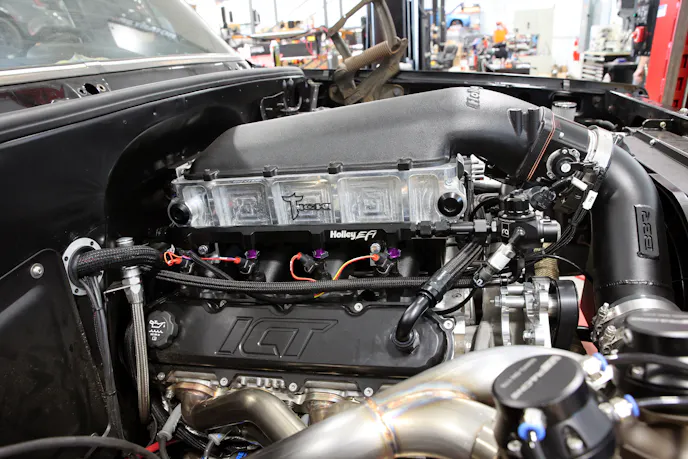
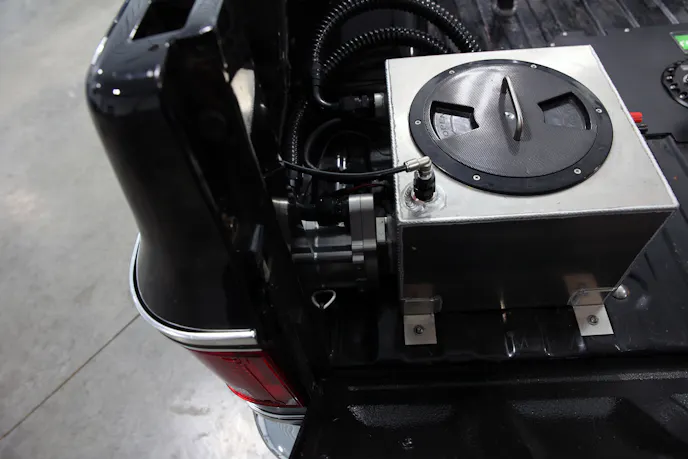
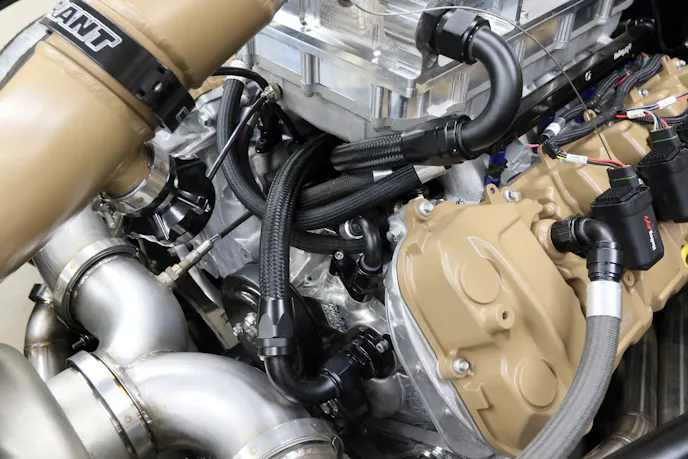
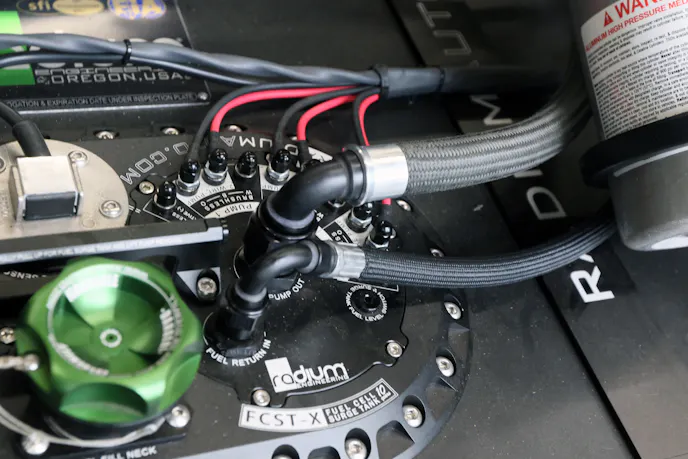
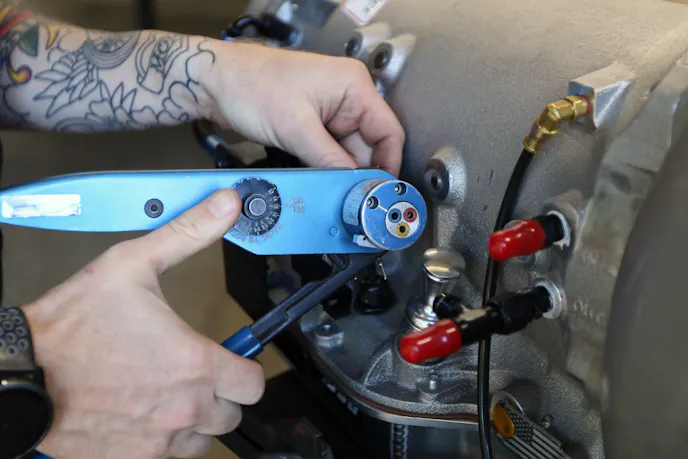
Plumbing the intercoolers, ice tanks, fuel, radiator, and transmission lines was the next item on the to-do list. Earl’s supplied Pro-Lite 350 Hose in -8, -10, and -12AN to use throughout the builds. The Pro-Lite is a lightweight black nylon covered high-pressure hose, good for up to 350psi of pressure and 350 degrees Farenheit (hence the “350” name). The material is also easy to cut and assemble, and accepts Swivel-Seal, Auto-Crimp, and Auto-Fit Hose Ends. Both teams selected an array of Earl’s Auto-Crimp straight, 90-degree, and 45-degree hose ends with matching hose end collars. As you can imagine, we had some random fittings come up that we needed at the last minute outside our initial order, but Summit came through to supply those.
Two slightly different approaches were taken to wiring each truck, given the status of both when they were delivered, along with the end goal in mind, though both used Holley EFI systems to power and control the engines. The Big 10 square-body seemed to have a recent restoration and overhaul, and its wiring was in good shape for the starter and lights. Big 3 was able to piggyback on that, adding the Holley EFI Main Power Harness to wire into a 6.86-inch Pro Dash (PN 553-395) mounted in a Holley Dash Bezel (PN 553-395). Just like on the engine dyno, a Dominator EFI ECU (PN 554-1114) is the brains of the operation, but it also has access to 2-axis g-meter, driveshaft sensor, and travel sensors from Holley. An AEM 12 Position Trim Pot was used to make tuning changes on the fly. Moroso Toggle Switches were added as additional control, plus the beefy Radium fuel system was attached to an MSD Solid State Relay and a wiring kit from Radium. Two more MSD relays were used to complete the wiring.
The Coyote 10 is also running the Holley 2-axis g-meter, driveshaft sensor, and Racepak travel sensors to mate to the Holley EFI system, but the rest received a rewire from the ground up. Two MSD Solid State Relays (PN 75643-HC) and a Racepack Smartwire Power Control Module (PN 500-KT-SWST) eliminated the traditional fuse system. TJ Cannon is the wiring extraordinare at Customs by Bigun, who spent countless hours meticulously wiring up the fuel system, lights, cooling fans, and Pro Dash with the Dominator ECU.
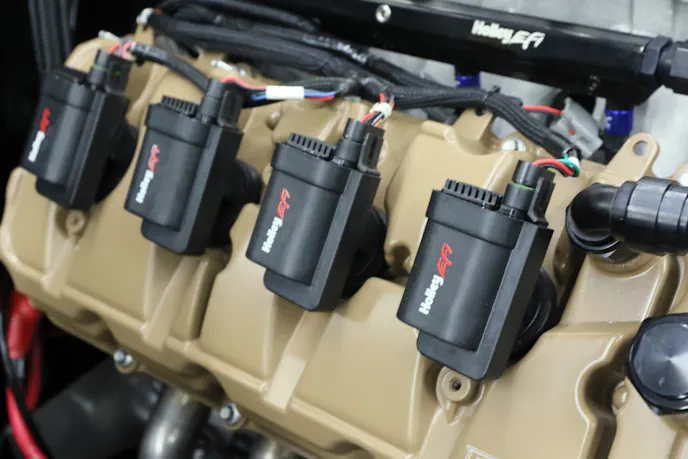
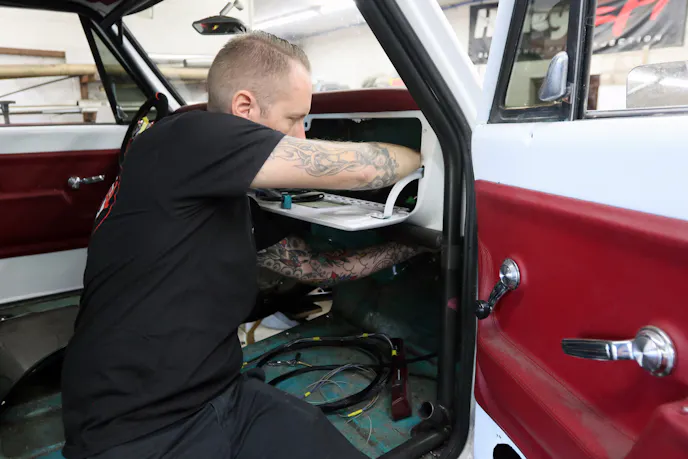
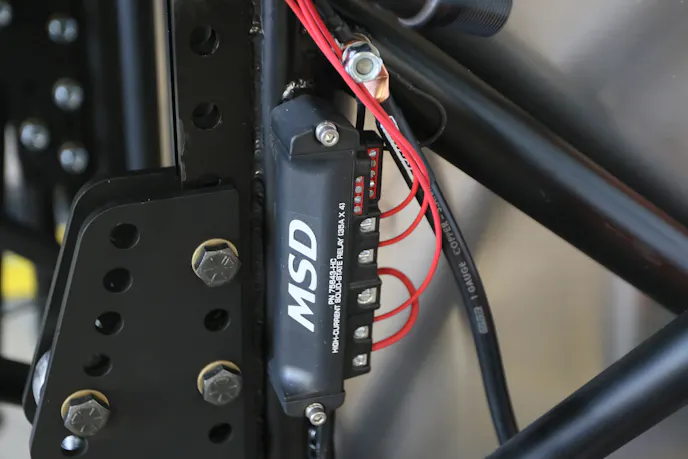
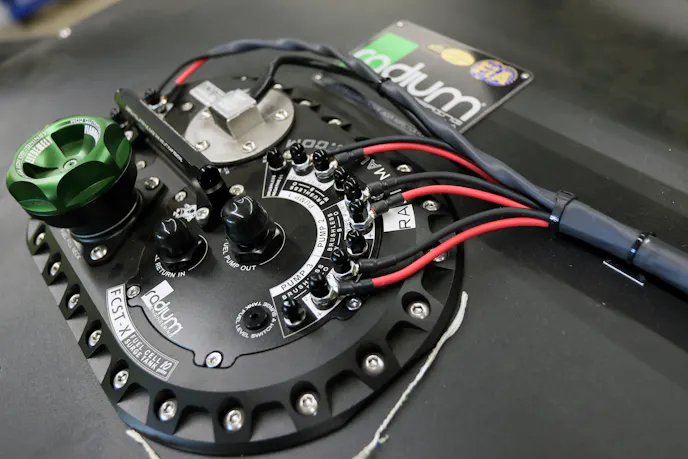
“One set of relays controls the three fuel pumps and lift pump, and another for both fans,” stated Yost. “The Smartwire controls everything else, one power wire in and 24 outputs. The Smartwire makes controlling the entire vehicle so nice and easy. Any input can control any output. In conjunction with the Dominator ECU, we can control things from that side also. The turn signals are displayed on the Holley touchscreen dash through the Smartwire then out to the turn signals. The transbrake bump button is also the high beam headlights. The amount of safeties or functions is endless.”
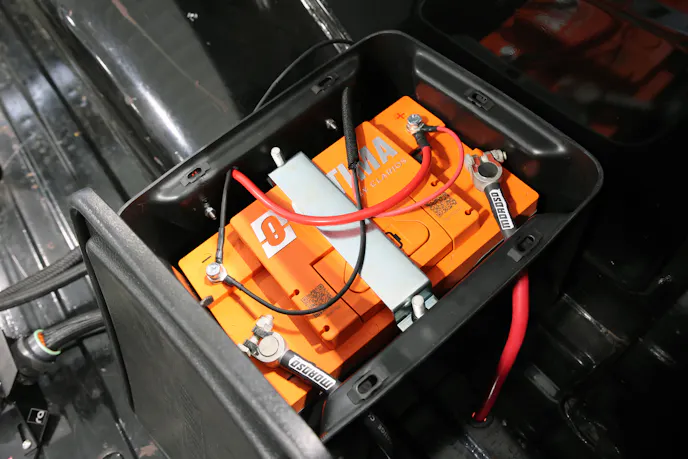
To wrap up the electrical side, both trucks used Moroso battery cables, connectors, terminals, and disconnect switch on an Optima OrangeTop QH6 lithium battery. The new OrangeTop has a massive 880 amps of cranking power at 0°F, and is quite a bit lighter than its AGM equivalent. With any high-powered EFI setup, maintaining a constant supply of 12-volts (or higher) is a must for optimum injector and coil performance. To keep the OrangeTop charged, the Big 10 used a Powermaster 220-amp, high output alternator (PN 48237) mounted on an ICT Billet accessory drive while the Coyote 10 used a Ford Racing High Output Alternator Kit (PN M-8600-M50ALTA) from Summit.
Fluid Situation
Once the wiring was done, it was time to fire up those engines – but not without fluid! Big 10 raided the Amsoil catalogue for 15W50 Dominator engine oil, DOT 4 brake fluid, 30WT transmission fluid, Power Steering fluid, 75W-140 gear oil, and handful of other stuff like Quick Detailer and Glass Cleaner to keep the Big 10 looking good, too. (Did you know Amsoil offers detailing products too? I didn’t.) Most of these products are 100% synthetic, including the Dominator engine oil, which is a multi-viscosity, shear-stable race formula that is heavily fortified with zinc and phosphorous. In higher-powered applications like this that also get driven on the street, it’s important to have oil that can operate effectively at different temperatures (hence multi-viscosity) and that can maintain the given viscosity under the extreme mechanical stress (which is what we mean by “shear stability”).
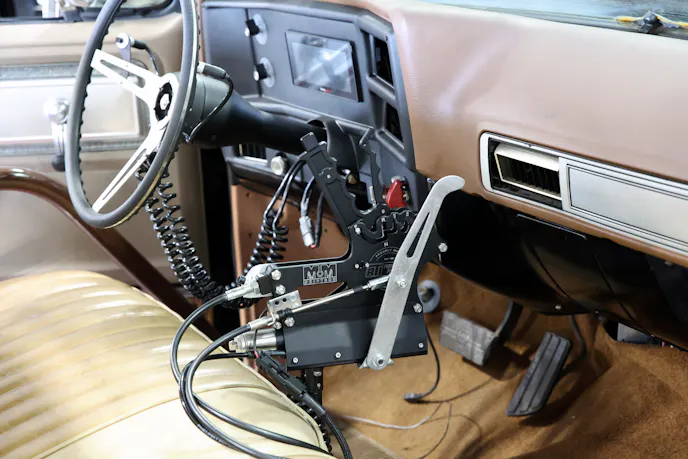
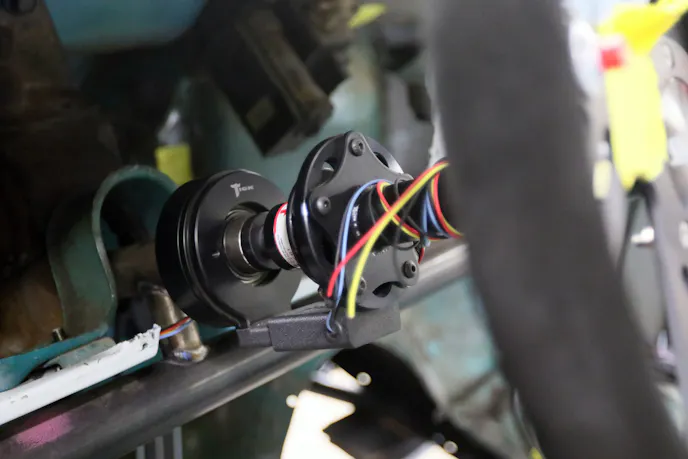
Bigun chose nearly the same main fluids, such as the 15W50 Dominator oil, DOT4 brake fluid, and CTJ05 30WT transmission fluid. However, the Coyote 10 received 70W90 gear oil. Both versions did come in that handy “Easy Pack” and not a hard bottle. With gear oil, film strength is paramount as it prevents the gears from wearing by providing that protective barrier in metal to metal contact. The 100% synthetic formulation maintains viscosity and prevents “thermal runaway,” and the proprietary additives form an iron-sulfide barrier coating the gear surfaces.
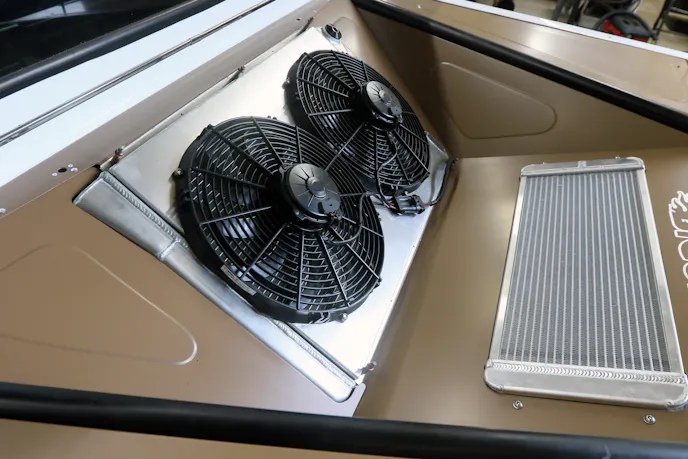
Last but not least, the radiators and intercooler systems were mixed with PEAK Titanium concentrate and distilled water. The Titanium line is its most advanced line, providing ultimate protection from corrosion in your brand-new engine and its compatible with any color or type of antifreeze/coolant. It received a perfect 10 score in water pump protection (ASTM D2809). Because it is free from 2-EHA, silicate, nitrite, borate, and amines it does not inhibit cooling system performance. It has boilover protection to 265 degrees and freeze protection to -34 degrees, so you shouldn’t have to drain it every winter. Unfortunately coolant has been vilified in the drag racing community, but it is not illegal with the NHRA. In drag and drive it is quite common and ideal in a streetcar.
While it was not a concern on the square-body with the front-mounted radiator, Bigun did state that with a rear-mounted radiator a vacuum refill kit is a must. By pressurizing the system, you can get those nasty air pockets out, which will repeatedly cause the engine to overheat. Anyone who has owned a Gen 2 LT1 with its infamous reverse-flow cooling system knows this pain, too.
Testing, 1-2
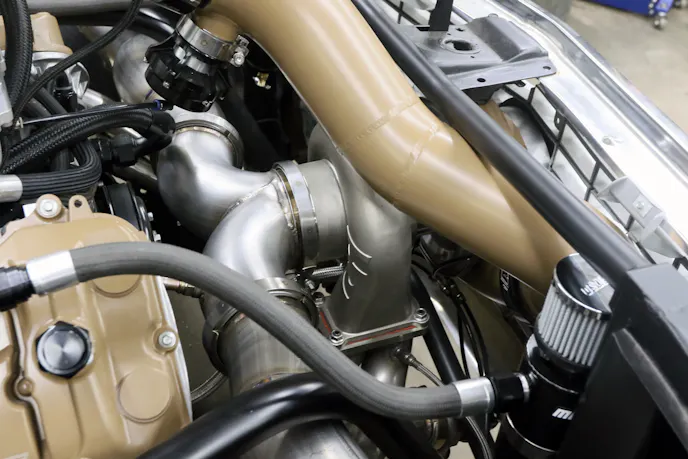
As soon as Bigun got the base tune-up loaded and fired up the Coyote 10 for the first time, it was driven up the hill to Harrel Engine Development for a few rips on the chassis dyno. During LS vs Coyote testing, the FFRE-built powerplant not only was using a smaller turbo but the E85 was quite a bit different than the ETS Z85 race fuel. Typical boutique E85 producers (ie not what you get at the pump) essentially make a consistent 85% blend of ethanol, that’s not terribly fancy but makes life easier for tuning and living life without a flex fuel sensor. What sets Z85 apart is the whopping 30% of oxygenation. Simply looking at the octane can be misleading, as its only rated a modest 94. However, the gravity helps tell a different story – as much more dense fuel – as does the 9.5 stoichiometric point. Tuner Pete Harrel immediately noted the difference when tuning on the dyno that the engine continued to run stronger as he enriched the tune on the Holley EFI. This did, after all, prove challenging to the fuel system. But at the end of the session, Pete made 1,330 horsepower at 25psi as he approached the limit of the injectors and pumps. Rough estimates for a roller dyno put the Coyote at over 1,600 crank horsepower – or around 200 more than the engine made with the smaller turbo.
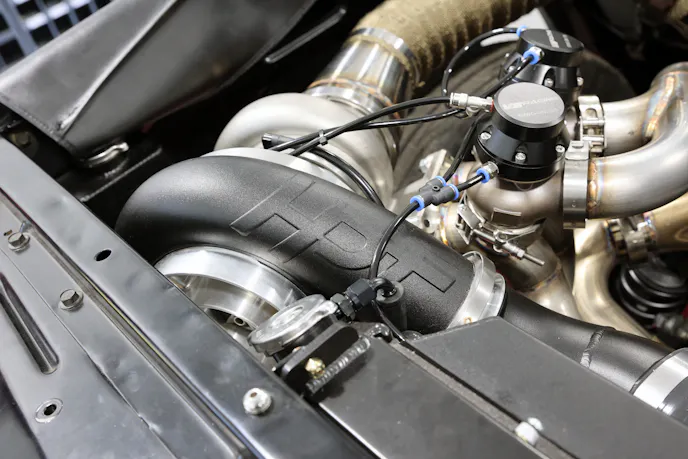
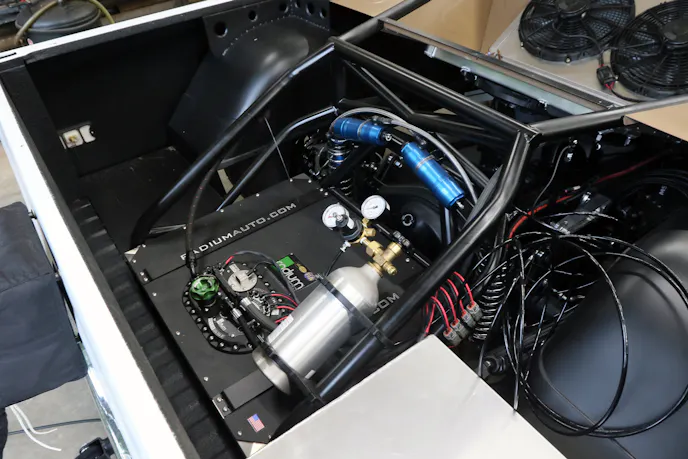
Bigun loaded up the truck for Rockingham the next day to catch a grudge race for some less-than-incognito testing. Although we kept the scoreboard off, the truck could have been spotted on the livestream. Whoops! After running late into the night, Bigun left happy after a few eighth-mile hits but kept the times under his hat. There was just enough time to go home, catch a few Zs, and then pack up to leave for Ohio.
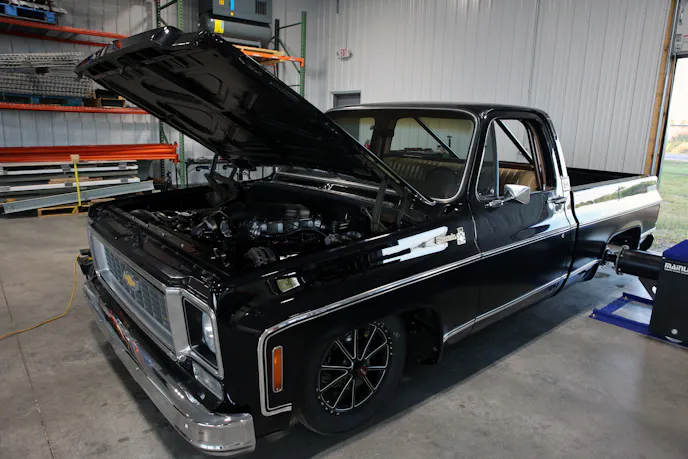
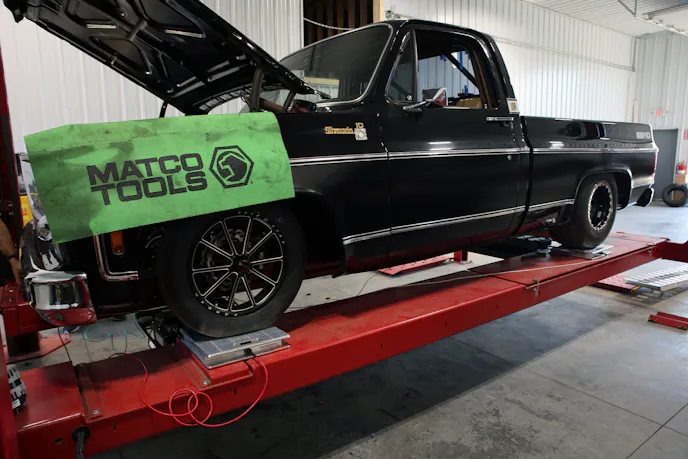
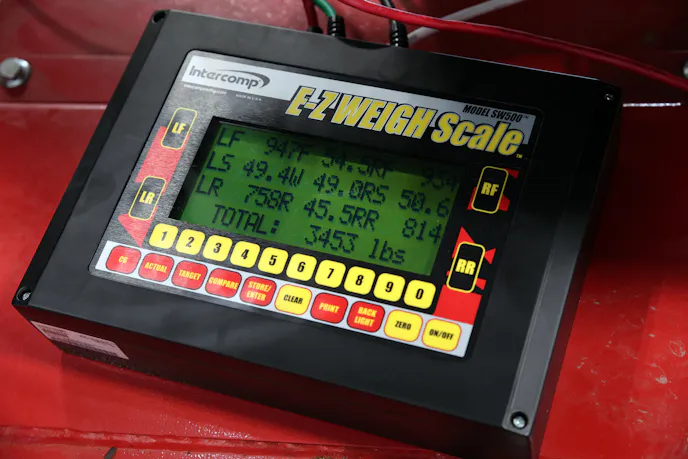
As for Big 10, they were fighting and clawing to the last minute. In fact, the square-body was finished the night before we got there to start filming for the competition, which meant they finally got a test hit or two in the day before the cruise and two days before the race. On the hub dyno at Big 3, tuner Rick Trunkett had the turbo LT singing to over 1,470 horsepower without breaking a sweat, which meant the new turbo also had it peaking over 1,600 crank horsepower as well at only 27psi. With such limited testing time this could simply come down to who dials in their truck faster, which certainly puts the Big 10 at an advantage.
If you want to know how it plays out, then you’ll have to tune in to the final episode coming up next on Horsepower Wars C10 Shootout, presented by Summit Racing. We’ve got a lot more in store next year, so look for announcements on the new series in early 2026. (Hint: it may include something that rhymes with “10k brag hootout.”)
Horsepower Wars C10 Shootout would like to thanks its sponsors for making this possible including Summit Racing, Holley (Holley EFI, Simpson, etc), Manley Performance, Diamond Racing Pistons, COMP Cams, Moroso Performance Products, Total Seal, Automotive Racing Products (ARP), Cometic Gaskets, AMSOIL,Vibrant Performance, HPT Turbochargers, ICT Billet, ATI Performance, Meziere Enterprises, AFCO Racing, Optima Batteries, Old World Industries/Peak, Strange Engineering, SPAL, ETS Racing Fuels, Auto Metal Direct, and Wiles Driveshaft.
You might also like
Ned Dunphy Wins HOT ROD Drag Week 2026 And Sets New Record
Ned Dunphy is a two-time HOT ROD Drag Week Champion. Dunphy won the title while also laying down the quickest Drag Week pass ever.