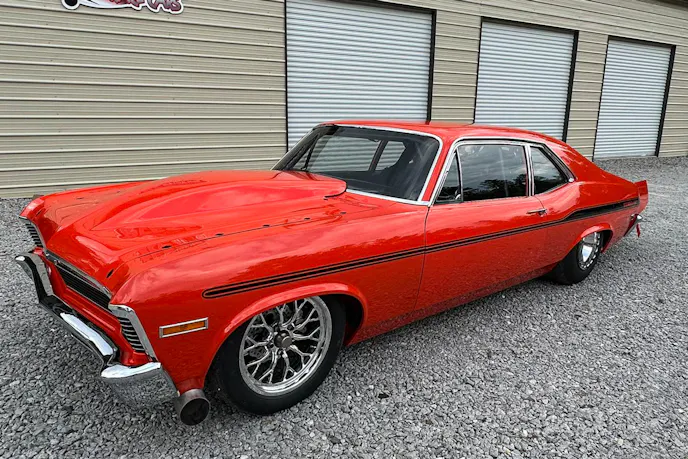
When Shayne Johnson’s father, Johnny, had a major heart attack two years ago, life changed for the family in many ways. “We thought he wasn’t going to make it, so I bought this car from him and told him it was going to be the baddest Nova he would ever see,” said Johnson. Now, both Johnny and the 1970 Chevrolet Nova are still around, and Johnson delivered on his promise of turning the car into one of the finest showpieces built for the street and the strip.
Growing up in Temple, Georgia, now 40-year-old Johnson remembers going to the local drag strip when he was a child, alongside his father. “When I was 13 or 14, dad had another Nova, and he’d make a few passes with his window down so they would see him driving, then he’d put the window up, and I’d hop in and make a pass,” shared the man.
Not long after, family matters took center stage and racing got put on hold. Around 2015, though, Johnson got involved with some small-block nitrous cars, but shifted gears to focus on growing his two businesses instead of racing.
His father’s heart attack, though, was a chilling reminder of how short life can be and inspired Johnson to return to the racing family’s roots. And, with one of the top shops in the world, Reese Brothers Race Cars, not far from his home, Johnson called his friend, David Reese, and got rolling right away.
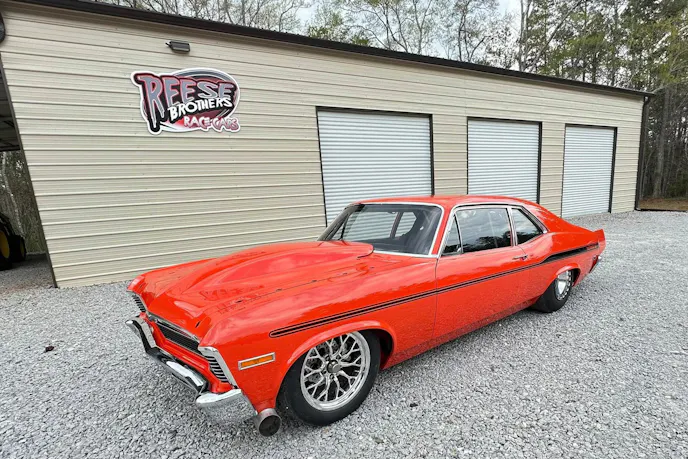
At the time, Johnson was planning to build the Nova for drag-and-drive duty with a 6.0-liter, LS-based turbo engine; he was also planning to just have Reese mini-tub the car and run it on leaf springs. But, when Reese jokingly told him, “If it doesn’t have a four-link, it’s junk,” Johnson changed trajectory. “I told David I had to get back to work and he should do whatever he wanted… next thing I knew, I got a bunch of invoices,” he laughed.
Johnson’s project transformed into a full teardown and complete racecar rebuild. While it was at his shop, Reese invested more than 900 hours into the Nova, his average Pro Mod takes around 750 hours from start to finish, mostly because of multiple changes to the combination along the way. “David built me exactly what I wanted, even though I changed my mind once or twice, and I’m sure he wanted to kill me a few times,” joked Johnson.
Beginning around September of 2024, the transformation began when the factory structures were all stripped away. Reese reimagined the Chevy around a 25.2 SFI-spec chassis, built entirely in-house at RBRC. “The chassis and front subframe are all modular,” noted Reese, who designed the intended street car with his trademark top-tier, racecar-spec craftsmanship. “It made sense for Shayne’s car, since it kept evolving toward something more serious anyway.”
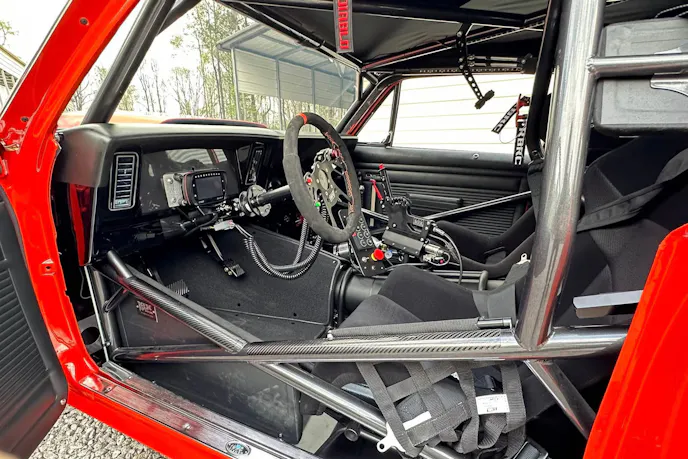
To get the metalwork off the chassis table and rolling, the rear suspension was constructed around an RBRC-fabricated four-link, a hardcore Hammer Concepts & Designs rear end, Menscer Motorsports shocks, TBM brakes, and a set of eye-catching RC Components wheels wrapped in Mickey Thompson’s 275 drag radial rubber.
Around Thanksgiving of that year, it was time to test-fit the twin turbos behind the tires for placement and plumbing. “Then the plan changed from the LS to a big block, then back to an LS, and then we went to bigger turbos, but they wouldn’t fit in that location,” Reese said. The team contemplated a single turbo setup, but that wasn’t feasible either, so eventually the two 86mm Apex turbos were mounted in the front.
Reese ended up having to make a lot of other modifications to make the street car a race car, and vice versa. “We put the transmission coolers behind the front tires under the front fender, the radiator is in the trunk, and the fuel cell for the alcohol is in the front with an expansion tank on the side,” he added.
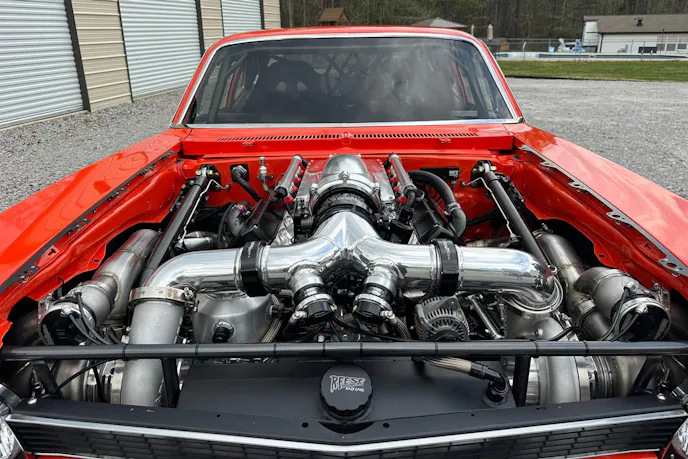
That alcohol is only one half of the Nova’s fuel system, as the car was carefully crafted to primarily run on E85 until a specified boost level is reached, and there’s a separate fuel tank and pump in the back just for the corn juice. “That’s what made it so complicated,” Reese affirmed. “We were trying to fit ten pounds of parts in a five-pound sack. Ultimately, this is a racecar wolf in streetcar sheep’s clothing.”
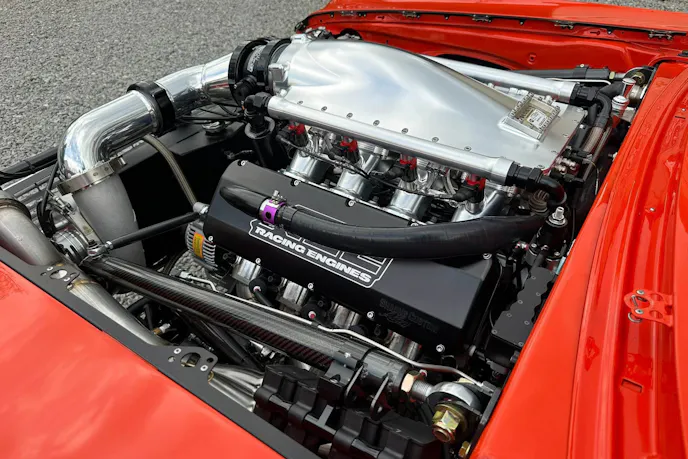
Once the fuel system had been sorted, the engine combination was finally nailed down. Built by Stefan Rossi at ACE Racing Engines, a 461 cubic inch Noonan LS-CR billet block was topped with cast cylinder heads and a beautiful billet intake manifold. Inside the engine, a Winberg crankshaft slings Ross pistons atop GRP connecting rods, and the rotating assembly interacts with the Manton valvetrain.
RBRC also fabricated the turbo headers and exhaust system, with each welded seam a work of art, then installed the M&M Turbo 400 transmission with a matching M&M shifter, Neal Chance converter, and Precision Shaft Technologies driveshaft, although the drivetrain was initially equipped with a 4L80-E, as Johnson had contemplated being able to class race in Overdrive categories.
Additionally, the wiring, which was handled by Michael Bunton, was laid out to accommodate the working factory headlights, taillights, turn signals, and more.
By early April of 2026, the Nova was ready to leave Reese’s shop and enter the real world. “We ran the car on the dyno at Nicolas Performance with the overdrive, and the converter was too loose,” explained Reese, noting that the Nova had produced 2,300-wheel horsepower at Nicolas Feliciano’s place with a FuelTech FT600 computer controlling it all. “That was when Shayne decided to switch to the Turbo 400 with a lockup instead and upgrade to the FT700.”
Not long after, on the dyno at FuelTech’s headquarters in Ball Ground, Georgia, the Nova more effectively utilized its potential power and put down 2,775 at the wheel. Yet another session elsewhere after that yielded 2,975 WHP, and Reese is confident the combination can easily go north of 3,000.
Another switch in direction came during the body phase, when a carbon front end and doors were added. Johnson wanted to keep All Steel All Glass (ASAG) racing as an option for the Nova’s future, though, so steel body panels were eventually put back on.
“Paul Vanderpool had replaced the trashed parts and repaired all the rust before I brought it to Reese, but it’s still got one original factory door and one factory fender,” said Johnson. “It’s also got a carbon hood, carbon deck lid, and carbon wing, but the rest is all steel, it’s got factory bumpers, grille, trim, and even roll-up windows.”
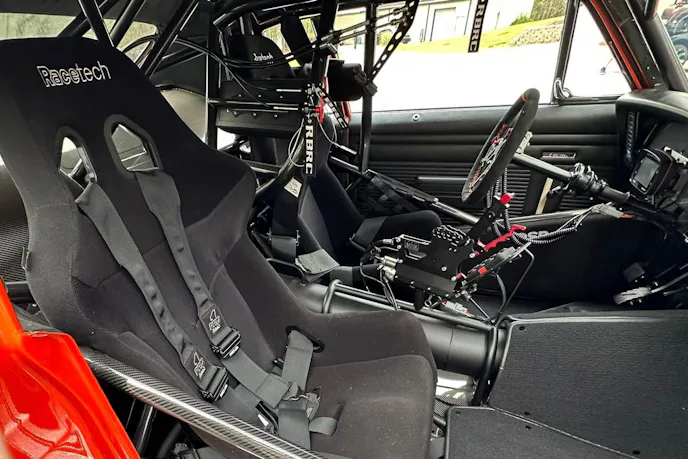
With the intent of the Nova having always been primarily for drag-and-drive use since day one, the interior of the Chevy had also been carefully crafted. Dual Racetech seats were installed to hold the lucky occupants firmly in place, while RBRC templated the intricate upholstery and carpet, all of which neatly snaps into place. “We added the carbon dash, too, which is airbrushed like the factory unit,” Reese added.
At 3,250 pounds with driver, Johnson’s Nova has all the right parts and pieces to be a serious contender at whatever events it ends up at. But, it didn’t come together without a ton of help from a talented team of professionals. “David Reese absolutely killed it,” asserted Johnson. “And I bothered Brett LaSala to death with questions, but I appreciate the help, advice, and hard work from everyone involved.”
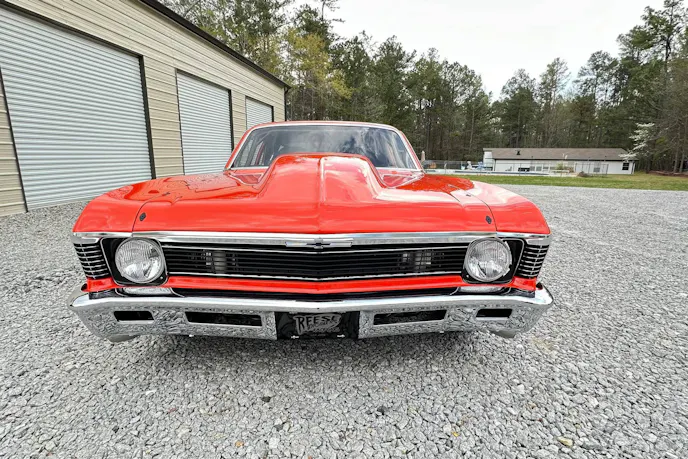
Seeing such a sentimental (and complex) project through to completion meant more to Johnson than any other car he’s owned because of his father’s involvement, and the new appreciation for life that they both have as a result of his health scare. “I couldn’t be happier with my little streetcar. My dad was absolutely blown away when he saw me unload it,” said Johnson, who is looking forward to putting the first official pass on his Nova in the near future. “This car couldn’t be any more perfect for what I wanted.”
Ironically, even though Johnson had intended to compete in drag-and-drive events throughout the entire duration of the two-year build, Reese built the 1970 Chevy Nova with such show car-worthy good looks, and capped it off with a stunning, vivid paint job and heritage-style Yenko S/C striping, that the finished product threw a wrench in Johnson’s plans. “It came out so nice, there’s no way I’m going to drive it in the rain,” stated the car’s owner, who will now be incorporating weather forecasts into his racing plans. “So, that’s why now I’m building another drag-and-drive car!”
CAR: 1970 Chevrolet Nova
CHASSIS: 25.2 SFI built by Reese Brothers Race Cars
ENGINE: ACE Racing Engines 461 cubic inch LS-CR, Noonan billet block
HEADS: cast LS
CRANK: Winberg
RODS: GRP
PISTONS: Ross
VALVETRAIN: Manton
POWER ADDER: Twin Apex 86mm turbos
ENGINE MANAGEMENT: FuelTech FT700
FUEL SYSTEM: FuelTech injectors
TRANSMISSION: M&M Transmissions Turbo 400
CONVERTER: Neal Chance
DRIVESHAFT: Precision Shaft Technologies
REAR END: Hammer Concepts & Designs
SUSPENSION: Reese Brothers four-link, Menscer shocks
BRAKES: TBM
WHEELS: RC Components
TIRES: Mickey Thompson 275 Drag Radials
HORSEPOWER: 2,975 hp
BEST 60’: TBD
QUICKEST ET: TBD
FASTEST MPH: TBD
You might also like
Take A Tour Inside One Of John Force Racing’s Nitro Funny Car Trailers
Nitro teams bring an incredible amount of gear to the track. We take a look at what you'll find inside one of John Force Racing's trailers.