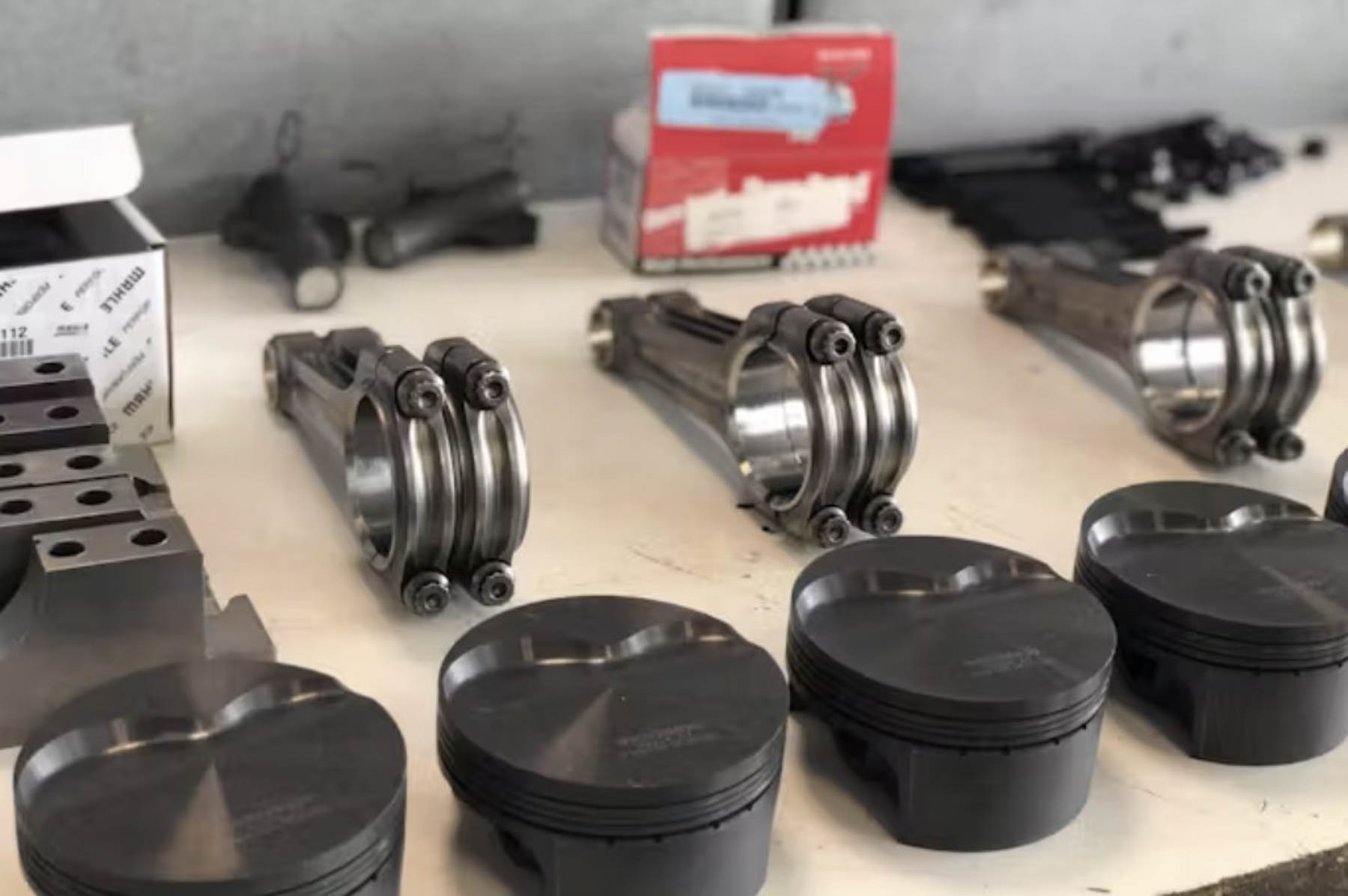
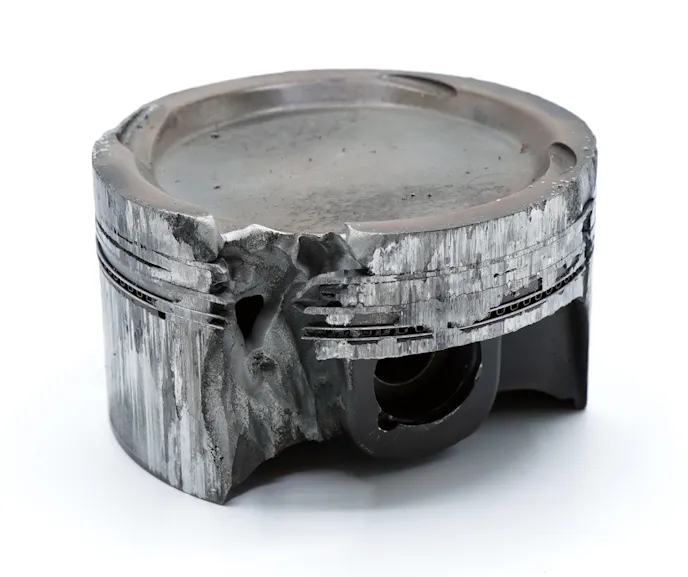
Nothing ends a track day faster than a piston with a lifted ring land or a shattered skirt. These are classic signs of an OEM piston being pushed beyond its design limits. Before adding boost or nitrous to an engine, it’s critical to understand the metallurgical differences between factory hypereutectic pistons and purpose-built forged pistons.
To get an expert engineering perspective on piston selection, we spoke with Justin Dossett, Senior Application Engineer at MAHLE Motorsport. Since joining MAHLE in 2014, Dossett has designed custom pistons for everything from first-time engine builders to professional Cup Series teams.
“The majority of my professional career has been piston application and design,” Dossett says. Like many people in the performance industry, he describes himself as a “typical hot rodder” whose hobbies include engine building, drag racing, and street rods.
As with every aspect of motorsports, piston design is highly application-specific. The following information provides general guidelines, but careful planning for your specific combination is always recommended.
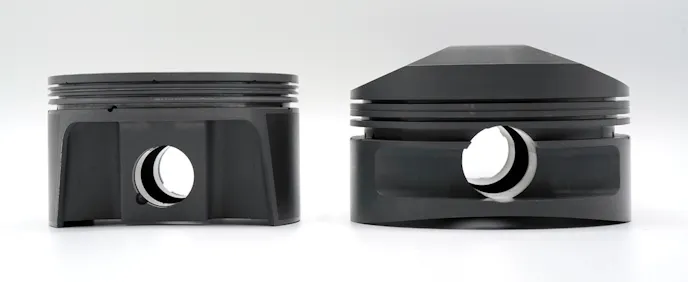
Failure Modes: OEM Pistons Under Pressure
When you add a power-adder — whether it’s a turbocharger, supercharger, or nitrous oxide system — you dramatically increase cylinder pressure, heat, and stress inside the engine.
“Typical OEM pistons are cast hypereutectic aluminum alloy, which allows tighter running clearances because of the lower thermal expansion and improved wear resistance, both due to the higher (greater than 12 percent) silicon content,” Dossett explains. “The downside is that hypereutectic pistons are less ductile.”
In simple terms, they are more brittle.
That becomes a problem when elevated cylinder pressures and tuning mistakes enter the equation.
“We have all seen how capable stock short-block LS and Coyote engines are,” Dossett says. “We have also seen basically stock engines break pistons due to a bad tune.”
The Role Of Tuning In Piston Survival
Proper ECU calibration is critical in any boosted or nitrous application.
Engine tuning determines fuel delivery and ignition timing. If those values are incorrect, detonation, pre-ignition, lean conditions, or excessive cylinder pressure can occur. The result may be permanent piston deformation, cracking, scuffing, or melting.
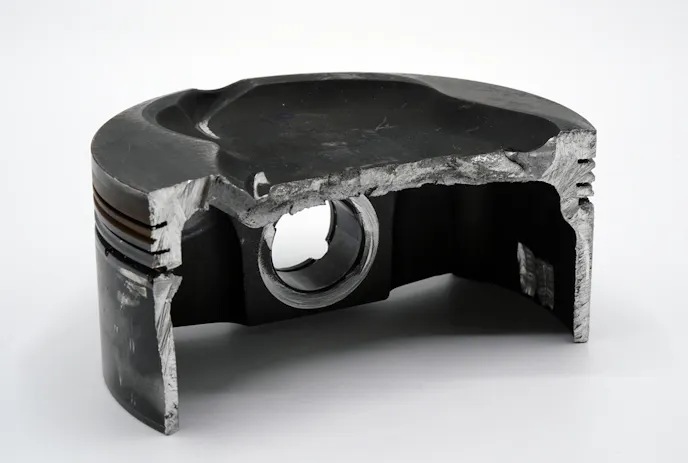
“It can lift ring lands, crack the skirt or ribs, or crack between the pin bores,” Dossett notes. “The majority of these issues result in significant engine damage.”
While design improvements can increase durability, even the strongest piston can fail if the tune-up is poor.
“Most of the time it’s from the tune,” Dossett says. “The best piston can still fail from poor tuning.”
Metallurgy Matters: 2618 vs 4032 Aluminum Alloy
When selecting pistons for a high-performance engine build, two forged aluminum alloys dominate the market: 2618 and 4032. The right choice depends on your horsepower goals, intended use, and desired balance between durability and longevity.
Most high-performance pistons intended for serious power-adder applications are manufactured from forged 2618 aluminum.
“2618 has little to no silicon, which significantly improves its ductility and strength, but at the cost of increased thermal expansion,” Dossett explains.
Because of its superior toughness and resistance to cracking, 2618 is commonly used in:
- High-boost turbocharged engines
- Large supercharger applications
- Nitrous-assisted race engines
- 1,000-plus horsepower combinations
- Professional drag racing applications
The tradeoff is increased piston-to-wall clearance requirements and the potential for cold-start piston noise.
“2618 alloy has more ductility. It’s a little more forgiving for a tune-up,” Dossett says. “The downside is that it expands more, so you need greater clearances.”
4032 forged aluminum contains approximately 12 percent silicon, placing it between cast hypereutectic pistons and 2618 forgings.
“4032 has around 12 percent silicon, which reduces thermal expansion and improves wear resistance, but at the cost of ductility,” Dossett explains.
For many street/strip combinations, 4032 offers an excellent balance of performance and longevity.
“With a proper tune, a forged 4032 piston will perform very well in street/strip power-adder applications,” Dossett says.
In general:
- 2618 offers maximum strength and forgiveness.
- 4032 offers improved wear resistance and quieter operation.
As power levels increase, piston design changes dramatically.
“From a custom piston standpoint, we evaluate each application and decide the correct thickness, clearances, and features to help the piston survive,” Dossett says.
Compared to naturally aspirated applications, power-adder pistons typically feature:
- Lower top ring lands
- Thicker second and third lands
- Increased ring-land clearance
- Thicker piston crowns
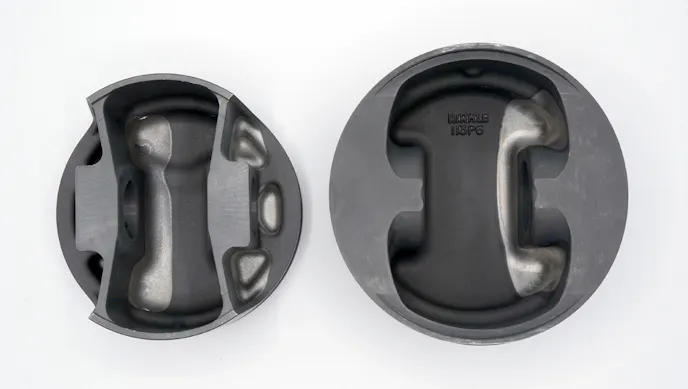
- Stronger skirts and support ribs
- Larger wrist-pin wall thickness
- Hard-anodized top ring grooves
- Thermal barrier crown coatings
According to Dossett, once piston design reaches a certain level, the piston itself doesn’t necessarily know whether the additional cylinder pressure comes from a supercharger, turbocharger, or nitrous system.
The key is designing for the expected power level. Multiple designs in both 2618 and 4032 alloys, plus extreme duty applications as noted. Heavy duty pins may be recommended based on the application. “Don’t hesitate to contact us for clarification,” Dossett welcomes.
Survival Strategy: Avoiding Common Mistakes and Critical Install Errors.
The most common mistakes Dossett says people make is choosing the wrong pistons for the application and not planning ahead. “Someone will choose the wrong alloy, wrong compression ratio, and try to run a lightweight piston and/or pin for their goals. There’s cross-over and a good tune will keep parts alive in applications outside of their original intent. But a bad tune can kill the best parts.”
Some of that stems from a general misconception to go lightweight on everything motorsports. That’s not true with pistons in a high cylinder pressure environment. Avoid the temptation of lightweight. “That’s not what you want for a power-adder application by any means,” Dossett warns. “Lightweight pistons are typically too thin. It’s essential to have the correct material thickness in the right places for the piston to survive.”
When it comes to installing pistons, particularly in power-adder applications, a common mistake is not accounting for thermal expansion completely. Setting a proper ring gap is critical. As the piston expands, the ends of the ring move closer together. “You don’t want the ends to butt. It’ll damage the cylinder and the pistons. It’s a pretty catastrophic failure at that point.” Dossett warns. “A little loose and you may know. A little too tight, everyone knows.”
This is where planning comes in. We often build in stages in the continuous pursuit of faster times. “I’m building naturally aspirated cars now, but I might add a supercharger or turbo later. Well, you need to go ahead and gap the rings for the later blower or turbo setup,” Dossett forewarns. That extra step now may save you tomorrow.
Dossett explains there’s overlap in design features between running either a supercharger, turbo, or nitrous that the piston, “would likely not know the difference.” The danger, and most common mistake, comes once again in planning and future goals. Why stop at just one power-adder when you can stack nitrous on top of a supercharger or turbo. “Be realistic about the engine goals. It depends on how much boost and nitrous.” You may outrun the practical expectations of the material and design considerations for that particular piston design. In which case, plan to upgrade pistons again.
Future-Proofing Your Build
Power-adders subject stock pistons to stress levels they were never designed to withstand. Upgrading to a properly designed forged piston and pairing it with a quality tune is one of the best investments you can make in engine reliability.
As a general guideline:
- Choose 2618 forged pistons for maximum strength and high-horsepower applications.
- Choose 4032 forged pistons for improved wear characteristics and street-driven combinations.
- Select piston designs based on realistic horsepower goals.
- Plan for future upgrades before final assembly.
- Set ring gaps appropriately for boost or nitrous applications.
In closing, Dossett offers one final piece of advice:
“It never hurts to call a manufacturer directly and say, ‘Hey, I’m doing this with this combination. What do you recommend?’”
That conversation could be the difference between building an engine that survives years of abuse and one that ends its life with a cracked piston and a windowed block.
You might also like
JEGS Launches New E-Commerce Website To Simplify Performance Parts Shopping
JEGS has launched a redesigned website. It features vehicle-aware search, improved fitment data, real-time inventory, and much more.