
Race teams and drivers know sanctioning body rules before every tech inspection. But what’s it like from a manufacturer’s perspective? Engineering teams may know the results of building up to or beyond the rules. They may also know hidden advantages and benefits in durability and technical service expertise. A race team’s relationship with their sponsor’s engineering department is extremely valuable.
Recently, ProCharger updated their popular F-4X-140 centrifugal supercharger commonly used in Pro Mod competition. To get an inside look at how product innovation plays out, we sat down with Walt Sipp, Director of Motorsports Services at ProCharger. Sipp has been around motorsports his entire life, and his professional career has taken him from OEM engineering departments to this leading performance parts manufacturer.
Building To The Rules
There is more than one way to add power, and sanctioning bodies are tasked with balancing those combinations so no single power-adder has an inherent advantage. “We’re competing against turbochargers, nitrous, screw superchargers, and other combinations, so the rules aren’t based on blower size alone,” Sipp explains.
“They look at how quick and fast each combination is running, how consistently it performs, and how much effort it takes to reach that level.” For ProCharger, the objective is to engineer the most competitive product possible within those established limits. “Our job is to understand the ruleset and deliver an optimized version of everything the racer is allowed to have,” Sipp adds.
Rules and competition also spark innovation. ProCharger wasn’t maxing out rule specs with previous models because they didn’t need to. “At the time, we didn’t have a ton of incentive to make our superchargers all the way up to the rule spec. We were actually a little undersized in most classes we were running in,” Sipp reveals. “As new products came along from other companies, they did take their specs all the way out, and it caused some confusion about what our performance levels really were.”
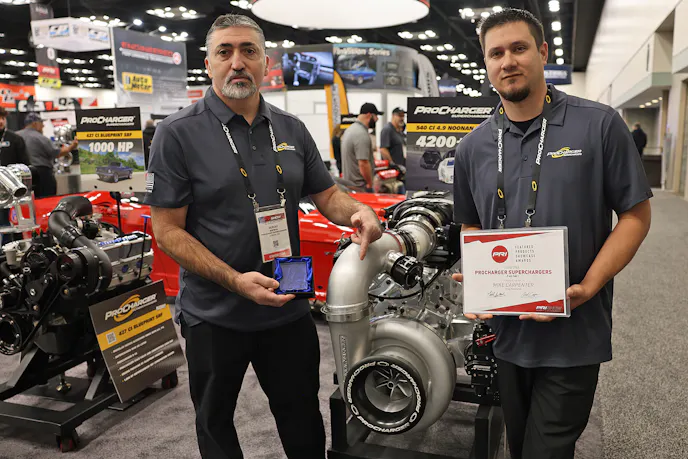
The Top Three Technical Improvements to the ProCharger F-4X Architecture
ProCharger released the F-4X series a few years ago to fully match the speed and acceleration Pro Mod teams are running. Then, racers benefited from an improved aero stage that included a larger 12 inch or 13.5 inch housing and different step-up drive ratio. Building on that success, the most recent updates to the ProCharger F-4X-140 unveiled at the 2025 Performance Racing Industry Show brought three significant improvements to further excel where top teams are headed.
First, the impellers are increased to rule limits, measuring 140.99mm on the inducer and 188.99mm on the exducer. Increasing the size of the impeller on a centrifugal supercharger has real track advantages. As diameter goes up, the blade tip speed increases and with it, air volume. On the F-4X-140-1, that difference shifts more of the available 65 psi max boost lower in the RPM range and broadens the powerband.
Second, are improved fitment tolerances. This is possible because of ProCharger’s advanced manufacturing and quality control processes. “We design and build everything in-house. We have excellent engineers that can make these work. As anyone can tell you who’s made a centrifugal supercharger like ours, it’s not easy,” Sipp explains.
Third, as noted earlier, the original F-4X supercharger received a larger housing with a different 4.77:1 internal step up ratio. Recent updates here include proprietary bearing material improvements. Sipp adds, “we make the bearings in-house as well.”
Combined, these updates significantly improve durability and performance. “Most guys are going to see 5 to 7 psi change between the previous version and the new,” Sipp points out. “Someone that might have been making 3,500 horsepower can add another 300 plus horsepower to their program just with a head unit upgrade.”
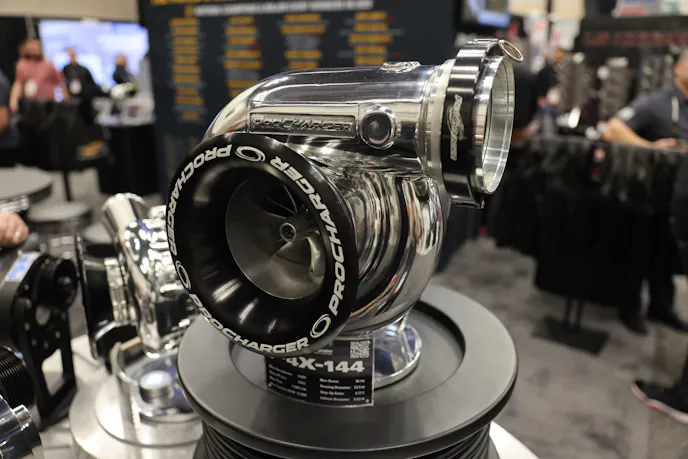
How Builders Can Benefit
For current F-4X owners, ProCharger can make most upgrades happen during regular service intervals. “We make it easy on them. They can take their existing F-4X model and send it in for upgrades, which means they don’t have to buy a whole new supercharger,” Sipp says.
For racers with a 12-inch or 13.5-inch first-generation housing, the upgrade retrofits the unit with the latest 14.5-inch housing, which uses a V-band connection to the bell mouth and charge pipe for easier mounting and simpler maintenance. Other considerations include routing fuel lines and intercooler tubing. “We’re going to help go through it with them,” Sipp confirms.
When pushing 3,500 to 4,500 horsepower in Pro Mod applications, it’s common for crews to have routine inspection and service on major powertrain components, such as connecting rods and the clutch. Given the max 72,000 rpm at which the F-4X centrifugal supercharger models spin, and the precise tolerances between the impeller wheels and housing, it is often included in that routine inspection and service plan.
ProCharger recommends typical inspection and service intervals every 50 passes on F-4X models. “We’ve had some of these models make more than 100 passes without any issue. That just goes to the durability of these units. When used properly at the advertised blower speed, these superchargers are extremely durable,” Sipp notes.
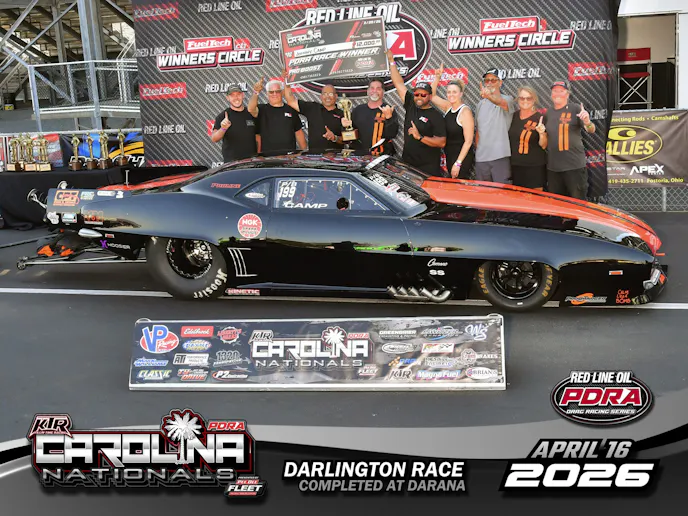
Picture source: Johnny Camp.
Trackside Engineering and Real-World Record Performance
ProCharger staffs a large team of full-time engineers in their dedicated motorsports department. They each offer technical, tuning, and performance expertise and can often be found at the racetrack. Many times they’re either racing their own vehicles or supporting sponsored teams.
There’s no confusion anymore where ProCharger’s performance lands. We caught up with one of their sponsored teams, PDRA Pro Boost record holder, Johnny Camp. According to an April 2026 news release from ProCharger, “Camp set the new PDRA ProBoost World E.T. Record, laying down the quickest elapsed time in ProBoost history: 3.542 seconds at 213.88 mph (.898-second 60-foot, 2.398-second 330-foot). That 1.144 second back-half split and insane trap speed speak for themselves, showcasing the level of performance and reliability the new F-4X-140-1 supercharger is capable of.”
“We as a team were very excited to test and put into competition the new generation of F-4X-140’s,” Camp remarks. “I feel it’s definitely making more power overall, especially on the top end. We’ve seen a noticeable difference in trap speed gain.”
In regard to the quality upgrades, Camp continues to say, “We feel that the new generation of bearings greatly improves reliability by helping eliminate failures and impeller touchdowns. This newest generation of ProCharger superchargers, along with the tuning expertise of Brandon Stroud, made it possible for us to set the PDRA Pro Boost ET record.”
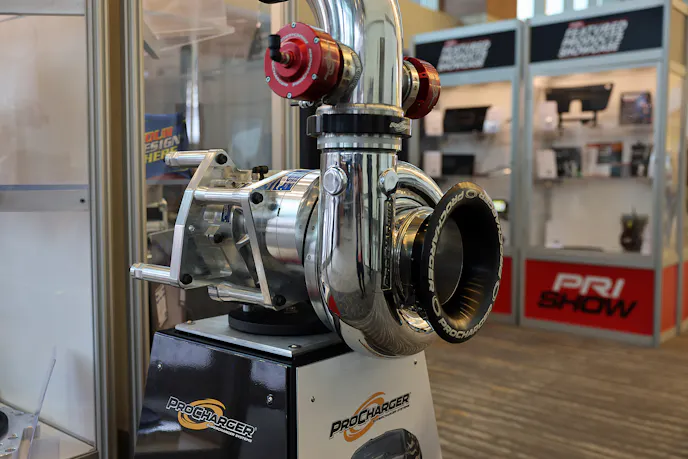
The Future of Centrifugal Supercharger Efficiency
The team at ProCharger has their eyes set on the future with the F-4X model family. “The rules are set in regards to sizing. We’re going to keep making efficiency improvements. Things that make sure you’re able to go quicker, and quicker. We’re always working on ways to improve,” Sipp explains. “We’ll let the rule makers sort out how to slow them down.”
You might also like
Take A Tour Inside One Of John Force Racing’s Nitro Funny Car Trailers
Nitro teams bring an incredible amount of gear to the track. We take a look at what you'll find inside one of John Force Racing's trailers.