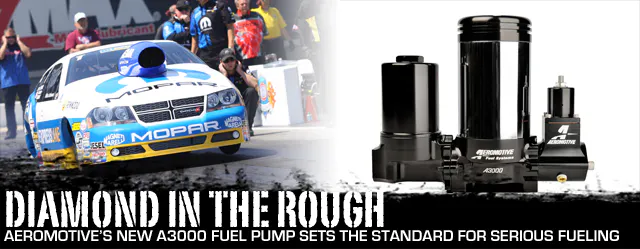
With a component like a racing fuel pump, advances in technology are hard to come by. The designs that exist in the marketplace have functioned so well for so long that to innovate the manufacturer really needs to think outside the box. The guys at Aeromotive are well-known for doing just that, providing fueling solutions that are different from a traditional externally mounted pump and filter. We’ve reported before on their unique line of Stealth fuel systems that place a high capacity fuel pump inside a factory-style tank to take advantage of the factory’s baffling systems and keep pump noise and plumbing concerns to a minimum for the street and street/strip enthusiast.
Well, they also make real deal racing fuel pumps that are targeted at the small-tire racing classes and professional racers like NHRA’s Pro Stock contingent; part of their slogan is “Serious Fuel Systems”, and that’s exactly what they work to provide to the racing community under the direction of company president and NHRA Pro Mod racer Steve Matusek.
Today we’ll be taking an in-depth look at the company’s newest top dog offering, the A3000 fuel pump, which has already been into the winner’s circle a number of times this season in Pro Stock and other upper echelon classes. Don’t let us fool you into thinking that the A3000 is only designed for that top level racer, though, because it has many uses in both small-tire and bracket racing applications where fueling consistency, volume, and performance are paramount to the racer using the equipment. Read on as we detail the finer points of what make the A3000 so special.
Detailing Technological Advancements
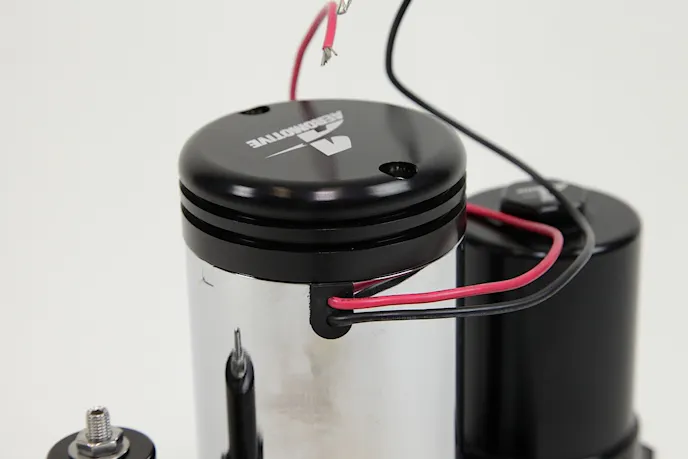
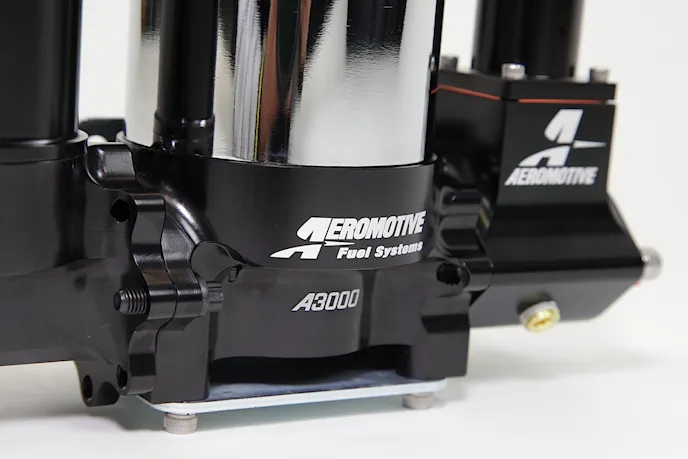
The A3000 sits in the same footprint as the A2000 (and many competitor’s pumps), but offers many features designed to improve overall fitment – like the detachable regulator and filter sections. Fresh off its debut at the 2013 SEMA show, where it garnered the runner-up spot for Best Engineered New Part, the A3000 fuel pump [PN 11215 complete/PN 11216 pump only] has already found its way into the vehicles of approximately three quarters of NHRA’s Pro Stock field, mainly due to its technological advancements. Not only is it available as a complete system, each of the components can be purchased separately.
We caught up with Aeromotive’s head of research and development, Jared Cox, to discuss some of those advancements and how they help the racer looking for more performance and consistency from their fuel system.
“This pump is the next evolution of our A2000 pump, its predecessor. We were looking to not only make it lighter, but also more user-friendly. If you look at the A2000, the regulator is built onto the pump, and if you wanted to use a bypass regulator, you had to disable the regulator by blocking it off and purchasing a bypass regulator for under the hood. With this pump, since you can purchase it without the regulator, you not only save weight but also money. With the A3000, we made the whole system modular, so you can pick and choose the parts you need,” says Cox.
The pump itself uses the same motor as the predecessor A2000, but internal improvements netted a serious improvement in performance.
Many Fitment Options
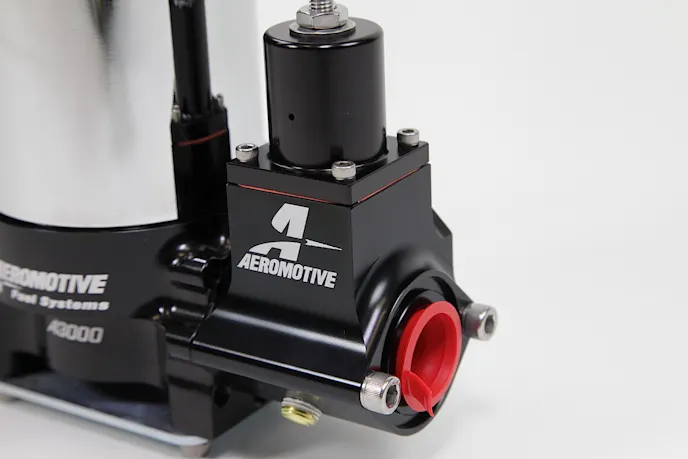
Opening up the flow area gave the vanes more time to push fluid out and through the pump. – Jared Cox, AeromotiveThis modular design allows for not only the pump and regulator to detach from one another, but also permits the filter to be removed as well – and both peripheral pieces can also be clocked every 45 degrees in either direction to make the system more user friendly. By using an O-ring seal on both the filter assembly and the bypass regulator where it seals to the pump base, along with machining multiple mounting holes into both sides of the pump base, Aeromotive was able to create a system that excels in applications like a dragster where space is at a serious premium. Not only can you index the regulator every 45 degrees, you can also flip the regulator 180 degrees to point the return orifice the opposite direction. The system is made so that all of the components can be indexed for chassis and component clearance.
By separating the filter and regulator from the pump body, the company was also able to gain access to the inlet and outlet ports. With this access unfettered to the inlet and outlet of the pump section, Aeromotive was now able to gain machine entry to the pump’s base and contour it to the pumps race. The inlet to the pump is now spec’d out to use a -12ORB fitting, as compared to the A2000′s -10 inlet. Outlet size is unchanged at -10, but the larger inlet coupled with access to the outlet side of the pump (with the regulator now a separate component) allowed for a serious increase in pump performance.
“With the inlet port at the larger size, it now allows our CNC machines better access to the inside of the pump base — better than drilling a straight hole through it like before. We are able to go in and contour the inlet and outlet ports to the race in a diamond shape. By doing so, we roughly picked up a gallon per minute in flow,” says Cox.
Since the A3000 pump uses the same internals and motor of the A2000, Cox was looking for internal improvements during the new pump’s design process. The diamond shape in the race existed previously, but due to the configuration of the smaller inlet and regulator outlet, it wouldn’t permit access to create the A3000′s diamond shape during the machining process and was in fact its limiting factor in terms of increasing performance.
“I was looking at it, and for me from a logical standpoint, if I could get in there and open up the two corners, I’d have to be able to get more flow out of it. To me it was a common sense thing to try, and since it was such a huge increase in performance, it made it into production. As the vanes sweep across the inlet, it now has more surface area and time to move more fuel. Think of it in terms of CNC’ing a cylinder head port,” he explains.
Powers Many Combinations
Power Support
The A3000′s massive pump section is capable of supporting all of the power any naturally aspirated engine can throw at it, as well as powering the largest nitrous systems on the planet.
How large, you ask? According to Cox, the pump flows enough fuel to handle well over 4,500 horsepower on a naturally-aspirated gasoline engine and 2,000 horsepower on a methanol engine (16V system). We don’t know of too many gasoline engines in the racing world producing that kind of horsepower on gasoline, and methanol-fueled machines in that power realm are few and far between. Rest assured that the A3000 can power anything you put in front of it.It’s not just the increase and flow in modularity of the design that Cox is so proud of developing, though. Because the regulator has the -10 ORB ports, it can be removed from the pump and moved to the engine bay. Why do this if it’s designed to be used on the pump itself? There’s one simple reason: in a nitrous application, or if a racer is using split Dominator carburetors, they want different pressures on the carburetors because of how the scoop references air to the carburetors. With the old-style A2000, the onboard regulator needed to be blocked and a racer had to purchase a new one to use in the engine bay. With the A3000′s modular design, it can just be removed and placed up front with the deadhead regulators, saving the customer money while being more user-friendly in the process.
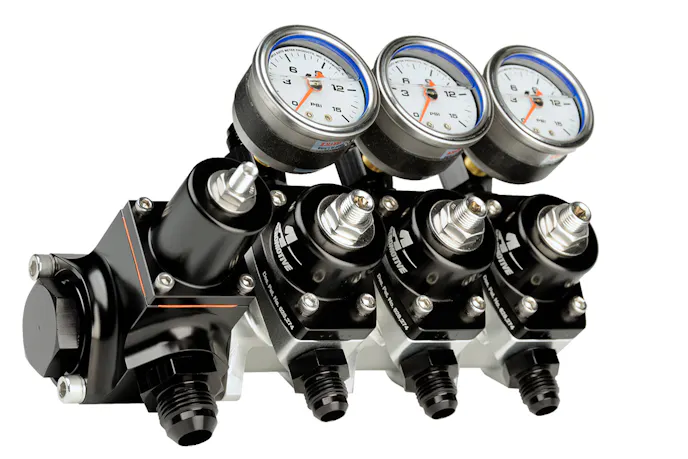
Deadhead regulators can now be installed easily for those nitrous applications with the A3000′s regulator installed as a bypass regulator on the back side. Since the company offers their nitrous stackable deadhead regulators [PN 13217] that seal with an O-ring, the A3000′s regulator can be installed at the end of a stack and used properly as a return style regulator – it follows the same external contour and matches right up. For a nitrous application, simply install the stackables in front of the A3000 regulator, run the return line out, and manage your fuel pressures simply and from one location.
The only purpose of the bypass regulator is to keep the pump happy and set line pressure. Since the A3000 requires the bypass regulator, if one does not exist in the system it will deadhead, cause excessive current draw and damage the pump. When a pump deadheads, the fuel pressure acts like a solid wall and has nowhere to go. Pressure shoots up to 50 or 60 psi, current draw spikes, and boom – your fuel pump is no more.
Other Technical Details And Features
The pump itself offers 15 percent more flow than the A2000 as mentioned above, due to the improvement in the entry and exit positions. As it is used often with 16-volt electrical systems, as the voltage goes up, so does the pump’s performance.
At 12 volts and 20 psi, the pump moves 4.8 gallons per minute. At 13.5 volts, it goes up to 5.6 gallons per minute, and at 16 volts it pumps out a whopping 7.2 gallons per minute – or enough fuel to power all but the most insane combinations using a carburetor. In addition, the A3000 is compatible with all fuel types including alcohol and methanol. The multiple bolt patterns machined into the pump base allow for many different mounting options, and may even fit an existing competitor’s pump bracket. The regulator is designed to dampen pressure spikes and provide smooth, controlled flow.
When the pump system is purchased as a complete kit, it arrives with one of Aeromotive’s A3000 100-micron fuel filters [PN 11218] as part of the assembly. This filter uses ORB-12 O-ring ports and mates right to the inlet side of the pump to provide excellent filtration. As it’s designed to be used only with the A3000 pump, it’s a simple bolt-on, and as mentioned above, can be clocked for clearance reasons.
In Conclusion
After 50-plus years of continuous improvement, research, and development in the hot-rodding and racing industry, large gains in performance from any one product are hard to come by. It takes a relentless focus on engineering, thinking outside the box, and trying new things to develop a part that not only exceeds that of its predecessor, but does so by a wide margin with an improved user experience, more flexibility, and better quality, but it appears as though Aeromotive has done just that with the creation of the A3000 fuel pump system.
It’s good enough for Allen Johnson, Jeg Coughlin, Jr. and many others to win races with in just its first season of widespread availability; moving forward Aeromotive hopes to see it in the winner’s circle as often as possible.
You might also like
Chad Green Targets Third Funny Car Win Of 2026 At Rockingham
Chad Green is ready to get back to his winning ways at Rockingham. The CGM team has identified issues and is looking for another Wally.