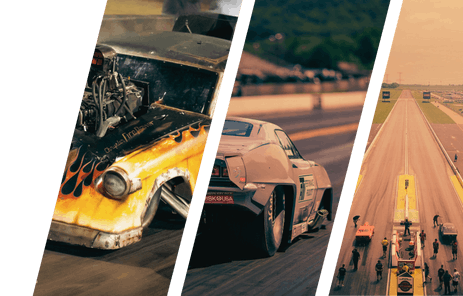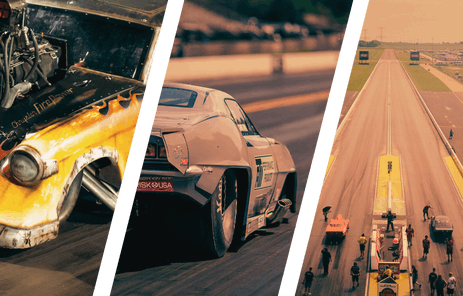
Last week, ADRL Technical Services Representative Tom Grooms issued a reminder to the series’ competitors to be certain to review and understand all current rules for their particular class. In addition, it was mentioned that all new technologies and new body designs or alterations must be accepted by the tech department prior to being allowed to compete at an ADRL event. “We really just want to keep the classes in the ADRL in the direction its going now. The big draw and the excitement of our series is watching ’69 Camaros racing 62’ Corvettes, and Ford Mustangs, and they look like muscle cars that you could’ve bought when you were a kid. What we don’t want to do is run into a situation where people are building big, wild, swoopy looking things that take away from the whole flavor of these muscle car battles
that we’re seeing in our series now,” explained Grooms.
The ADRL has been very open to fulfilling the very idea of “run whatcha’ brung” style of outlaw racing – more so than any other series or sanctioning body in the sport – and while the ADRL rulebook leaves much to the imagination, there is a general understanding between the series and its competitors on what is truly acceptable. Tom continued “Our rule book is pretty thin; its easier for us to have an open dialogue with the racers so they understand the jist of what we’re trying to do. If you look at our rule book, there is no rule in there that says you must have an internal combustion engine, so what I don’t want is a racer thinking…well, I can just can go ahead and put a jet engine on my Pro Extreme car because the rulebook doesn’t say I can’t do that.”
The ADRL rulebook is more or less intended to outline the various safety aspects that the series feels are necessary to keep its drivers, fans, and track personnel safe. However, when it comes to pushing the envelope on performance, the series is largely open to advancing technology and ideas, so long as it can be proven safe and doesn’t hinder the vision that President Kenny Nowling and his team have set forth.
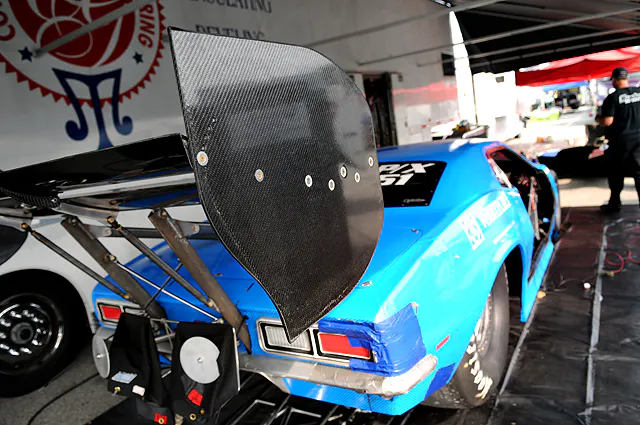
Last season, Don Wootton showed up at the St. Louis event with an A/Fuel Dragster-sized rear wing bolted to his nitro-burning Camaro, and while it was given the green light to compete, it also threw up some caution flags from the technical department and the drivers in the lane opposite to him as to just how stable it would be downtrack.
In addition, the series welcomed the infiltration of traction control devices over the last two couple of seasons on many of its cars, and this year, there are rumored to be as many as ten Pro Extreme cars running nitrous oxide in addition to the screw blower hanging out of the hood.
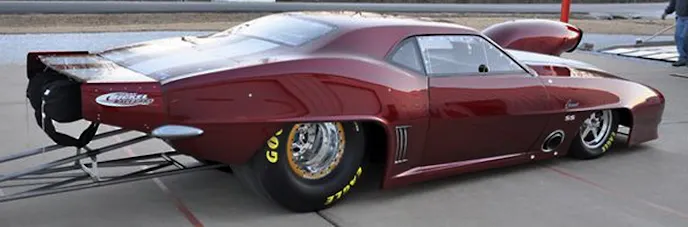
“We don’t want to get in a situation where somebody develops a body or some kind of crazy wing that wouldn’t be safe, or that would have such an advantage over the competition that would force everybody to build one. What we don’t want is Funny Cars, because they all look the same,” said Grooms.
Many of the bodies in the doorslammer classes have been altered in varying fashions from one another, including scaling and narrowing. This is evident in the numerous different twists that body and chassis builders have put on the 1968 Camaro. However, thus far, the ADRL has not deemed any body to hold a performance advantage over another, and as such, have all been approved. Grooms states that there are engine developments that the technical staff has kept a keen eye on, including the rapidly expanding cubic inch sizes of Pro Nitrous engines and the platforms to which Pro Extreme Motorcycle racers utilize.
“We pretty much allow anything, except for things that are so far outside of the box that they would totally change the dynamic of the class. Before someone goes out and spends a bunch of money on research and development and brings something to the racetrack that they are trying to explore some gray area in our rules, we kind of prefer them to run that by us first. There are some things that we really want to look at that people are developing, just to keep the organization healthy, the car count up, and the racing close and exciting.”
You might also like
Déjà Vu: The Small Tire 1973 Plymouth Duster Michael Judd Couldn’t Shake
Michael Judd's Ultra Street “Déjà Vu” supercharged 1973 Plymouth Duster kept finding its way back into his possession.