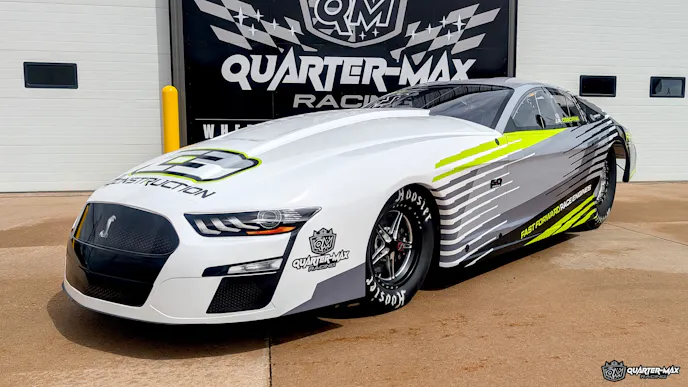
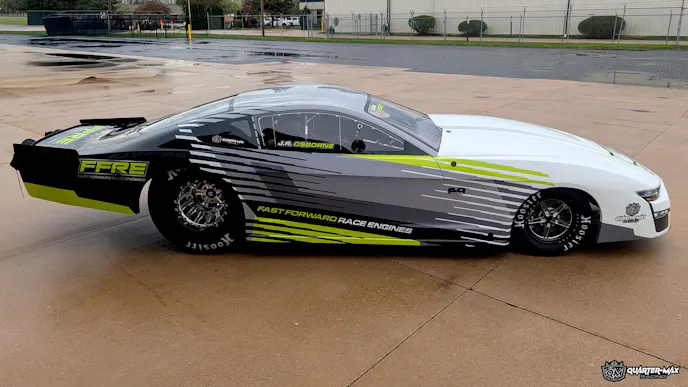
J.R. Osborne has spent more than three decades chasing speed around chicanes, esses, and hairpins. But that’s soon to change. The Colorado road racing standout, an SCCA national champion five times over and a recent inductee into the Colorado Motorsports Hall of Fame, is stepping into one of drag racing’s most unforgiving arenas with a brand-new Ford Mustang Pro Modified car built by Quarter-Max Racing with a one-off combination that could raise some eyebrows.
The move comes after a decorated road racing career that included championships in everything from Formula 1000 to sports cars, plus years competing internationally in superkarts. But as the logistics and demands of national-level road racing piled up, Osborne found himself searching for something different.
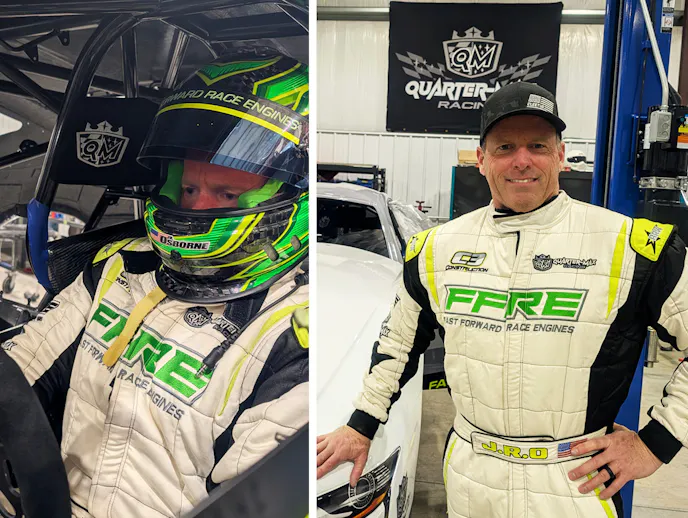
“I just ran out of desire to do all the stuff that it took behind the scenes to compete at the level I wanted,” he says. “I still love driving. I just didn’t want to do what I’ve done for 30 years.”
That search led him to drag racing, and quickly, to the deep end: Pro Modified. What started as curiosity around drag-and-drive cars and unconventional engine combinations evolved into a full-blown pioneering Pro Mod program after conversations with chassis builders, engine developers, and industry veterans. The final direction came together through a partnership with Joe Irwin and company at Fast Forward Race Engines (FFRE), from where Osborne’s car will be campaigned and developed.
At the center of the program is a 5.0L Coyote-based engine platform from FFRE, paired with a Compressed Air Supercharging (CAS) system, an unconventional new combination in the class.
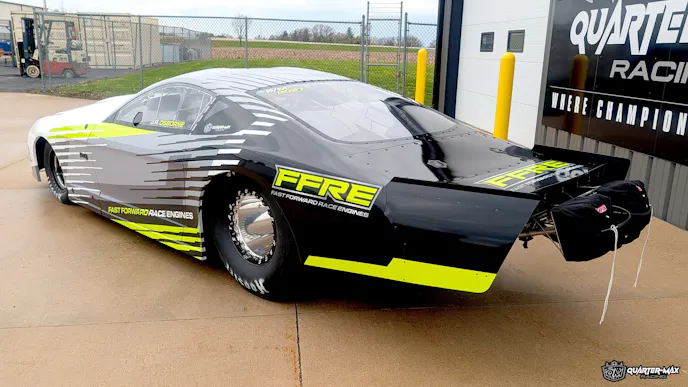
“Everybody’s running the same thing, and this is something different. We just want to prove out the concept. The math works for it to make the kind of power for us to be competitive,” Osborne says.
The engine itself sticks to its roots in some ways, with stock-style cast cylinder heads atop a Noonan billet block to handle the power levels required. Instead of turbochargers, Osborne and his team are leaning into compressed air supercharging from CAS, which delivers cool, compressed air from onboard tanks rather than relying on parasitic-loss superchargers and turbochargers.
The benefits, at least on paper, are significant. “It’s instant boost,” Osborne explains. “We don’t have to sit there and spool for four or five seconds. And the intake temps are 40 degrees, so we’re not tuning around heat…we can actually tune for performance.”
The system also allows for greater consistency, something Osborne and engine partner Irwin see as critical in today’s Pro Mod field, where cars are so close in performance that only reaction times prove the difference.
“When you’ve got 32 cars separated by four hundredths of a second, raceability is very, very important,” Osborne says. “Not just going fast, but going fast consistently.”
To bring the program together, Osborne has assembled a group with a wealth of experience with fresh thinking. Irwin leads the engine effort, while tuner Job Spetter handles the MoTec electronics and data side. A Rossler transmission rounds out the drivetrain, with development support tailored to the unique characteristics of the smaller-displacement engine.
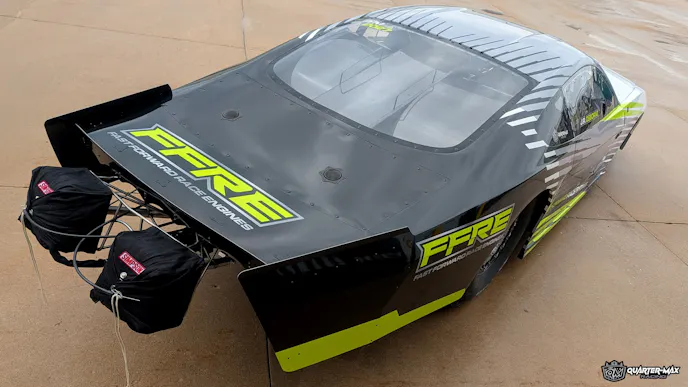
“It’s different. We’re talking 300 cubic inches instead of 550. The way we get to torque is different, so we needed partners willing to work with us to refine this thing,” Osborne says.
Despite being new to competitive drag racing, Osborne isn’t approaching the challenge lightly. He’s already completed licensing at Frank Hawley’s Drag Racing School and is preparing physically and mentally for the transition.
“I know the acceleration’s going to take a little bit to get calibrated to, but I’ve done a lot of racing very successfully, and I know how to race. After the first few runs, your brain does what it’s supposed to do…it starts understanding, and then everything starts to feel slowed down. I’m going right to the deep end, but I’ve got a great team around me.”
Osborne adds, “As a driver, road racing is like being a quarterback, I could mess up a turn, I can mess up a braking point, but it doesn’t kill my race. Drag racing is like being a field goal kicker, you either do it right or you screw it up. There’s no fixing it on the next lap.”
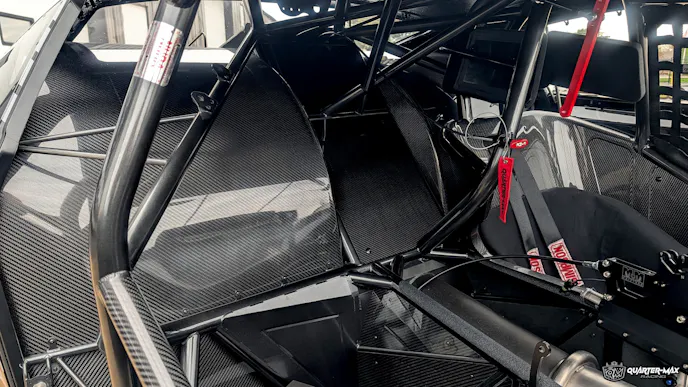
Testing is expected to begin later this summer, with a goal of hitting the track in August before making a competitive debut in the Winter Series later this year. Osborne says discussions are ongoing to provide the combination a competitive slot in the class rules. And if the combination performs as expected, it could shake up a category that has grown increasingly uniform.
“I think people are going to look at it and say, ‘That’s a pretty cool deal. It’s a Mustang, it’s a Coyote, it’s something they can relate to. And it’s racing against those big Hemis,” Osborne says.
For Osborne, that contrast is part of the appeal, as it’s a different discipline, different machine, and brings out the same competitive fire — it’s just pointed in a new direction.
You might also like
FuelTech’s New FT470 ECU Packs Big Features For Under $1,000
FuelTech's new FT470 ECU is packed with new features. The FT470 is FuelTech's first ECU that doesn't come with a built-in display.