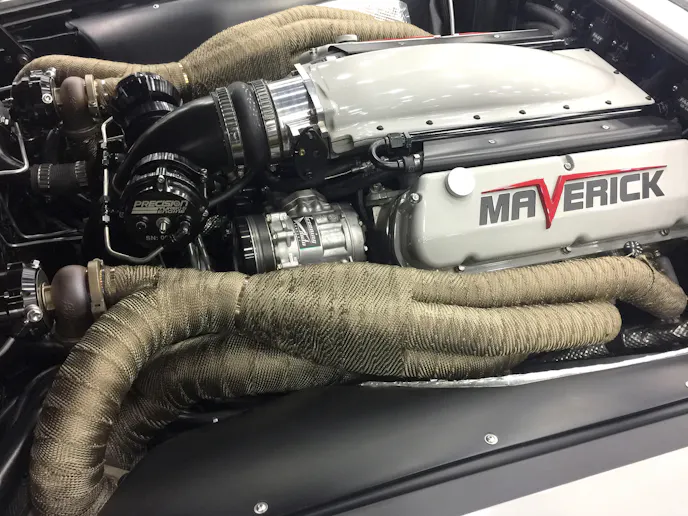
Excessive heat and vibration are two physical realities that can quickly create serious problems in any high-performance vehicle. Whether you’re building a street/strip car, drag car, or dedicated race machine, proper underhood heat management should be part of your build plan from the very beginning.
In this article, we’ll take a closer look at underhood temperatures, explain why heat-related failures occur, and show you how to control them using proven products and proper installation techniques.
To gain a better understanding of heat management, we spoke with Steve Garrett, Marketing Director at Design Engineering Inc. (DEI). DEI develops and manufactures its complete line of heat-management products at its headquarters in Avon Lake, Ohio. Garrett has spent more than 14 years in the performance aftermarket and, like many enthusiasts, grew up around racing and automotive repair.
Identifying Thermal Failure Points: Fuel, Brake, and Ignition Volatility
The exhaust headers are the primary source of underhood heat. Even during warm ups and a quick blast down the strip, heat can be excessive.
“A header is going to cook any component within a half-inch of it,” Garrett remarks. “I know it’s only a short burst, but a lot are getting up to a thousand degrees under the hood.” Let’s take a moment and understand the dangers that presents.
While the baseline material specs and fluid behaviors detailed below serve as universal rules, every street/strip build presents its own unique plumbing layout, tight clearances, and packaging constraints. Treat the technical parameters as your baseline, and adapt them to the exact requirements and operational demands of your specific vehicle.

Fuel lines. E85 pump gas contains 85% ethanol and 15% gasoline, although it can vary by seasonal blends. It typically begins to vaporize as low as 95oF degrees through 110oF and completely flash into a vapor between 165oF and 172oF. In a modern fuel system pressurized to 60 PSI you can artificially raise the boiling point and keep the fuel stable around 220oF. Now that may be good for a pass, but heat soak takes over once you’re in the shutdown area and fuel pressure bleeds down. Just as it sounds, heat soak happens when it builds up faster than it can dissipate.
As a result, the stagnant fuel in the rails vapor locks and causes hot restart troubles.
“The fuel gets to a boiling temperature and vaporizes in the line. You get vapor lock, and you’re going to shut down,” Garrett concludes.
Brake lines. Hydraulic brake fluid has a similar effect and dangerous consequences. Brake fluid is non-compressible, meaning the force applied to the caliper pistons is related to the feel at the pedal. The fluid has a minimum boiling point. It also attracts moisture from the air as it ages, and that lowers the boiling point – particularly if the car is seasonally stored in varying temperature climates.
DOT 4 brake fluid commonly used in drag racing contains glycol/borate ester mix with a dry minimum boiling point of 446oF, dropping to 311oF if containing 3.7% water contamination. When brake fluid flashes into a vapor, it becomes a gas that is highly compressible.
When you apply the brake pedal, instead of applying force to the caliper piston, it simply compresses the gas. You feel the pedal sink to the floor, not effectively stopping the car. “You boil brake fluid, and you’re going into the sand trap at the end. That’s bad news,” Garrett warns.
Spark plug wires. Burning through a plug wire creates a serious fire hazard. Depending on your setup, some race coils can discharge upwards of 30,000 volts or more. If the plug boot or wire’s insulation is worn or burned from a header, that high voltage is going to find the path of least resistance. Often resulting in arcing to the header.
“Next thing you know you got a fire in the engine bay. I’ve had it happen to me,” Garrett says. “DEI has a protective boot. You slide it over the plug wire, and you’re good to go. You won’t burn through a wire.”
[Editor’s note: it’s important to note here that these are not a solution for ill-fitting wires or wires that are touching the primaries. It’s not a Band-Aid. It’s insurance.]
In addition to safety concerns, excessive underhood temperatures can wreak havoc on electrical components and computer-controlled systems, drop air intake density, causing lower power performance, and give you some serious sweat behind the wheel.

Developing A Heat Management Plan
Now that you’re aware of the dangers and consequences of excessive heat, it becomes a priority to work it into your project plans early.
Begin at the source, which are the exhaust headers.
“The number one way to control anything under the hood is with DEI Titanium Exhaust Wrap around the headers before you install them,” Garrett recommends. “It’ll instantly knock down up to 50% of the heat coming off the header and lower the engine bay temperature.”
To achieve this, DEI uses a proprietary process of reconstructing pulverized basalt lava rock into strands of fiber that are diagonally woven together. The 2-inch-wide flexible material wraps around the header pipes and then forms to it once heat cycles. DEI marketing literature states it withstands up to 1,800oF direct heat and 2,500oF indirect heat.
“The wrap is super flexible and can handle another 600oF to 700oF compared to typical fiberglass,” Garrett explains. “It’s straight 100% basalt lava rock and made in the USA.” Garrett further emphasizes, “You’ll find less expensive wraps on the market that claim titanium and lava rock, but it only contains a small percentage, with the rest being a mix of materials. The price goes way down and so does the quality and effectiveness.”

Ceramic coating the exhaust headers is another alternative, however, Garrett gives a cautionary warning. “If you touch a ceramic-coated header after a run, you will instantly melt your skin. If you touch a properly basalt-wrapped header, you can quickly tap it without losing your skin.” Ceramic coating is a barrier reflection method to keep heat from radiating outward into the engine bay, while basalt wrap insulates the heat and holds it in the header.
This brings us to an important installation tip about exhaust wrap. Carefully follow the instructions and lay a quarter-inch overlap with each pass. Only wrap the pipe once. Garrett says from industry experience,
“Where you get into trouble is in thinking ‘if I wrap it once and it’ll take care of 50%, then if I do a second wrap around it’ll take care of even more heat.’ If you hold too much heat, that’s when you can fatigue the metal. That’s why we always recommend a quarter-inch overlap. It lets the right amount of heat in and out.”
With the exhaust headers wrapped, the next steps in heat management are to cover the spark plug wires, brake lines, and fuel lines with the recommended DEI products.
“We have a product called Vapor Block that wraps around a line with an adhesive flap that seals it. It’ll block the heat from getting into the fuel line and prevent vapor lock,” Garrett mentions. “Customers will use it on brake and transmission lines too. Plus, you’ll get some vibration protection if the lines are rubbing anywhere.”

Trackside Myths: Infrared Gun Errors and Insulation Missteps.
Two misconceptions surround heat management. The first is the use of an infrared temperature gun to measure the heat off a titanium basalt lava rock-wrapped exhaust. This method indirectly measures temperature from the infrared electromagnetic energy emitted by a surface and then calculates it from a predetermined table embedded in the gun’s software. The material’s lower surface emission, plus high reflectivity, breaks the tool’s fixed internal table parameters and you’ll get an inaccurate reading.
Garrett notes how misunderstanding measurement methods leads to false claims, “You’ll see videos of people saying this titanium basalt wrap made the pipe heat go up, instead of down. Well, you can’t use an infrared temperature gun because of its reflectivity. It doesn’t read and calculate it properly. You need to use a temperature gauge to read the heat coming off there.”

The second misconception is that sound damping also blocks heat. It does not, unless purpose-built, because different materials are required. Following a three-step plan can block heat from radiating through the firewall and transmission tunnel, plus quiet the interior and look great.
First, place damping material directly on the bare metal, which controls the vibration and noise. Then add a thermal insulation layer engineered to block heat and absorb noise instead of ineffective jute or carpet padding, and last, place an aesthetic layer such as carpet. Orientation matters, and Garrett recommends that “products with an aluminum skin are meant to face the heat source directly to reflect that energy away. If you install them on the inside of the cockpit facing the wrong direction, they lose their reflective properties and won’t block the underhood heat soaking into your interior panels.”
Eliminating Heat Before the Point of No Return
In conclusion, heat management needs to be part of your plan and not an afterthought. By understanding why there are real safety concerns involving fuel, brake fluid, and ignition spark, you can make the necessary decision to purchase DEI heat management material early in your build process. “It’s a process of really thinking about heat management before you get to the point of no return where you have to start tearing things apart again to redo it,” Garrett says.
He drives it home by telling a story picked up amongst peers. “I still use a line Jeremy Gerber, co-owner of Roadster Shop, told me when we were at their shop doing an interview. It goes, ‘a build is only as good as how tight it is and how well it’s insulated when it’s done.’”

Sources:
1) ASTM D5798 – Standard Specification for Ethanol Fuel Blends.
2) American Chemical Society / ACS Energy & Fuels Data.
3) Federal Motor Vehicle Safety Standard (FMVSS) No. 116, “Motor vehicle brake fluids.” Sections S5.1.1 Equilibrium Reflux Boiling Point / Dry ERBP and S5.1.2 Wet ERBP.
You might also like
Take A Tour Inside One Of John Force Racing’s Nitro Funny Car Trailers
Nitro teams bring an incredible amount of gear to the track. We take a look at what you'll find inside one of John Force Racing's trailers.