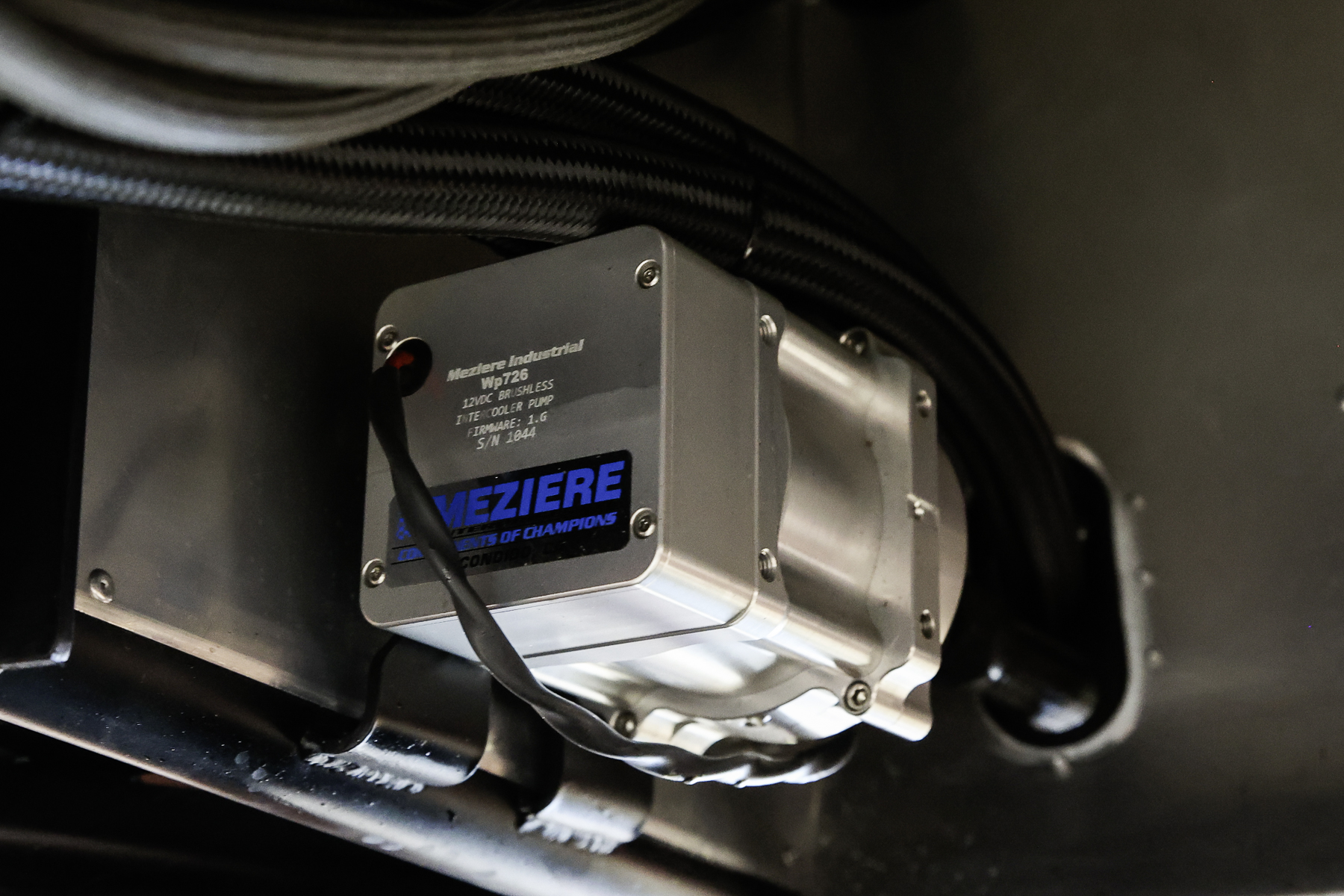
Engine builders will tell you that there are areas to save a few bucks, but you’re better off saving yourself some heartache by purchasing a proper intercooler pump the first time around. Boosted engines love chilled air. When intake temperatures are low and consistent, you have the recipe for serious horsepower.
For expert insight into intercooler pumps, we called in champion drag racer and parts manufacturer Don Meziere of Meziere Enterprises. We also spoke with Horsepower Wars C10 Shootout truck builders Chuck Stefanski and Eric Yost to see how they used these intercooler pumps in their projects.
What Is an Intercooler Pump
Before diving into the pump itself, let’s briefly explain what an air-to-water intercooler does. In boosted engine configurations, it’s positioned between the turbo or supercharger and the intake manifold. The intercooler’s job is to lower intake air temperature, increase oxygen density per volume, and make the engine less prone to detonation with your fuel of choice. Simply put, cooler air makes the engine happier and more powerful.
The intercooler contains plumbing that circulates a coolant mixture, sometimes further chilled with an ice tank like the C10 Shootout. Thermodynamics transfers heat from the hot, boosted air to the coolant. The now-hotter coolant passes into a dedicated heat exchanger, releasing heat to the atmosphere. The cooler, compressed air in the charge piping is then fed into the intake manifold. This closed-loop cycle continuously repeats as we hammer down the drag strip chasing maximum horsepower.
The key component in this system is the pump pushing the water or coolant through the intercooler loop. The pump must be robust, high-quality, and dependable.
Both Chuck Stefanski of Big 3 Racing and Eric Yost of Customs by Bigun installed Meziere Enterprises brushless intercooler pumps on the C10 Shootout trucks.
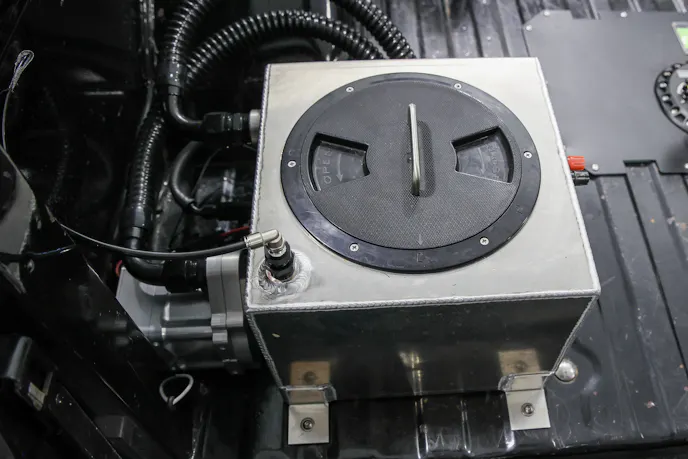
Mounting one of these pumps is fairly easy since they have a relatively small footprint. Having multiple mounting options also provides flexibility when it comes to where the water tank is placed.
“We wanted to mount our water tank in the bed of the truck, and space was limited. An intercooler pump like this made that idea a reality since we could mount it under the truck. That made it easier for us to plumb and wire everything,” Yost says.
There are a lot of different ways you can wire these types of pumps up. The most popular method uses an on/off switch the driver would have access to. Stefanski went a different route to show how versatile these pumps can be.
“We wired the intercooler pump to be triggered by the Holley ECU. Basically, when the ECU sees a specific reading from the TPS sensor, it will start the pump. This helps to manage how much the pump runs, and it also eliminates the possibility of the driver forgetting to turn the pump on.”
With the basics covered, let’s look at how pump design and quality directly affect performance in boosted applications.
Intercooler Pump Design and Options
Both Stefanski and Yost installed Meziere Enterprises brushless intercooler pumps. For a deeper understanding, we turned to Don Meziere, owner of Meziere Enterprises in Escondido, California. Meziere, a professional drag racer himself, develops purpose-built parts for the racing community.
Meziere Enterprises places the customer and racing innovation at the core of its product development. “The approach we took when developing the intercooler pump was exactly the same as across our entire product line,” says Don. “We look for a segment that’s not being served well, where engineering can be improved and customer satisfaction elevated by making a sincere engineering effort.”
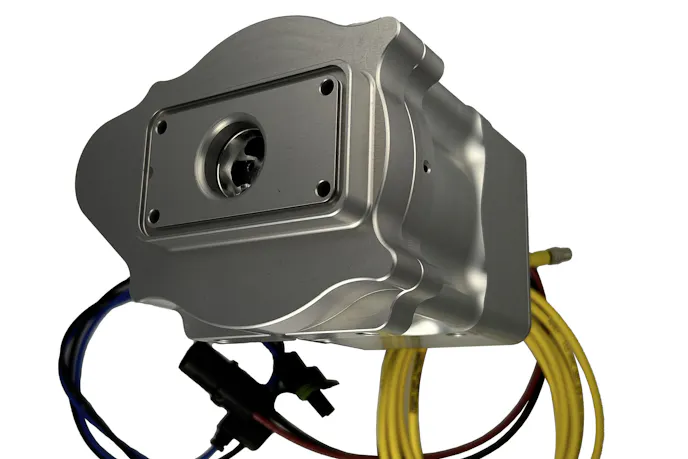
An intercooler pump must handle high temperatures and flow pressures. “In the design phase, our engineers carefully select materials and components to withstand the rigors of racing applications,” Meziere explains. “Billet aluminum construction of the impeller and outer housing ensures excellent corrosion resistance. Stainless steel internal parts and industrial seal components are chosen for temperature and pressure durability. We also developed our own control board with proprietary electronics tailor-made for our customers.”
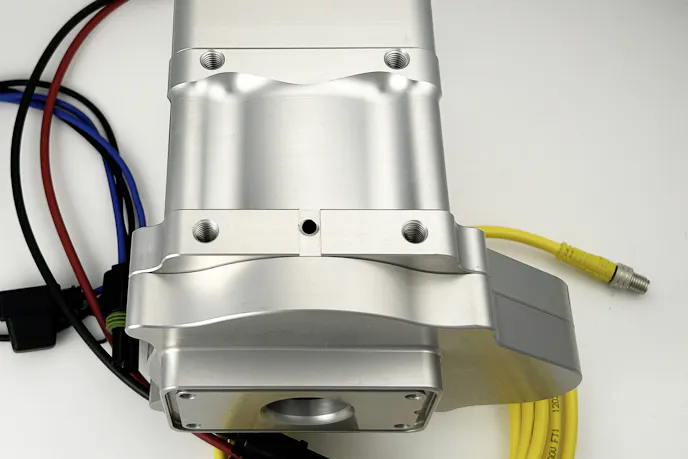
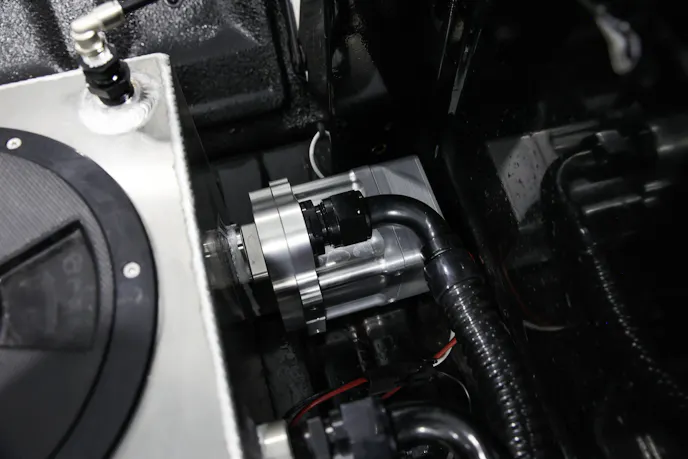
Another major component is the electric motor. Traditional brushed motors can underperform or fail under high demand. Recognizing this weakness, Meziere designed a brushless motor. “Brushless motors can run at higher RPM, allowing us to flow more coolant than a comparably sized brush-type motor pump,” Meziere notes. Stefanski adds, “We chose the WP728 pump because the brushless design outflows most pumps, and with the weld-on flange we could bolt it right to the tank—less plumbing and less weight.”
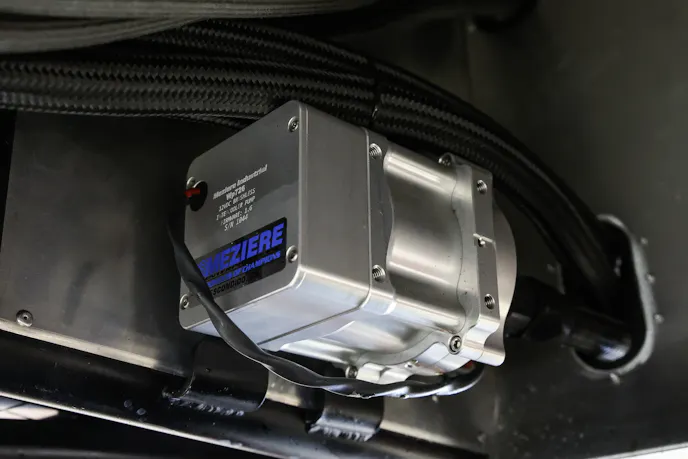
Builders also benefit from brushless technology through feedback monitoring, temperature sensing, and variable speed control. Meziere offers three pump models: a simple on-off version; a two-speed version with external control; and a full CAN-capable model that integrates into a vehicle’s bus loop to send and receive performance data.
What You Should Know
Before installing an intercooler pump, ensure there’s adequate space and proper orientation. The pump’s inlet must be below the outlet to prevent air locking. “Keeping the outlet above the inlet helps guarantee the pump won’t be subject to air locking, a common issue with centrifugal pumps,” clarifies Meziere.
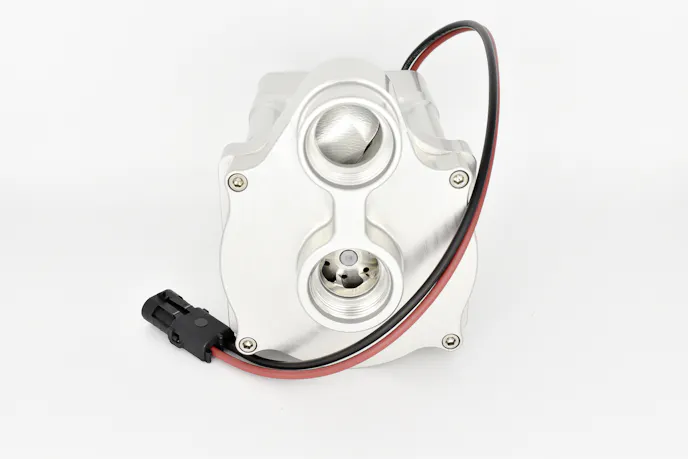
Meziere offers three configurations to suit most builds: an inline model with -16AN ORB connections on each end; a bulkhead-style model with both inlet and outlet on the same side; and a tank- or radiator-mounted design. The latter uses a welded plate where the lower hose connection would normally be—the tank connection becomes the inlet, and the outlet sits opposite.
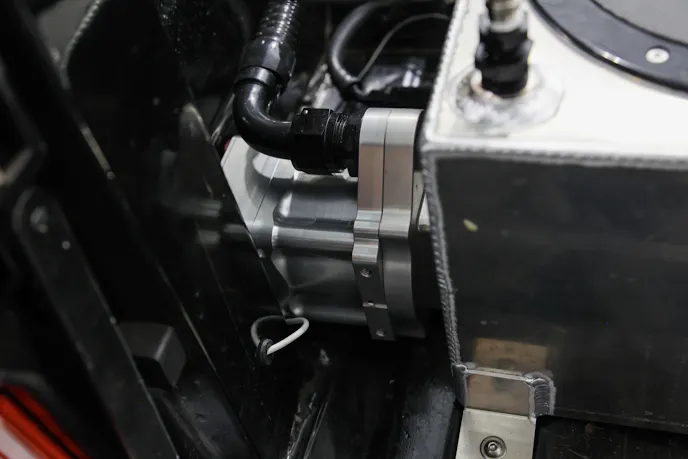
“If using the inline or bulkhead-style pump, remember hoses must be properly sized,” emphasizes Meziere. “A centrifugal pump does a much better job pushing fluid than pulling it, so the low-pressure side must be very free-flowing.”
On the electrical side, plan how the pump’s power draw and wiring will affect your system. Meziere intercooler pumps are available in both 12-volt and 24-volt configurations, providing 250 watts continuous and up to 400 watts peak power. “The 12- or 24-volt models, combined with three plumbing options, give our customers a wide variety of choices,” says Meziere. “They’re highly effective thanks to their flow and pressure characteristics, as well as their longevity.”
Next, decide how the pump will be activated and which brushless features your build requires. “Many customers like to ramp up or reduce speed depending on demand, and the most sophisticated builds need the full CAN-capable pump for reliability,” says Meziere.
Mistakes to Avoid
It’s easy to make mistakes when choosing or sizing a pump. Undersizing, oversizing, or using the wrong hose diameter can hurt performance. “A few mistakes to avoid would be purchasing too much technology, too large a pump, or too small a pump for your application,” advises Meziere.
Meziere’s intercooler pumps are purpose-built for racing and aftermarket performance, backed by extensive testing and support. “We use computer software to simulate flow characteristics, but we also conduct real-world testing to balance flow rate versus power consumption. Every product is tested to ensure proper function,” Meziere adds.
Conclusion
An intercooler is key to reducing intake temperatures and creating a denser charge for more power. In an air-to-water setup, a quality intercooler pump ensures the right flow and heat transfer balance for maximum performance.
The Meziere intercooler pumps proved themselves in the C10 Shootout builds. “The intake temps were very low the entire time and the flow was insane,” says Stefanski. Yost adds, “It moves a ton of water and makes for a clean install. Our intake air temperatures were 112 degrees with 25 pounds of boost on the motor. This setup was very efficient and reliable.”
The builds proved that a well-engineered intercooler system with a high-quality pump can stabilize intake temperatures even under 25 pounds of boost, delivering measurable gains in power and reliability.
You might also like
Win a 1,000+ HP 632 Big-Block Chevy: Inside the EngineLabs Giveaway
This 632 cubic-inch big-block Chevy makes 1,000+ HP naturally aspirated with EFI, DR-17 heads, and race-proven parts—and you could win it.