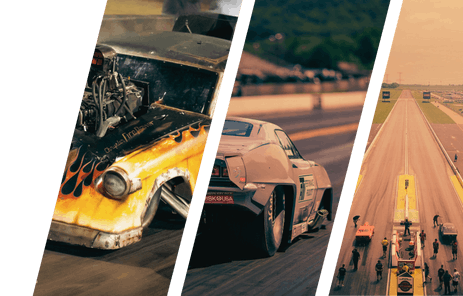
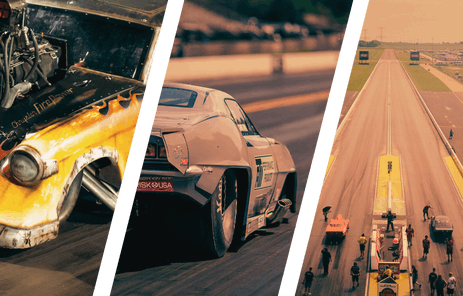
You don’t earn a reputation in the no-prep world like Joey Hiykel’s without constantly improving your program. Hiykel’s “Beater Bomb” Mustang has won numerous races, but the drive to go even faster has pushed the car’s engine program in a new direction. That effort has already led Hiykel to set the stock-block LS record, and now he’s chasing a three-second pass.
The Beater Bomb had been running a big-block Chevy engine since 2020. While the rat motor made plenty of horsepower, the added front-end weight made it difficult for Hiykel to manage the car on no-prep surfaces. After competing in the first RWD vs. AWD race hosted by Cleetus McFarland, Hiykel saw an opportunity to significantly improve the Beater Bomb’s performance by switching to a lighter engine package up front.
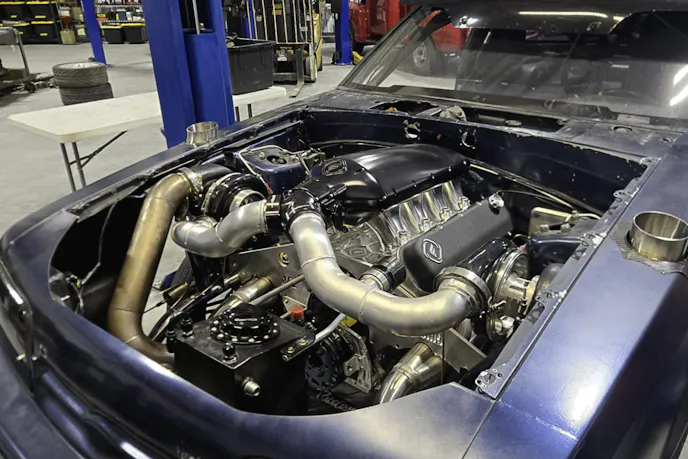
Hiykel began gathering parts in May 2025 to build a new stock-block LS. The mill measures 427 cubic inches, uses an LC9 block as its foundation, and features Darton sleeves. Hiykel and his engine builder, Maschmeier Performance Engines out of Oak Grove, Missouri, made a strategic decision to use off-the-shelf components since there was a real chance this engine might experience an unscheduled high-energy disassembly on track. The short block consists of a Callies Magnum crank, R&R aluminum rods, and Wiseco pistons.
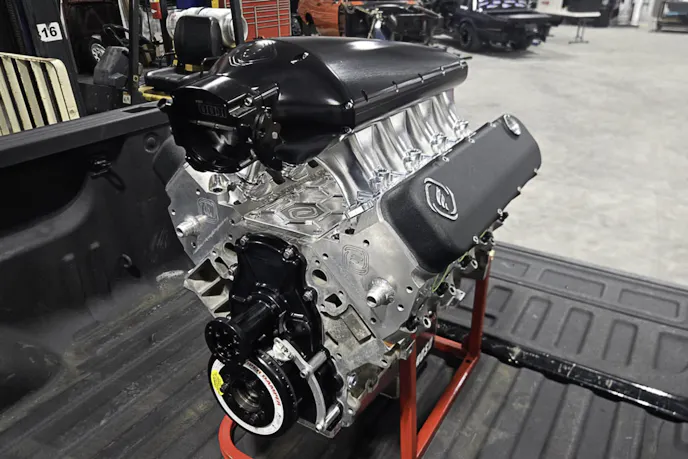
The top end is just as serious. Hiykel has always been impressed with Frankenstein Engine Dynamics’ cylinder heads and intakes, so he bolted on a set of their F710 heads and a billet intake. A .900-lift Cam Motion solid-roller cam and BAM lifters complete the valvetrain. Boost comes from the same 88mm Comp Turbos the Beater Bomb has run for years. On the dyno, this combination produced 2,200 horsepower at 25 psi of boost. That number showed Hiykel the combo could make serious steam, if the block held together.
Hiykel’s goal was to have the engine ready for the October RWD vs. AWD Cleetus race and then go after Jonathan Capizzi’s 4.13 LS stock-block record.
“After the Cleetus race, Bradenton hosted a radial event, FL2k. I entered mainly to do some testing to see how the combination would perform. I left the extremely loose Circle D converter in from the backside race and just started making hits. Off the trailer, we went 4.40 at 170 mph on low boost. Showing a lot of room for improvement, I knocked it down to a 4.14 at 180 mph. That put me within three thousandths of Capizzi’s record.
“There was only one day left for my stay in Florida to beat the record. The next day, it rained a lot, so they cut all the testing, and we went straight into eliminations. I crept up on the tune-up and added about five more psi of boost out back. The car went an astonishing 4.06 at 184.75 mph, setting the LS stock-block record,” Hiykel says.
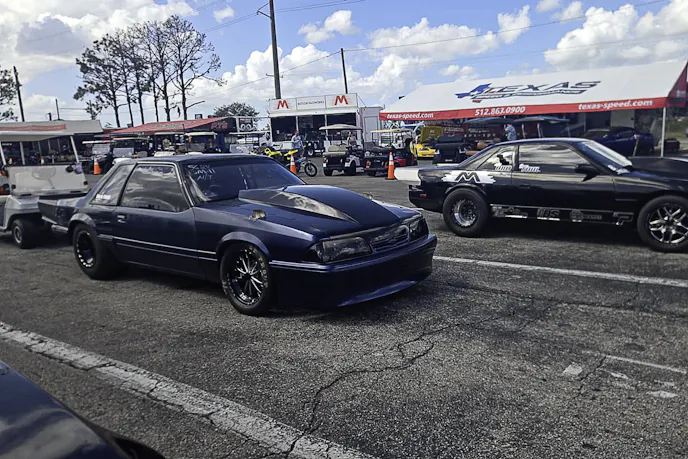
With the record in hand, Hiykel could taste a three-second pass. After returning home, he decided to swing for the fences. A new stator went into the torque converter, and Hiykel headed to Flying H Dragstrip in search of a three-second slip. The Beater Bomb developed a wheelie issue during the session, so Hiykel added 200 pounds to the nose of the Mustang. On a pass with a 1.04 60-foot time, the transmission lost high gear, ending the day, but yielding valuable data.
Chad Fegley from The Shop Inc. rebuilt the transmission, Hiykel swapped stators again, and it was time to head back to the track. The stator change wasn’t the only adjustment, he added some serious fuel to the mix.
“The other major change I made was that I added Nitromethane into the mix. I played with Nitromethane with the BBC, and absolutely loved it. So, I wanted to try it with the LS as well. The first pass off the trailer, it hit 3Gs on the G-meter and spun. Next hit, I went .998 to the 60-foot and wheelied hard. However, the motor didn’t sound right. I tore the engine down and discovered the Nitromethane tune-up wasn’t right, and that led to three hurt pistons,” Hiykel says.
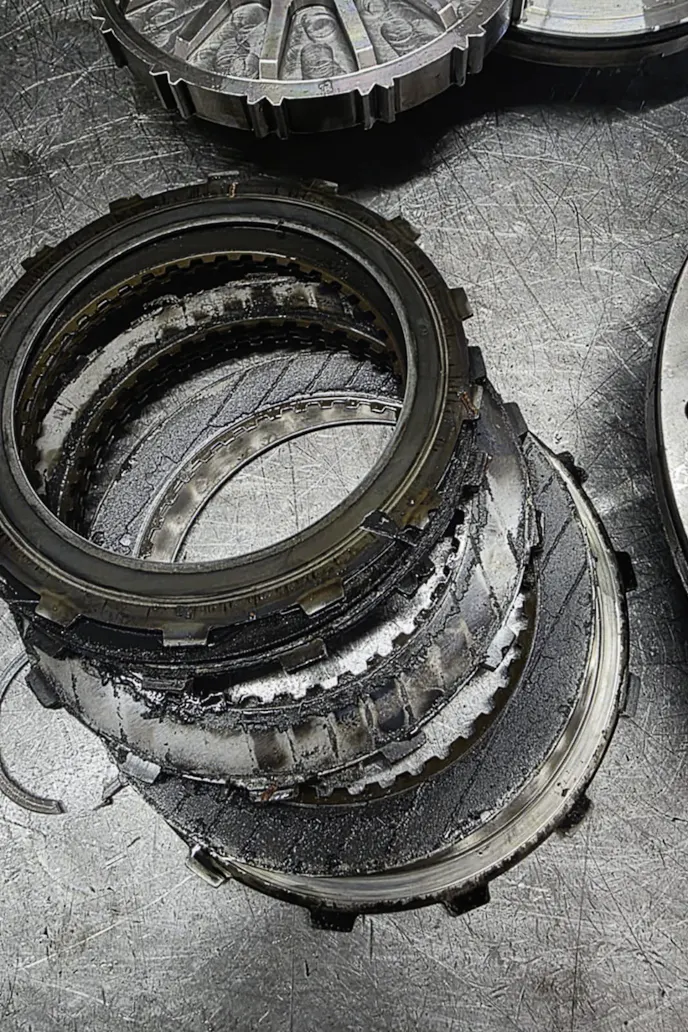
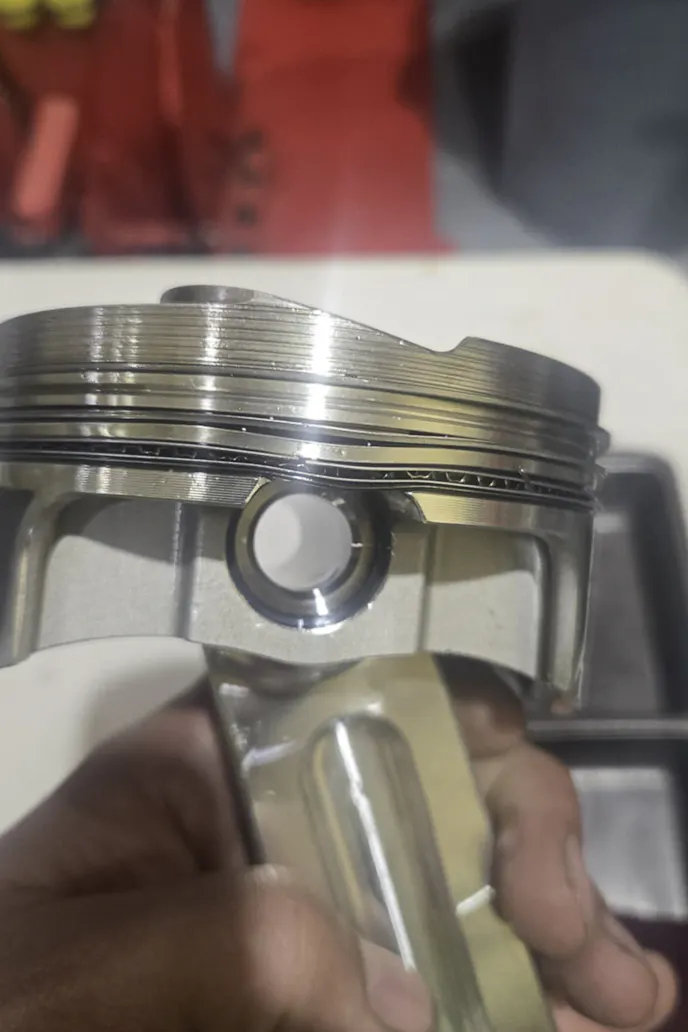
With the engine apart, Hiykel took the opportunity to inspect everything before Maschmeier Performance Engines installed fresh rods and pistons. He was happy to find the bearings looked great and showed no signs of another failure developing. Going forward, he plans to leave the nitro at home and run straight methanol.
“Based on prior data, during the .998 60-foot run we were near 2,800 horsepower. And I 100% believe that data showed it would have been an upper-3.80 run at 190 mph. I don’t see an end in sight to the limitations of the stock block. But as we all know when pushing parts, it can go from running its very best to catastrophic failure in a split second,” Hiykel states.
Chasing these LS records has pushed Hiykel harder than ever—and he’s loving it.
“It sounds like going from a 4.06 to a 3.99 is easy, but it’s actually extremely hard. I’m doing this for all the LS guys out there. I’m pushing the limits for all my fans. I’m devoting all this hard work to the future of motorsports. I want to see the sport grow, and I believe guys like me help motivate others,” Hiykel says.
Hiykel is now headed to the Texas Motorplex for another test session and another shot at resetting his own record en route to a three-second rip. One thing is for sure: when GM engineers designed the LC9 block, they never imagined someone pushing it this hard, or filling it with nitro.
You might also like
Nitro Chaos Ups The Ante With $10,000-To-Win ‘A’ Field In 2027
Nitro Chaos racers will race for bigger payouts in 2027. The series will now pay $10,000 to the A-Field winners at every event.