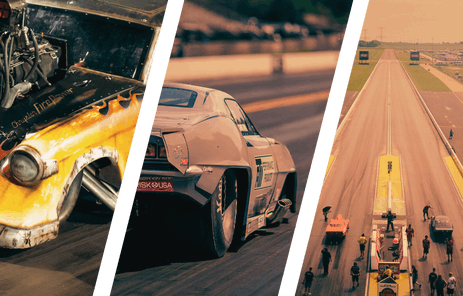
Imagine braking hard in the shutdown area and watching your oil pressure gauge needle start to bounce. It’s one of the most unsettling sights a driver can experience. It indicates that air is entering the oiling system, which can lead to oil starvation and catastrophic engine failure. So why does this happen?
In this article, you’ll learn about the limitations of a factory wet sump oil system in motorsports and why upgrading to a dry sump oil system is critical for engine reliability. We’re joined by Jim Bianca, regional sales manager and technical department supervisor at Moroso Performance Products, who brings more than 15 years of industry experience, including training Moroso’s technical staff.
Wet Sump vs Dry Sump
First, let’s understand the limitations of a factory wet sump oil system in motorsports. In this design, a deep oil pan contains the vehicle’s surplus oil. A single oil pump and pickup is typically located at its deepest point to suction the oil. The system is cost-effective for high-volume production cars and daily driving. It also has its shortfalls when it comes to motorsports.
“When you accelerate hard, a lot of times the oil is going to try and climb the back of the oil pan,” Bianca remarks. “Then you hit the brakes hard in the shutdown area, it’s doing the exact opposite. It’s running away from the pickup.”
This is where you’ll most likely encounter danger. In the shutdown area, the engine is not under load, and oil is not being pumped at higher pressure. In combination with oiling, moving to the front of the pan, you can lose prime on the pickup. When this happens, air enters the system.
“Anytime air can get into the pump and lose prime, even half to one second, can cause issues right away,” Bianca warns. “Air compresses under pressure and does not cool and lubricate essential parts, like bearings.”
In addition, a second caution comes from windage. Windage is the movement of the oil inside the pan caused by the crankshaft turning at high RPM. As revs increase, it creates an “oil rope” effect where it will suck the oil around the crankshaft. This leaves less in the pan, plus creates parasitic drag and horsepower loss. The effect is similar to a tornadic waterspout drawing water out of a lake. “Every time the counterweight goes around, it can blow oil away from the pickup. This is especially true on long stroke engines,” Bianca mentions. Again, it risks losing prime on the oil pump and air entering the system. Even brief interruptions can increase engine wear and lead to catastrophic failure.
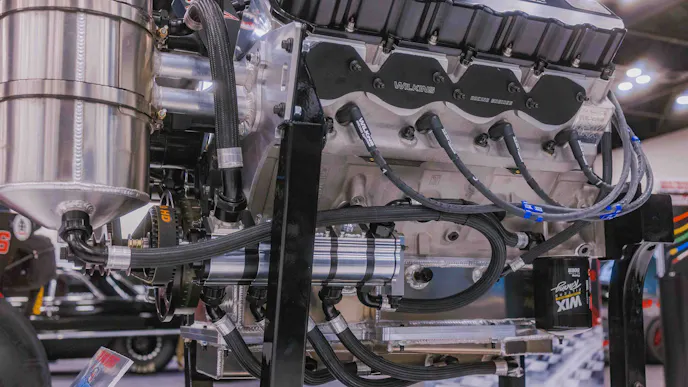
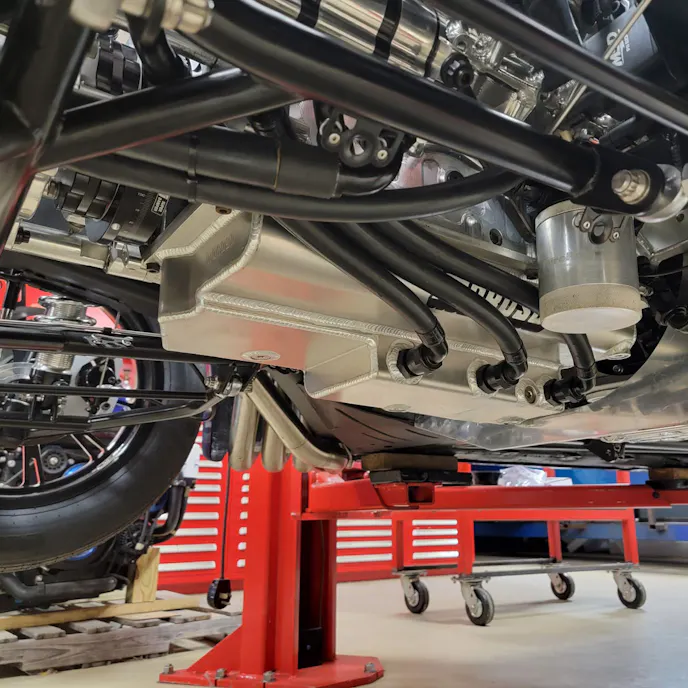
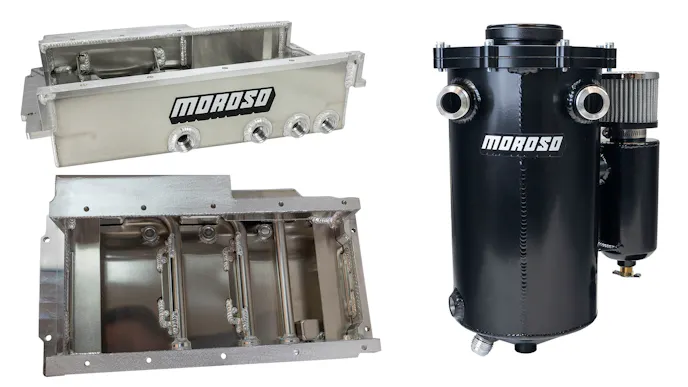
A dry sump oil system places the pump and tank outside the engine. The wet sump deep oil pan is then replaced with a shallow pan consisting of multiple pickups and baffles. The design allows oil to be quickly picked up, no matter how it moves in the pan. “The biggest benefit of the dry sump is the ability to add multiple pickups to the pan. Anywhere the oil goes, it is getting picked up before it can travel very far at all,” Bianca explains.
How To Plan For The Proper Dry Sump System
The benefits of installing a dry sump oil system are clear in drag racing. The next step is to understand the various components and how to design a system for your application. The goal is to ensure there is proper oil scavenging across the entire pan for the motion it’s experiencing under acceleration and braking. That is determined by sheer performance force and the number of pickup points you put in place.
Before you determine the number of pickups, you need to check the rules of the class you’re racing in. “It could be dictated by your class, and if there are weight restrictions,” Bianca comments. “Generally speaking, if it’s a V8 engine, you can fit three or four pickups in a pan. That’s great, but that also requires a larger pump.” The larger pump and added oil capacity will add weight.
By the same token, the number of pickups you can place is physically limited to the size of the engine. A V8 may have three or four, while an in-line four or V6 may only need two to three. By balancing any rules restrictions, physical space, and the level of competition performance, it’s best practice to err on the side of caution and plan towards more scavenging.
Dry Sump Pumps
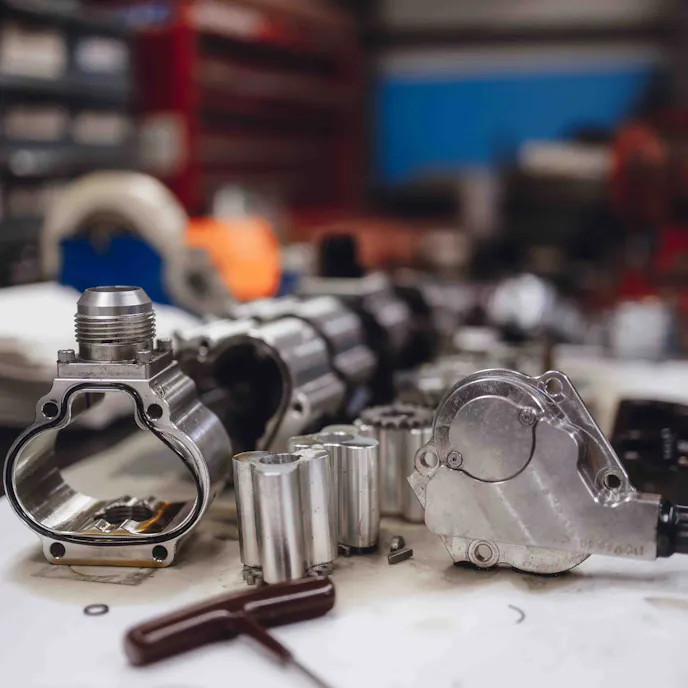
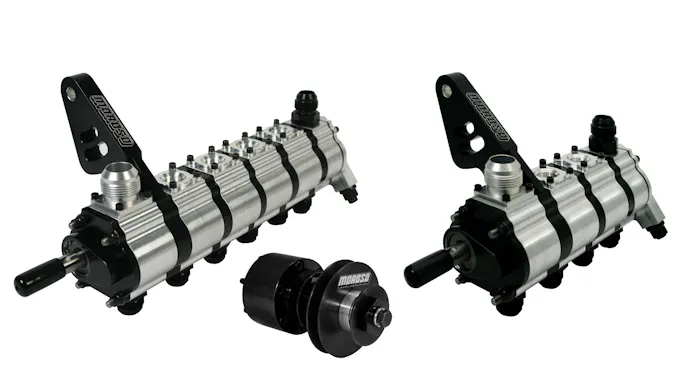
Once you choose how many pickups to go with, the next step is choosing a matching dry sump oil pump. You’ll find these rated in “stages” or sections. On a four-stage pump, a single pressure stage feeds the engine while the remaining three stages scavenge oil from the pan.
In Moroso designs, with the pulley side of the pump facing towards you, the pressure stage is always at the rear. For example, on our four-stage pump, the first three stages scavenge oil from each pickup in a three pickup pan, while the last pressure stage pushes the oil out that’s lubricating the engine.
The exception in high-performance competition is that you may encounter five-or six-stage pumps in use with only a three-or four-pickup oil pan. In these instances, the extra stages are often dedicated to scavenging oil from remote engine components, such as the lifter valley or a turbo.
The scavenge stages utilize a high-volume, positive-displacement design that moves both oil and any crankcase air. Before, air was bad and uncontrolled, the difference now is that we’re managing it. If it’s managed, then you can remove it. This constant suction of both oil and air also creates crankcase vacuum, which reduces windage, plus improves piston ring seal, leading to claimed horsepower gains.
Plumbing and Drive Configuration
Now that we’ve chosen our dry sump pump and oil pan, the next step is to install the oil tank, plumb the oil lines, and configure the pump drive. These are all critical steps as they will determine oil pressure and volume.
Oil capacity will be determined by the size and needs of the engine and the application. The goal is to have enough oil at all times to lubricate and manage heat without adding unnecessary weight. The external oil tank plays three important roles: holding extra oil capacity, improving oil cooling to ensure consistent oil viscosity, and acting as a de-aerator to remove managed air that the scavenge side of the pump draws in.
A tall and slim design that prevents oil movement below the supply line and remains two-thirds full while the engine is running is ideal. When it comes to mounting it for drag racing applications, “it depends on the car. Sometimes they put them right on the front nose,” Bianca says. “Ideally, put it right near the engine and give it the shortest distance to the pump.”
Correct oil pressure also varies by engine and application. While it’s best to consult with your engine builder, according to Bianca, “we’ve seen a lot of naturally aspirated engines run 60 to 80 PSI. Sometimes, even a little lower, depending on what the engine needs for volume. Many of the high boost supercharged and turbocharged engines want to see 100 PSI or more at all times. It really depends on the build.”
Oil pressure is determined by the diameter of the oil line and the rate of flow. Balancing pressure and flow is important. A smaller diameter line increases fluid velocity, which can lead to cavitation and restricted volume. One of the most common mistakes Bianca sees is undersizing the oil lines. “The rule of thumb on the inlet side is bigger is not necessarily going to hurt you at all,” Bianca mentions. “Having a larger inlet size is only going to reduce the possibility of any cavitation, especially if they decide to switch their pulley combination and drive the pump faster.” Cavitation, the growing and collapsing of vapor bubbles, is particularly problematic because it causes excessive heat and increases friction and wear by reducing lubrication.
For the lines themselves, “A good functioning dry sump is going to create vacuum. You don’t want to worry about any oil line pulling close. Choose any type of braided AN line that’s good for vacuum,” Bianca recommends. AN braided lines are typically found in high-performance settings and use standardized 37o flared seating surfaces. When it comes to sizing the -x AN number corresponds to each 1/16 of an inch. For example, a -10 AN equates to 5/8 inch, -12 AN equals 3/4 inch, and -16 AN is one inch.
That brings us to pump speed and the last part to consider in our dry sump oil system. The dry sump pump is often mechanically driven off the crankshaft with a mandrel mounted to the harmonic damper. Generally speaking, for drag racing, Bianca says, “we recommend a 50% drive ratio to start with.” Pumps can be run faster if you’re trying to achieve a certain volume or pressure. However, remember that driving the pump too fast can lead to cavitation. If this happens, the oil cannot enter the pump quickly enough. This risk can be mitigated by increasing the inlet line size to ensure the pump remains fully fed at high RPM. This ability to control the speed of the pump is also another advantage of a dry sump pump over an internal wet sump pump.
Race Day Confidence
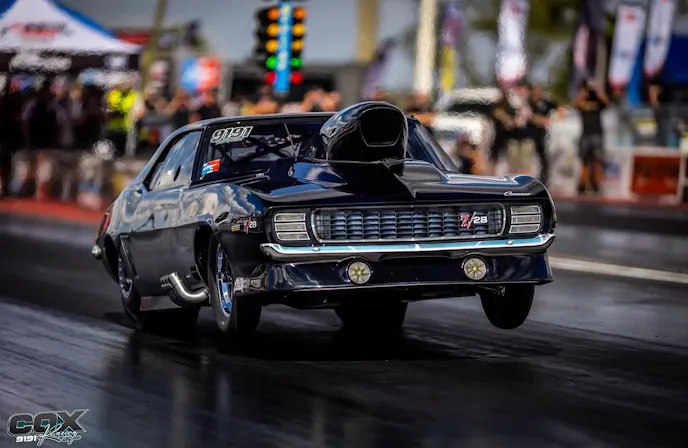
Cox Racing. Photo courtesy: Moroso Performance Products
Race day is reassuring with a properly configured and installed dry sump system. It’s best practice to heat the oil in the tank and then prime the system before firing the engine. Bianca concludes, “Most will pop the belt off and put a drill on the snout of the pump and spin it until they see pressure. Then throw the belt back on.”
With that, drive it hard. Engine reliability under hard acceleration and braking is the real benefit of installing a dry sump oil system. All the better, too, if you pick up horsepower from reduced windage and improve weight distribution along the way.
You might also like
Swanfest Money In The Bank: Stanton, Perry And Buginga Score Wins
Weather Can’t Stop Swanfest Money In The Bank At Rockingham Dragway. Here's a recap of who scored wins at this no time party.