Every grassroots drag racer knows the painful rite of passage that comes with assembling braided stainless steel lines. Frayed wires, sliced fingers, and ruined hose ends are just the start. When Dick Raczuk faced that challenge while plumbing a street rod in his own garage, he invented a tool that changed hose assembly forever.
The story behind Koul Tools and Raczuk’s life’s work in automotive performance is an operational playbook. Here he sits down with Dragzine to share his wisdom for anyone looking to turn shop frustration and race-car building into a thriving commercial business.
Never Say Never
You have to look at Raczuk’s unconventional start to understand his approach to entrepreneurship. Raczuk was diagnosed as a child with a rare debilitating hip condition called Legg-Calve-Perthes disease. He admits, “I wasn’t supposed to do any heavy lifting or anything.” To improve the symptoms of his medical condition, the family moved from cold, industrial Eastern Pennsylvania to the warm Southern California sunshine in the late 1950s.
Raczuk finished high school in 1957 and recalls, “I graduated in music because I wasn’t supposed to do any heavy lifting. I actually finished all my music curriculum in 11th grade, and my music teacher let me go work in the metal shop and auto shop during my music time.”
A spark was being fanned, and even before Raczuk completed school, he had built himself a Cadillac-powered Model A at their modest trailer park home. The timing was perfect, too, for the iconic SoCal hot rodding and drag racing scene.
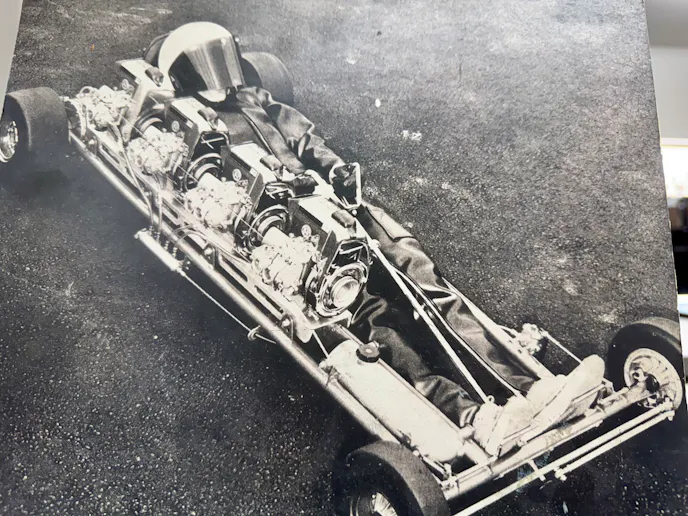
Then, in 1967, he finished building a wild, four-engine drag kart and took it to the strip. As Raczuk explains, “A good friend of mine was a designer, machinist, and engineer at McCulloch Motors Corporation, and he got me four of these big McCulloch engines, and I built this four-engine dragster. So, we took it to the drag strip, and the first time, without any tuning or any gear changes, it turned 112 mph and 12.12 seconds at San Fernando Drag Strip.”
That incredible drive and notoriety led him to borrow $2,500 to buy a small go-kart shop.
Start Where You’re At, With What You Have
As word got out, his small go-kart shop evolved into an engineering incubator. Raczuk continues, “I was designing stuff for go-karts and motorcycles. At that time, I had a customer who I built a go-kart for. He was a buyer at one of the major motorcycle OEMs. They needed a way to synchronize a bank of four-cylinder motorcycle carburetors. I came up with a synchronizing tool.”
Raczuk followed that up by designing and fabricating a bead breaker for the tires on the company’s first ATV model.
It would be tube bending, plus his retail shop, that would ultimately set Raczuk up for future success. As a shop owner, he had tires, handlebars, helmets, and other bulky items, but no way to properly display them. In true Raczuk fashion, he mentions, “So, I came up with display racks and fabricated them for my store. The same buyer saw them and ended up putting them in all their dealerships.” It became commercially known as Tubart.
Raczuk found that Tubart and his ability to design and manufacture, combined with his go-karting retail store, were a valuable business combination. In the late 1970s, the late George Kerker, designer of the original Kerker exhaust, came over. Raczuk owned the shop equipment in the back of the store and tells it, “I had tube benders because my store got bigger and needed to make displays for selling stuff out in front. George came by and asked if I would build for him. I said, ‘Yeah!’ and took over Kerker exhaust.”
After Kerker’s passing, Raczuk grew the business from building a hundred a month to 50,000 exhaust systems a year by 1984, with 130 employees in a 70,000-square-foot facility.
“1984 was a peak for our sales, and Fred Fox came along from Parts Unlimited,” Raczuk reveals. “He wanted to buy it, and I sold it to him. That’s when I retired. I was only 45 years old. I just kept busy working in my garage and playing golf.”
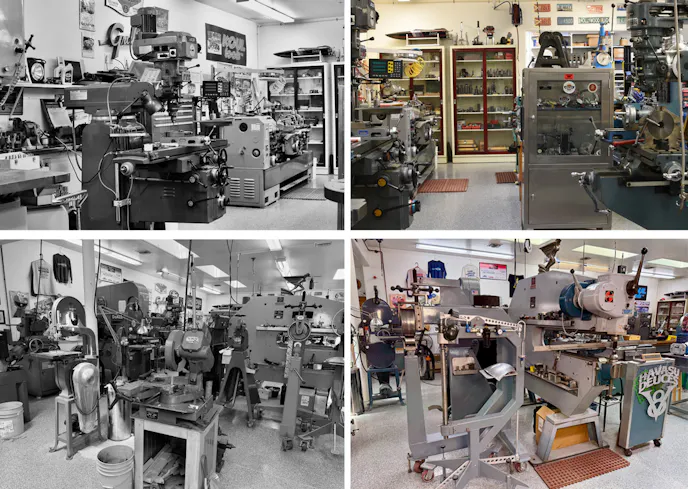
A True Builder Never Retires.
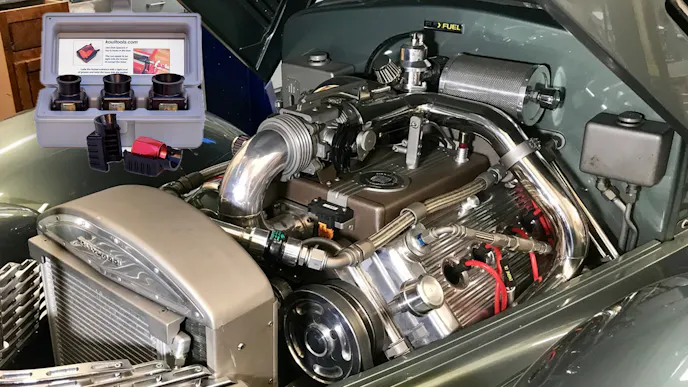
As so many in the industry discover, a true builder doesn’t sit on the sidelines for long. In retirement, Raczuk filled his time restoring classic cars and building street rods. The spark for Koul Tools came when he was fitting a Cadillac Northstar V8 into a 1941 Graham Hollywood, converting the entire engine and drivetrain layout to rear-wheel drive.
Working alone in his garage, he felt the exact same frustration that drag racers face every weekend. When you cut braided hose, the frayed metal has a nasty way of cutting up your hands as you force it into the fitting.
Raczuk remembers, “I’m working on the Hollywood, and it’s full of all these AN fittings. Well, basically what Koul Tools is, it’s a funnel. If you want to get something big into something small, you funnel it in there. That was my whole theory.”
The core Koul Tools design principle is simplicity. Raczuk constructed a composite sleeve that encapsulates the frayed braid in a funnel and secures the AN fitting socket. You then slide the hose end cleanly into it without snagging a single strand of wire. No cuts, no cursing, and anyone’s ability to run stainless braided plumbing with AN fittings got a whole lot quicker and easier.
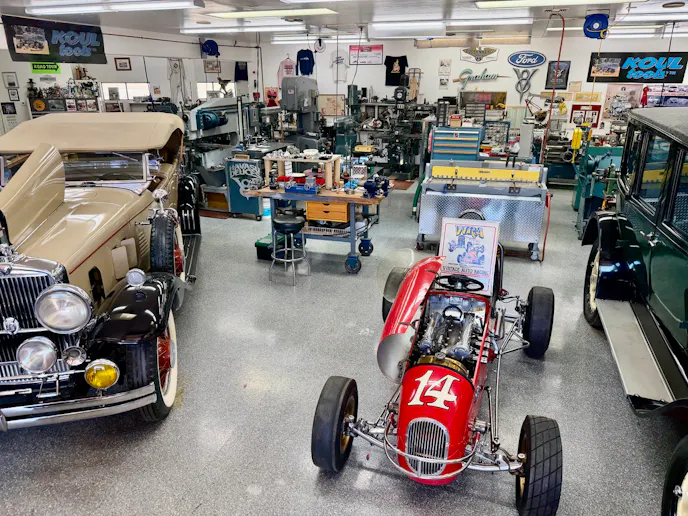
Good Enough Doesn’t Survive In Performance.
Raczuk knew that bringing the AN Hose Assembly Tool to market required more than a clever idea, so he began extreme durability testing and developed very high-quality standards. Reflecting on the reliability of the original tool design, Raczuk mentions, “Nothing has changed since the beginning. I have never gotten one back. Why would you change anything?”
When developing new products, such as the EZ-On Hose Press for push-lock hose installations, Raczuk built automated shop fixtures to simulate thousands of duty cycles before releasing the tool to customers.
As he details, “I probably did 5,000 cycles under load with an automatic impact gun to see what the heck’s going to break. We would find a weak spot, and then we strengthen the weak spot, and that’s how we come up with a final solution.”
Raczuk emphasizes for racers to take their time, too, when looking to develop their own products.
“Don’t go too fast. Take your time and try to find any possible error. If something fails the first time from something silly, you’ll lose it. You won’t get the same reaction. In other words, make sure it’s done right to begin with.”
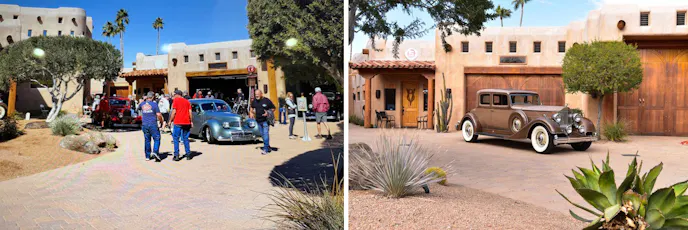
A Proven Road To Mainstream Success.
To get the original Koul Tools AN Hose Assembly Tool into the hands of grassroots racers, Raczuk took the product to the SEMA Show, where it earned runner-up for a Best New Product award in 2005. In addition, he also pitched several of the leading automotive media publications.
The combined exposure opened immediate distribution channels with major performance outlets. Raczuk points out that, “Soon as Summit Racing Equipment got a hold of it, Speedway Motors Inc., and distributors like that, it just took off when they put it in their catalogs.”
With success comes a common obstacle in the automotive aftermarket: copycats. To protect his invention, Raczuk secured a 20-year utility patent and remarks, “Well, I patent all my products. That kind of scares them away.”
It’s practical advice many engineers and business owners in the industry will also share when turning ideas into products.
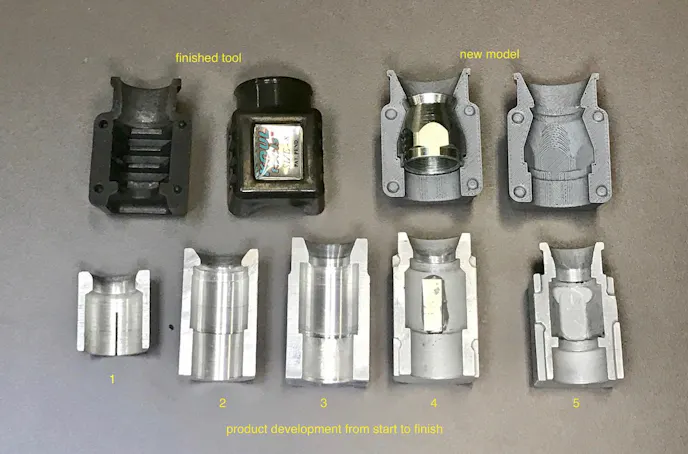
One Good Idea Leads To Another.
The inspiration didn’t stop with the Koul Tools AN Hose Assembly Tool and EZ-On Hose Press. After its success, Raczuk recognized how difficult it was to fix seating flares in tight spots while working on a persistent fuel fitting drip on his 1934 Packard V12.
Rather than pulling the entire hardline or fuel tank out of the car, Raczuk developed the Fitting Fixer and Line Lapper. The specialized tools feature diamond-coated lapping heads to resurface damaged flare seats directly on the vehicle.
Raczuk emphasizes that true mechanical solutions come from hands-on shop work, not abstract theorizing. He stresses, “This actually wouldn’t happen unless you’re hands-on. This wouldn’t happen just sitting around looking at stuff and trying to come up with a design. You have to be hands-on to invent this stuff.”
Passing On Wisdom: Inspiration For Current Drag Racers.
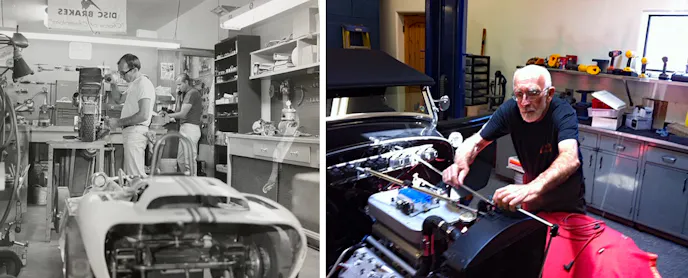
At 87 years old, Raczuk still spends his days prototyping in his 5,000-square-foot Lake Havasu shop while his son manages day-to-day operations at Koul Tools. In fact, within the past year he received yet another tool patent for assembling medical corrugated tubing.
His legacy, from the early days as a go-kart builder and shop owner to wrenching on car projects in early retirement, is proof that drag racers and engine builders are uniquely positioned to spot problems and create commercial products to solve them.
His advice for those sitting on a great idea is straightforward. Raczuk bluntly says, “If somebody wants to go into business and make a living, make it simple. Don’t get too complicated.”
His blueprint for multiple successful products has been to find a friction point in the shop, solve it with hands-on testing and rigorous quality control, and resist the urge to over-engineer the solution.
At the end of the day, turning a garage prototype into a thriving aftermarket business comes back to one simple, timeless rule. As Raczuk summarizes, “The one statement I can make is: find a need and fill it.”
He reflects, “I never worked a day in my life because whatever I did, I liked what I was doing. I was developing products for people to make their life simpler.”
You might also like
Tony Schumacher Joins Tony Stewart Racing For 2027 NHRA Top Fuel Season
Tony Stewart Racing kicked off the 2027 silly season early. It was announced that Tony Schumacher will join TSR in 2027.